
In ProductPlan's 2026 report, nearly half of product professionals named resource and capacity constraints as a top driver of roadmap misalignment, and almost as many pointed to shifting priorities from short-term commitments, according to ProductPlan's 2026 report.
This guide walks through five agile roadmap samples you can adapt, a reusable template structure, and a process for tying roadmap bets to evidence instead of guesswork.
If you have just inherited the roadmap — promoted out of engineering, support, or a domain role and now accountable for the thing everyone argues about — take the short path. Start with the Now-Next-Later sample below, fill in only the context, evidence, and outcome rows of the template, and set up the review cadence described in the maintenance section. The other four formats are variations you can add once the first one is in regular use.
One distinction matters before you build anything: a roadmap communicates direction and priority. It is not your backlog, and it is not a sprint plan. Mixing the three is where most roadmap trouble starts.
Key Takeaways
- An agile roadmap communicates direction and priority without pretending every date or feature is locked in.
- Strong roadmaps tie customer evidence to outcomes, initiatives, horizons, and a way to measure results.
- Match the format, whether Now-Next-Later, outcome-based, delivery, customer-facing, or portfolio, to the audience reading it.
- Review and update the roadmap whenever new evidence changes confidence, scope, or timing.
What Is an Agile Product Roadmap?
An agile product roadmap is a flexible, high-level plan that shows product direction: the problems or initiatives you're prioritizing, the outcomes you expect, and roughly when you'll tackle them. Scrum.org describes it as a visual aid for discussing what's coming next for a product, one that shows customer-driven outcomes without pretending to be a delivery calendar.
That's the real difference from a traditional feature schedule. A feature-date roadmap lists what ships and when. An agile roadmap explains why the work matters and uses relative horizons or confidence levels instead of fixed dates. One leaves no room for new evidence. The other expects it.
Roadmap, Backlog, Strategy, and Sprint Plan: Who Does What
These artifacts get blurred together constantly, so here's a quick breakdown:
- Product strategy: sets the direction, meaning which markets, customers, and problems matter most
- Roadmap: translates strategy into prioritized themes, outcomes, and rough timing
- Product backlog: holds the detailed epics, stories, and tasks under consideration
- Sprint plan: the short-term commitment for what the team builds next
- Release plan: bridges the roadmap and backlog, mapping work to a launch window
If your roadmap looks like a backlog with due dates stapled on, it's probably being used for the wrong job.
Why This Matters More as B2B SaaS Teams Scale
A five-person product team can keep alignment in a Slack thread. A fifty-person org spanning product, engineering, design, sales, marketing, and customer success cannot. An agile roadmap gives every function a shared, current view of what's being bet on and why. That's roughly where Shorter Loop's Product Strategy and Roadmap fits for growing teams: it keeps objectives, roadmap items, and the evidence behind them connected instead of scattered across decks and spreadsheets.
The roadmap should never function as a promise. It's a communication and decision-support tool. Treat it as a list of locked commitments, and you'll either miss dates constantly or stop experimenting to protect the ones you've already made.
Agile Product Roadmap Samples: 5 Formats to Adapt
No single format works for every audience. A roadmap built for your VP of Sales looks nothing like the one your engineering lead needs. The format should make three things obvious at a glance: what's prioritized, what trade-offs were made, and how confident you are in each bet.
Now-Next-Later Roadmap
This is the most forgiving format for fast-changing environments. Group work into three horizons:
- Now: active initiatives, described with real detail
- Next: likely upcoming work, described as themes
- Later: broader possibilities, described in a sentence or two
Near-term items get specifics. Long-term items stay intentionally vague. Scrum.org's roadmap guide recommends this structure, or pairing it with a goal-oriented view, whenever exact dates would create false certainty. It's a solid default for early-stage discovery and stakeholder updates.
Outcome-Based Roadmap
Instead of organizing around features, organize around what you're trying to change: activation, onboarding friction, reliability, retention. Each outcome should carry:
- The evidence behind it
- A leading indicator you'll watch
- Candidate initiatives being considered
- A review point for deciding whether the bet is working
In FlowDesk, a fictional demo dataset Shorter Loop uses to show the product, a company tracks an enterprise retention outcome against a 12% churn target. When churn sat at 15% past the review date, that mismatch triggered a reassessment instead of letting the bet ride indefinitely. Attaching a number and a review date to an outcome does more work than a feature name ever could.
Sprint or Delivery Roadmap
This view belongs to product, design, and engineering. It connects initiatives to upcoming sprints or releases with owners, dependencies, and current status, without sliding into task-level detail.
An illustrative delivery view, laid out the way a Shorter Loop roadmap board would show one (the items below are made up, not a real team's plan):
- Email Scheduler Engine and PDF Generator V2: Released (early October)
- Slack Bot Integration: In Progress (mid-October)
- AI Insights: Up Next (November)
Every one of those items should map back to a strategic outcome, not float on its own.
Customer-Facing or Theme-Based Roadmap
What you show customers isn't what you show engineering. Translate internal initiatives into themes or benefits, such as "faster reporting" or "simpler onboarding," and drop dates you can't guarantee.
Keep internal planning views and external communication separate. That way sales and customer success can set expectations responsibly instead of promising a date that slipped three weeks ago.
Multi-Team or Portfolio Roadmap
For organizations running several products or teams, a portfolio view uses swimlanes to show shared outcomes, dependencies, and sequencing. This is where duplicated effort and conflicting priorities surface. A practical rule: add a dedicated swimlane once you have more teams working toward related bets than you can hold in your head, usually around the third one.

What to Include in an Agile Product Roadmap Template
Think of the template as a decision record, not a feature list. Every row should answer four questions:
- What customer problem is this?
- Why does it matter strategically?
- What outcome do we expect?
- How confident are we right now?
| Template Section | Key Fields |
|---|---|
| Context & alignment | Vision, strategic theme, business objective, target segment, problem/opportunity |
| Evidence & assumptions | Supporting evidence, source, affected segment, assumptions, confidence level, open questions |
| Outcomes & metrics | Desired outcome, leading indicators, success metric, baseline, review date |
| Initiative & scope | Name, problem statement, approach, intended value, non-goals, MVP scope |
| Time horizon & confidence | Now/Next/Later or quarter, confidence level, discovery status, review trigger |
| Delivery context | Owner, dependencies, risks, capacity assumptions, backlog link |
| Decision history | Rationale, date added, last reviewed, evidence changes, decision owner, results |
Not every field deserves equal weight. The evidence and assumptions section is where most roadmaps fall apart, because it's easy to confuse a validated customer problem with a strong opinion from the loudest person in the room.
Record what evidence exists, where it came from, and what would change your mind.
Confidence stays the team's own judgment. Shorter Loop does not calculate it for you, and the opportunity score it does hold — Spread, Intensity, and Value — is typed in by the team as well. Write the level down together with the reason for it, so the next person to review the row can argue with the reasoning rather than with a number.
Shorter Loop treats a roadmap as a set of claims. Every roadmap item claims that a problem is worth solving a certain way, and a claim needs evidence attached to it as well as a target date. The Evidence tab on an item collects the feedback, documents, analytics, and related work behind it and marks each claim Backed, Evidence disagrees, or Untested, which keeps the claim honest as the quarter goes on.
How to Create and Maintain an Agile Product Roadmap
Building the roadmap is the easy part. Keeping it honest as conditions change is where most teams fall short.
- Start with strategy and customer evidence. Pull from interviews, support patterns, sales feedback, usage data, and post-release learning. Frame clear problems instead of stacking requests. In FlowDesk, a fictional demo dataset Shorter Loop uses to show the product, there are 1,100 support conversations, 60 sales call notes, and 14 churn interviews sitting in different places before anyone connects them.
- Prioritize problems and outcomes before solutions. Rank candidates with agreed criteria: customer impact, strategic fit, urgency, confidence, effort, and dependencies. An effort-versus-value matrix works for most teams; RICE scoring works when you need more rigor.
- Choose the right horizon and view. Now/Next/Later, outcome-based, sprint, release, or portfolio, picked to match the audience and the decision being made. More detail near-term, less detail further out.
- Connect the roadmap to delivery. Turn selected initiatives into epics and stories in the backlog, with a link back to the roadmap item and the outcome it's meant to drive. Review dependencies and capacity with engineering and design first.
- Communicate trade-offs and confidence. Say what you're doing, why, what you're not doing, and what could change. Confidence labels and review triggers make uncertainty visible instead of hiding behind a clean-looking chart.
- Review, learn, and update. Set a regular cadence, monthly or quarterly planning reviews for most teams, plus event-based triggers for new evidence or risk.

That review discipline is what keeps a roadmap honest. When FlowDesk's team found that churned accounts had already completed onboarding, they stopped two epics before writing a line of code and returned six weeks of planned engineering to the quarter. They avoided shipping a fix for a problem that no longer held up. That's what it looks like when evidence actually moves a roadmap instead of just decorating a slide.
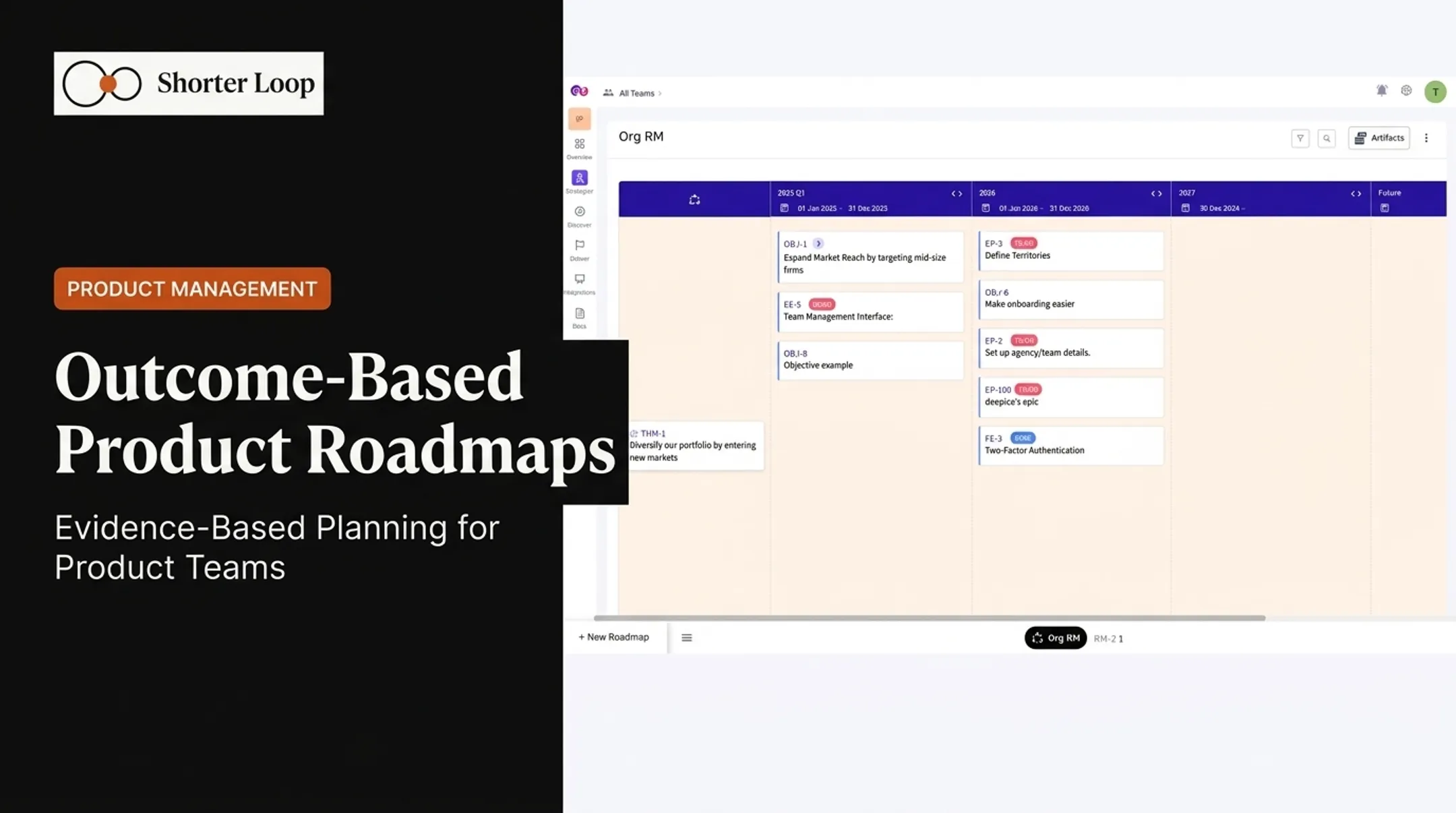
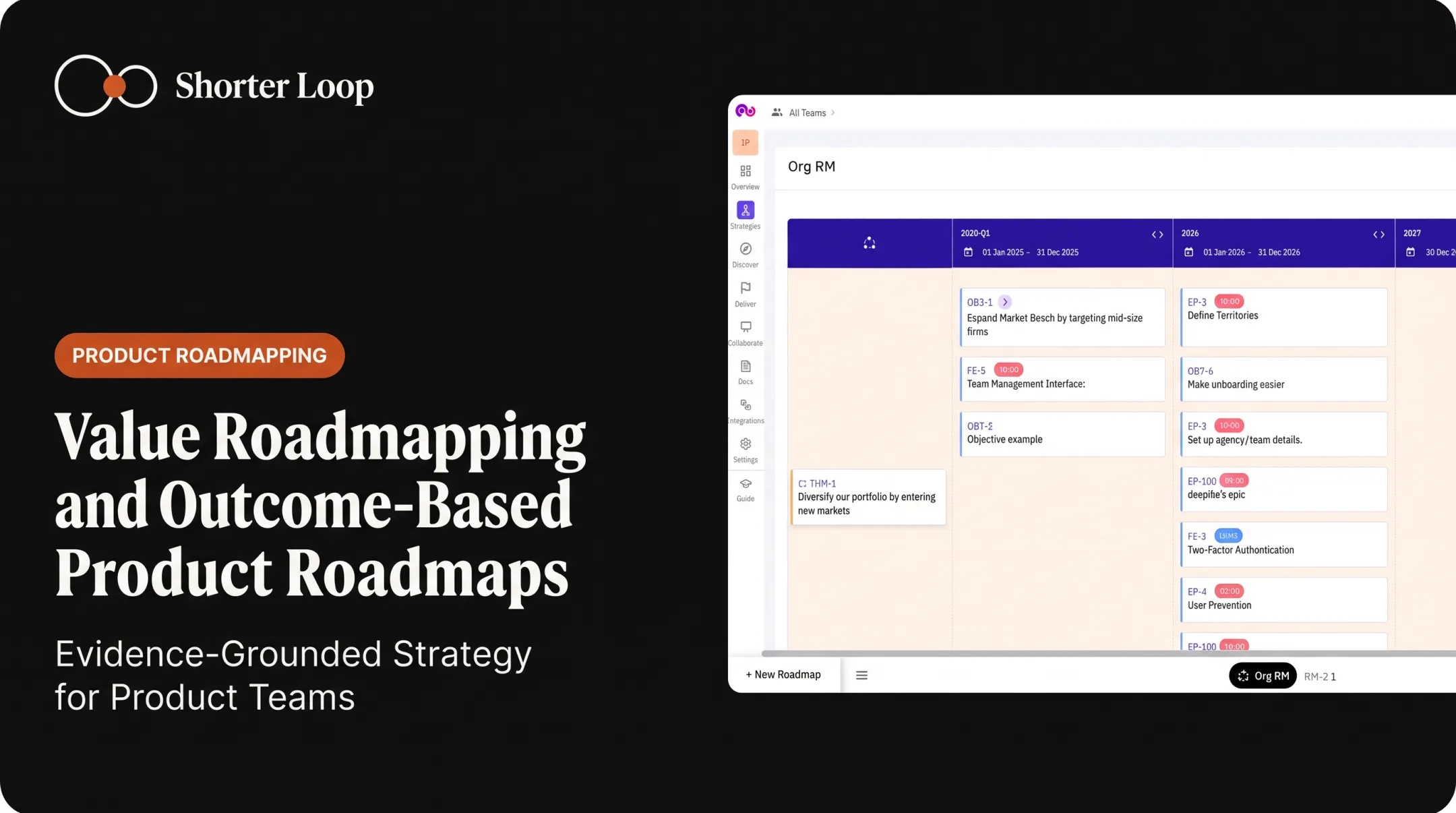
For teams that need that evidence-to-decision trail visible rather than reconstructed after the fact, Shorter Loop's claim checking was built for this. Claims on your objectives, opportunities and solutions are checked against your feedback, documents, analytics and related work, and the roadmap board lays opportunities, solutions, epics and features out by theme and objective, so you can open any card and see what it rests on. You can see that trail on your own roadmap in a 14-day trial, no credit card needed.
Common Agile Roadmap Mistakes and Best Practices
Most roadmap problems aren't about format. They're about habits. Six worth watching for:
- Treating the roadmap as a feature contract: use outcomes, themes, and confidence levels instead of locking in dates when uncertainty is genuinely high.
- Building it in isolation: pull product, engineering, design, customer-facing teams, and leadership into evidence review before trade-offs get decided.
- Confusing activity with progress: report the outcome you're pursuing, not just what shipped. ProductPlan's 2023 survey of 1,500+ product professionals found 54% of roadmaps (nearly 70% when executives drove them) focused on outputs over outcomes.
- Maintaining conflicting roadmap versions: keep one connected source of strategic context, and vary the level of detail per audience instead of rewriting the plan for each one.
- Updating only before executive meetings: define a regular cadence plus event-based triggers so the roadmap stays current without becoming an administrative chore.
- Treating the template as the process: prefer a plain, evidence-backed roadmap over a polished one built on assumptions nobody checked.

Tracing One Outcome on the Board
Open the roadmap and find the objective lane for the outcome you care about. In the FlowDesk demo dataset that lane is reduce first-90-day churn from 22% to 12%, and the cards inside it are the opportunities, solutions, epics and features aimed at it.
Click an opportunity or solution card and it opens in the strategy side panel. Open its full page, or the objective's, and the claims line sits under the title, reading something like "4 claims · 2 backed · 1 evidence disagrees · 1 untested". The Evidence tab lists the sources grouped as feedback, documents, analytics and related work, with the overall verdict. Epics and features open in the backlog quick view instead, and they sync two-way with Jira, GitHub or Azure DevOps.
Read top to bottom, the board answers three questions in one pass: what change we are after, what we are doing about it, and what makes us think it will work. You can try it on your own roadmap in a 14-day trial.
Frequently Asked Questions
What is an agile product roadmap?
It's a flexible, high-level plan that communicates product direction, prioritized problems or initiatives, expected outcomes, and approximate time horizons. It changes as the team learns, rather than locking in features and dates upfront.
What are the most common Agile methodologies?
Commonly cited approaches include Scrum, Kanban, Extreme Programming, Lean, Crystal, Dynamic Systems Development Method, and Feature-Driven Development, a list drawn from the Agile Alliance's reference guide to Agile methods. Most teams blend practices from several of these rather than following one exactly.
What should an agile product roadmap include?
At minimum: the strategic reason for each initiative, the customer problem and evidence behind it, the expected outcome, a time horizon, a confidence level, dependencies, an owner, and a trigger for reviewing the decision.
How often should an agile product roadmap be updated?
Review it on a regular cadence, monthly or quarterly for most teams, and update it whenever new customer evidence, strategy shifts, capacity changes, or outcome data meaningfully change the plan.
What's the difference between an agile roadmap and a product backlog?
The roadmap communicates strategic direction and prioritized outcomes at a high level. The backlog holds the detailed epics, stories, and tasks teams pull from to actually deliver that strategy.