
That's the gap outcome-based roadmapping closes. Instead of tracking what got built, it tracks what changed for the customer or the business, and whether the evidence still supports the bet. Research on shipped functionality backs up why this matters: a widely cited analysis of software usage data found that 80% of features are rarely or never used, according to Pendo's 2019 report.
This guide breaks down value roadmapping and outcome-based product roadmaps: the terminology, the components, how to build one, and how to keep it honest over time.
Key Takeaways
- A value roadmap prioritizes the outcomes a product should create, not a list of features with fixed delivery dates.
- Every outcome should connect to evidence, assumptions, strategic goals, candidate bets, ownership, and progress indicators.
- Roadmaps are living decision tools: update them when evidence, constraints, or observed results change.
- Delivery milestones test and deliver value; they aren't the definition of value itself.
What Is Value Roadmapping and How Is It Different From a Product Roadmap?
Value roadmapping organizes product work around the change you're trying to create for customers and the business, across a time horizon, rather than around a checklist of deliverables. It asks a different starting question: not "what are we building next," but "what needs to be true for the customer or the business, and what's the smallest bet that moves us toward it."
Roman Pichler draws a clear line here: a traditional roadmap assigns features (registration, search, reporting) to a timeline and states when they'll ship. An outcome-based roadmap still names features when useful, but the roadmap's actual goal describes the customer or business outcome those features are meant to serve.
How It Differs From Other Planning Artifacts
Value roadmapping isn't the only planning document on a product team's desk. It often gets confused with three other artifacts:
- A feature roadmap communicates what the team plans to build, without necessarily explaining why.
- A delivery plan handles sequencing, dependencies, capacity, and execution detail: the "how," not the "why."
- A strategy document sets direction but often stops short of showing how bets get tested and carried through delivery.
A value roadmap sits between strategy and delivery. Strategy defines the "why" and the intended change; the product roadmap translates that direction into validated bets, product increments, and learning milestones.
From Feature to Outcome: A Quick Example
Take "self-service account setup" as a planned feature. On a feature roadmap, that's the whole story: build it, ship it, done.
On an outcome-based roadmap, it gets reframed: reduce setup friction for new SMB accounts, measured by time-to-first-value and 30-day activation rate. That reframing forces you to attach evidence (why do we think setup friction is the problem?), assumptions (we assume users abandon setup because of form length, not pricing confusion), and a measure you'll actually check after shipping.

Outcomes should describe a real change in customer behavior, experience, business performance, or adoption. Feature completion, story points, and release volume aren't outcomes; they're activity.
What Are the Components of a Value Roadmap?
A value roadmap has more moving parts than a feature list, but each part earns its place. Here's what belongs on one.
Vision and strategic context. Name the customer problem, target segment, strategic objective, and why the opportunity matters now. FlowDesk, a fictional demo dataset Shorter Loop uses to show the product, a shift-scheduling vendor serving mid-sized logistics operators, framed its 2026 vision around a single target group (operations managers) with a business objective of reaching 400 accounts and cutting first-90-day churn from 22% to 12%.
Value themes or outcome areas. Group related bets around the change they are meant to create. FlowDesk's 2026 roadmap groups its work under three themes: Reducing churn, Platform and setup, and Depot experience.
Evidence, insights, assumptions, and risks. Show your reasoning, including what's still shaky. FlowDesk initially marked "onboarding is too hard" as an assumption with zero supporting evidence, until 14 churn interviews surfaced a different explanation: dispatchers, not just operations managers, were central to daily use.
Outcomes and indicators. Connected to each theme:
- The intended change in customer behavior or business condition
- Leading signals for early learning (activation rates, feature engagement)
- Lagging indicators for realized impact (net retention, expansion revenue)
Candidate bets, discovery activities, and delivery milestones. Framed as hypotheses, not guaranteed fixes. FlowDesk tested two options against the same churn problem: an invitation prompt during onboarding, and a shared schedule link requiring no account at all.
Ownership, confidence, dependencies, and review points. One FlowDesk theme, Depot experience, had no named owner yet, a gap the team flagged before committing further engineering time.

Why Use an Outcome-Based Product Roadmap?
Feature roadmaps are easy to build and easy to misread. Everyone can see what's shipping. Almost nobody can see whether it should.
Strategic Alignment Without the Guesswork
When every roadmap item links to an objective, and every objective links to a theme, leadership, product, design, engineering, and sales are reading from the same explanation of what the organization is trying to change.
FlowDesk's roadmap structure made this visible the hard way: two separate teams had each funded six weeks of engineering against the same untested explanation for churn, without realizing it until the roadmap connected their work to a shared, unverified assumption.
Prioritization Based on Evidence, Not Volume
Outcome-based roadmaps compare opportunities using reach, expected impact, confidence, and effort, not whichever stakeholder shouted loudest in the last planning meeting. A RICE-style scoring approach (reach, impact, confidence, effort) gives teams a consistent way to rank bets against each other.
Less False Precision, More Room to Adapt
Fixed dates on a two-year roadmap imply a certainty nobody actually has. Flexible horizons (now/next/later, or loose quarterly windows) paired with visible confidence levels make it normal to adjust when new research or results challenge the original plan.
Different Conversations, Better Decisions
Outcome tracking shifts the standing meeting question from "Did we ship the item?" to "What changed, what did we learn, and what should we do next?" The practical difference shows up in what gets reported: "we closed 47 tickets" versus "we shipped three features that moved retention by 8%."
That shift matters because shipped doesn't mean successful. FlowDesk's own retrospective found that guided integration setup improved integration completion by 18%, while retention barely moved. The solution worked, but the causal belief behind it didn't hold up. Without outcome tracking, that distinction gets lost.

How to Build an Outcome-Based Product Roadmap
Building the roadmap is a sequence, not a single workshop. Here's the order that actually holds up.
Establish strategic direction. Document the product vision, business objectives, target customers, constraints, and the problems your team is actually qualified to solve. FlowDesk's vision named one target group (operations managers) and two business objectives: 400 accounts, reduced early churn.
Gather and synthesize evidence. Pull from interviews, support conversations, sales calls, and usage data. Note where sources disagree instead of averaging the disagreement away. FlowDesk's evidence base included 1,100 support conversations, 60 sales call notes, and 14 churn interviews. Together they showed that 91% of accounts renewed when a second person logged in during week one, versus 68% churn when the account stayed single-user.
Convert evidence into outcome hypotheses. Use a consistent structure: "For [customer], improve [current condition] so that [desired change], measured through [indicator]." This keeps every bet traceable back to a reason it exists.
Generate and compare candidate bets. For each hypothesis, describe the smallest credible intervention, record the assumption it depends on, and flag discovery work needed before committing real delivery capacity.
Sequence by learning value and urgency, not just gut feel. Use quarters or now/next/later horizons where exact dates would imply certainty you don't have.
Define validation checkpoints. Decide what you'll observe before continuing, scaling, changing, or killing a bet.
Communicate differently by audience. Executives see outcomes and trade-offs. Product teams see evidence and decisions. Customer-facing teams see validated value, never unshipped promises.
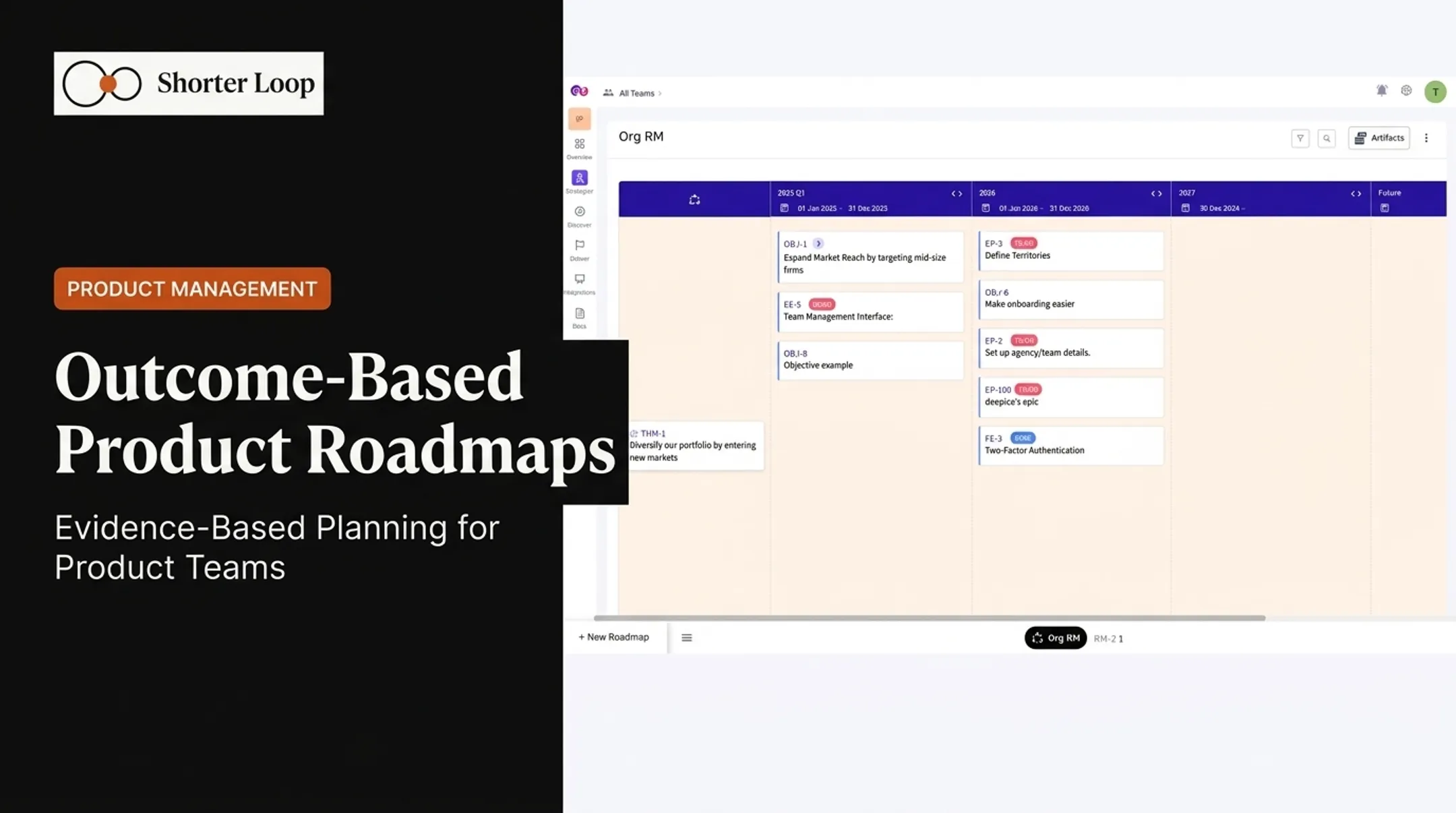
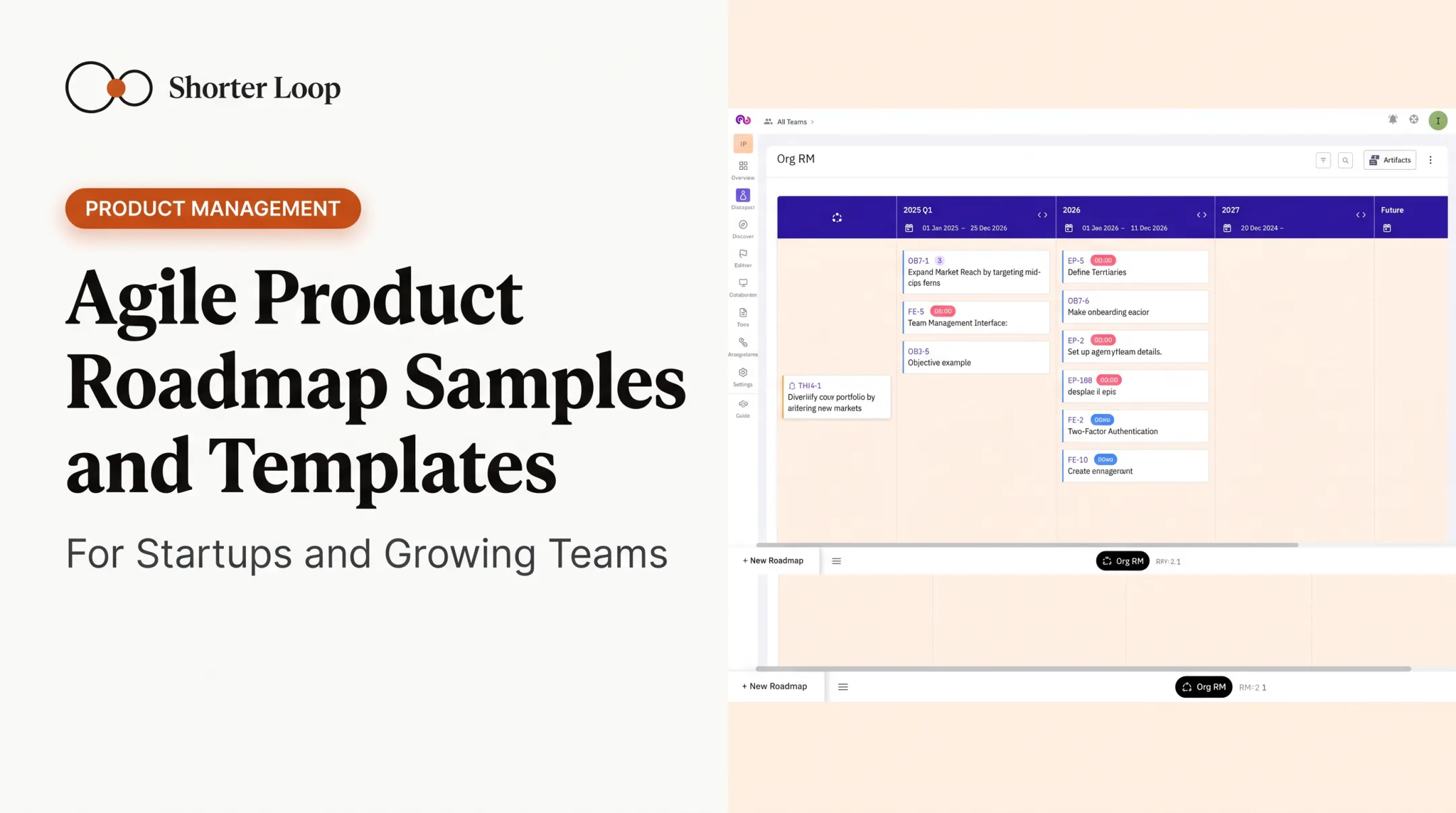
This is where a connected system earns its keep. A Shorter Loop roadmap, for instance, is a board whose rows are themes with objective lanes inside them, and whose cards are the opportunities, solutions, epics and features the team has placed on it. A level filter switches the same board between Strategy and Build, so leadership can look at objectives and the delivery teams can look at epics and features without anyone maintaining a second copy.
How to Run the Roadmap as a Continuous Evidence Loop
A roadmap built once and left alone decays fast. Running it as a loop means reviewing it on a cadence, comparing intended outcomes against what actually happened, and keeping the trail from insight to decision to outcome intact.
Three Decision Rules Worth Adopting
- Continue when evidence and outcomes still support the current direction.
- Adapt when the underlying problem is still real but the solution or assumptions need to change.
- Pause or stop when evidence no longer supports the bet, or the expected value is outweighed by risk and opportunity cost.
FlowDesk applied the third rule directly: in August, the team stopped two epics before a single line of code was written, returning six weeks of planned engineering to the quarter once the shared assumption behind them fell apart.
Keeping the Trail Intact
Traceability from insight to assumption, decision, roadmap theme, delivery work, release, and outcome is what lets a team inspect why a bet exists months later and what actually happened after it shipped. This is the core idea behind what Shorter Loop calls a product integrity system: evidence, strategy, decisions, delivery, and outcomes stay connected instead of disappearing across separate tools and handoffs.

A quick self-test illustrates the point: pick one committed roadmap item, trace it back to the claims and evidence behind it, and check whether that evidence is still current. Wherever the trail breaks is where integrity breaks too.
Before each roadmap review, check:
- What changed since the last review?
- What was learned, and from what evidence?
- Which assumptions weakened or broke?
- Which outcomes actually moved?
- What's still unknown?
- Is the next investment still justified?
Governance matters here too. Named owners, visible confidence levels, documented trade-offs, and a clear line between commitments and hypotheses keep the roadmap trustworthy instead of aspirational.
Conclusion
Value roadmapping is a method for making product bets explainable, testable, and traceable to real outcomes, not a prettier way to present a feature backlog.
The sequence holds up across contexts: define the value you're after, connect it to evidence, express it as a measurable outcome, choose and sequence your bets, deliver in increments, and let the results shape the next decision. Outcomes become evidence for the next round, closing the loop instead of starting from scratch each quarter.
Shorter Loop's mission (helping product teams make better bets and carry them through to better outcomes) comes down to one habit: carrying evidence and reasoning all the way through, not just to the roadmap, but past it, to what actually happened for the customer. A walkthrough shows what carrying it past the roadmap looks like in practice.
Frequently Asked Questions
What are the components of a value roadmap?
A value roadmap includes vision and strategic context, outcome areas or value themes, supporting evidence and assumptions, named risks, time horizons, candidate bets, milestones, ownership, and scheduled review points.
What is the purpose of the product roadmap in a value roadmap?
The product roadmap translates strategic value themes into prioritized bets and concrete delivery or learning milestones. It doesn't replace the outcome focus: it operationalizes it.
What does "roadmapping" mean?
Roadmapping is the ongoing practice of deciding, sequencing, communicating, and revising work in pursuit of strategic outcomes. It's a process, not a static document, according to ProductPlan's definition.
What does "value" mean?
Value is the meaningful benefit created for customers, the business, or both. It should be described as a desired change (in behavior, experience, or performance) rather than activity completed.
What is a value-driven business?
A value-driven business prioritizes decisions and investments based on the value they create, tests assumptions with real evidence, and adapts when outcomes contradict the original plan, rather than defending a fixed roadmap for its own sake.