
Introduction
Your team shipped three roadmap items this quarter. Leadership still asks the same question: did any of it change a customer or business result?
Delivering features, fixing bugs, and hitting sprint deadlines can keep a team fully occupied without anyone being able to say whether that work improved an outcome that matters.
Pendo's analysis of 615 subscriptions found that 80% of features in the average software product go rarely or never used. That figure doesn't explain why those features went unused, but it's a reminder that a full roadmap and a meaningful outcome are not the same thing.
OKRs and roadmaps solve different problems. OKRs define the outcome you're pursuing and the evidence that will show whether you're getting there. Roadmaps communicate the bets, initiatives, and learning path you're using to pursue it.
Here's how to connect them without turning your roadmap into a fixed feature schedule you can't back out of.
Key Takeaways
- OKRs and roadmaps answer different questions and should work together, not replace each other
- A strong roadmap starts with a corroborated problem or a strategic bet, not a backlog of requested features
- Link roadmap themes to key results, but leave room for discovery and reprioritization
- Review progress and evidence regularly, and use outcomes to decide whether to continue, pivot, or stop a bet
What Product Roadmaps and OKRs Actually Do
Before connecting these two tools, get clear on what each one does. Much of the disconnect starts when they're confused.
An OKR (Objectives and Key Results) names the change a team wants to create and the measurable signals that show it's happening.
Google's re:Work guidance describes Objectives as ambitious statements of intent, with Key Results providing the measurable evidence of progress. Key Results should describe outcomes, not a checklist of activities.
A product roadmap is a communication and prioritization view of how a product is expected to evolve. It includes goals, themes, opportunities, initiatives, time horizons, and dependencies. Melissa Perri's roadmap model builds this around outcomes, themes, and hypotheses rather than a list of untested features waiting to be built.
Outcomes vs. Outputs: An Example From Demo Data
FlowDesk is a fictional demo dataset Shorter Loop uses to show the product. It's set up as a shift-scheduling SaaS company serving mid-sized logistics operators, with an objective to cut first-90-day customer churn from 22% to 12%. In the demo story, one team believes the cause is "onboarding is too hard" but attaches no evidence to that claim, and ships a guided setup wizard anyway.
- Output: the guided setup wizard shipped on schedule
- Outcome: integration completion rose 18% after the release, but 30-day retention barely moved
With no control group, that rise coincided with the release rather than being shown to come from it. The flat retention result, though, is evidence against the claim the wizard rested on: getting more accounts through setup wasn't enough to keep them, so the evidence now disagrees with that claim.
Comparing the Two Tools
| OKRs | Product Roadmap | |
|---|---|---|
| Core question | What change are we trying to create? | Which bets are we considering to create it? |
| Time horizon | Typically quarterly | Spans multiple horizons (now/next/later) |
| Certainty | States a target, not a guarantee | Should reflect discovery confidence, not promises |
| Ownership | Team or org-level goal owner | Product team, often cross-functional |
An OKR shouldn't become a renamed feature list, which only hides output-thinking behind goal-shaped language. Likewise, a roadmap shouldn't present an untested Key Result as a guaranteed delivery date. Strategy provides the choices, OKRs make near-term success measurable, discovery reduces uncertainty, and the roadmap communicates what might move the result.
How Product Roadmaps and OKRs Work Together
Connecting these tools well means building a traceable chain, not a rigid hierarchy. Here's the sequence:
Customer evidence and assumptions → problem/opportunity → strategy choice → Objective → Key Results → roadmap themes/initiatives → delivery and experiments → observed outcomes.

That chain has to stay visible in both directions. When leadership sets company-level priorities, product teams should see how those priorities inform their own OKRs, without every higher-level Key Result mechanically becoming a lower-level Objective.
Christina Wodtke warns that forcing every team's OKRs through a leadership approval chain slows work down and erodes ownership. Teams need room to decide how they contribute.
Using Key Results to Stress-Test the Roadmap
Once Key Results exist, use them to stress-test what's on the roadmap:
- Keep initiatives with a credible connection to the desired result
- Investigate anything whose link rests on a claim with no corroborating evidence
- Challenge work that can't explain which outcome it might influence
The FlowDesk demo data shows what this check can catch. In the demo workspace, besides the team that ships the wizard, two other teams have six weeks of engineering effort planned on different solutions to the same uncorroborated churn explanation. Neither team knows the other is betting on that claim until the evidence trail puts both planned epics next to it.
Why Theme-Based Roadmaps Fit OKR-Driven Teams Better
A feature-and-date roadmap implies certainty before discovery has earned it. A theme-based, outcome-based, or Now/Next/Later roadmap works better when uncertainty is high, because it separates confirmed direction from speculative solutions.
In the demo data, the objective is framed around reducing early churn, with Key Results tied to integration completion and 30-day retention. Several possible initiatives (a wizard, better documentation, proactive check-in calls) can be tested under the same Key Result without committing engineering to one path too early.
The guided setup wizard is the first of those to ship, and its result, described above, is what sends the demo team back to the churn explanation rather than on to the next onboarding feature.
Not everything needs to hang off an aspirational OKR. Maintenance tasks, regulatory work, and technical debt often won't map to a customer-outcome objective, and that's fine. What matters is that the reason, ownership, and priority of that work stay visible on the roadmap instead of disappearing into an unexplained backlog.
How to Build an Outcome-Based Roadmap Linked to OKRs
Building this connection on purpose, rather than by accident, comes down to five steps.
1. Start With Reliable Inputs
Before drafting an Objective or a roadmap line, review:
- Product strategy and company priorities
- Customer interviews, support tickets, and sales notes
- Product usage data and past outcome reviews
- Known technical constraints and open claims
In the FlowDesk demo dataset, 41 related pieces of feedback sit across three separate systems until someone groups them into one picture.
2. Write an Objective That Names a Change, Not a Feature
A useful Objective describes the customer or business change you want, not the feature or project meant to produce it. "Reduce first-90-day churn" is an Objective. "Build a guided setup wizard" is not; that's a roadmap bet.
3. Choose a Small Set of Key Results
Pick Key Results the team can influence. Balance lagging outcome measures with leading indicators so you can course-correct mid-cycle instead of waiting until quarter-end to learn you missed the target.
For "Reduce first-90-day churn," churn rate is the lagging KR. A leading indicator might be setup completion within seven days.
4. Prioritize Roadmap Bets Against Each Key Result
For every candidate initiative, ask:
- What evidence supports this bet?
- Which claim does it test?
- What effort or dependency does it require?
- What would make us stop or change course?
5. Match Roadmap Detail to Actual Certainty
Use broad themes where uncertainty is high. Add initiative-level or delivery-level detail only once discovery has earned it. Don't present a speculative date as a promise.
Make ownership explicit too: who's accountable, what their expected contribution to the Key Result is, and what evidence will be reviewed after launch.

When OKRs live in one tool, evidence in a spreadsheet, and the roadmap in a third system, those links break. Shorter Loop is a Product Integrity System, and its roadmap is one view of the work, with each item traced to the claims and evidence behind it. It keeps evidence, claims, opportunities, and experiments linked to the objectives and roadmap items they inform, with Now/Next/Later and Timeline roadmap views.
Each claim carries a state (backed, evidence disagrees, untested, or untested with nothing found). When new evidence contradicts a claim, you can see which objectives and roadmap items rest on it, instead of finding out at the end of the quarter. Shorter Loop doesn't replace Jira: epics and features sync two-way with Jira, Azure DevOps, GitHub, GitLab, or Asana, and delivery status stays in that tool.
How to Operate, Review, and Improve the System
A connected roadmap and OKR set only stays useful if you run it as an ongoing system, not a one-time planning exercise.
Establish a cadence:
- Planning sessions: set or refine OKRs at the start of a cycle
- Regular check-ins: review signals, unblock work, catch early warning indicators
- Outcome reviews: decide whether a bet produced the intended change, and what to do next
Treat the roadmap as a living decision document, not a contract. When customer evidence, market conditions, or outcome data shifts your confidence in a bet, update the roadmap. Don't wait for the next quarterly planning cycle to admit it isn't working.
Common Failure Modes
| Failure Mode | Corrective Action |
|---|---|
| Feature-led OKRs disguised as goals | Rewrite Key Results as outcomes, not shipped items |
| Vanity metrics that always trend up | Test whether the metric shows the intended change |
| Too many objectives at once | Limit to 2-3 objectives, a handful of Key Results each |
| Roadmap dates treated as commitments | Separate confirmed themes from speculative solutions |
| "Set and forget" reviews | Schedule outcome reviews, not just delivery status checks |
Cadence and course-correction only work if the reasoning stays visible. Document why a bet was made, what evidence supported it, and what happened after delivery.
In the FlowDesk demo data, the wizard ships first, and its flat retention result contradicts the claim behind those two other planned epics. Both teams pause their epics before development starts, which keeps six weeks of planned engineering open for other work. On a real team, that kind of correction depends on the decision context still being findable months later, not buried in a chat thread.

A practical test for your next planning session: for each initiative on the roadmap, name the Key Result it's meant to move and the claim that explains why it would. If two initiatives point to the same claim and nobody has corroborated it, test that claim before funding either one. If you want to see how objectives, claims, and roadmap items link in practice, you can start a 14-day trial of Shorter Loop (no credit card) or book a walkthrough.
A Short Walkthrough: Objective, Roadmap, Evidence
What the loop above looks like as screens:
The objective. An objective holds the change you are after, with key results underneath that define what would count as having achieved it. It lives in Left rail > Strategy > Product Strategy > Objectives, alongside opportunities, solutions, and experiments. The table switches between List, Kanban, and Tree views, and Tree is the one worth opening when you want to see what hangs off a goal.
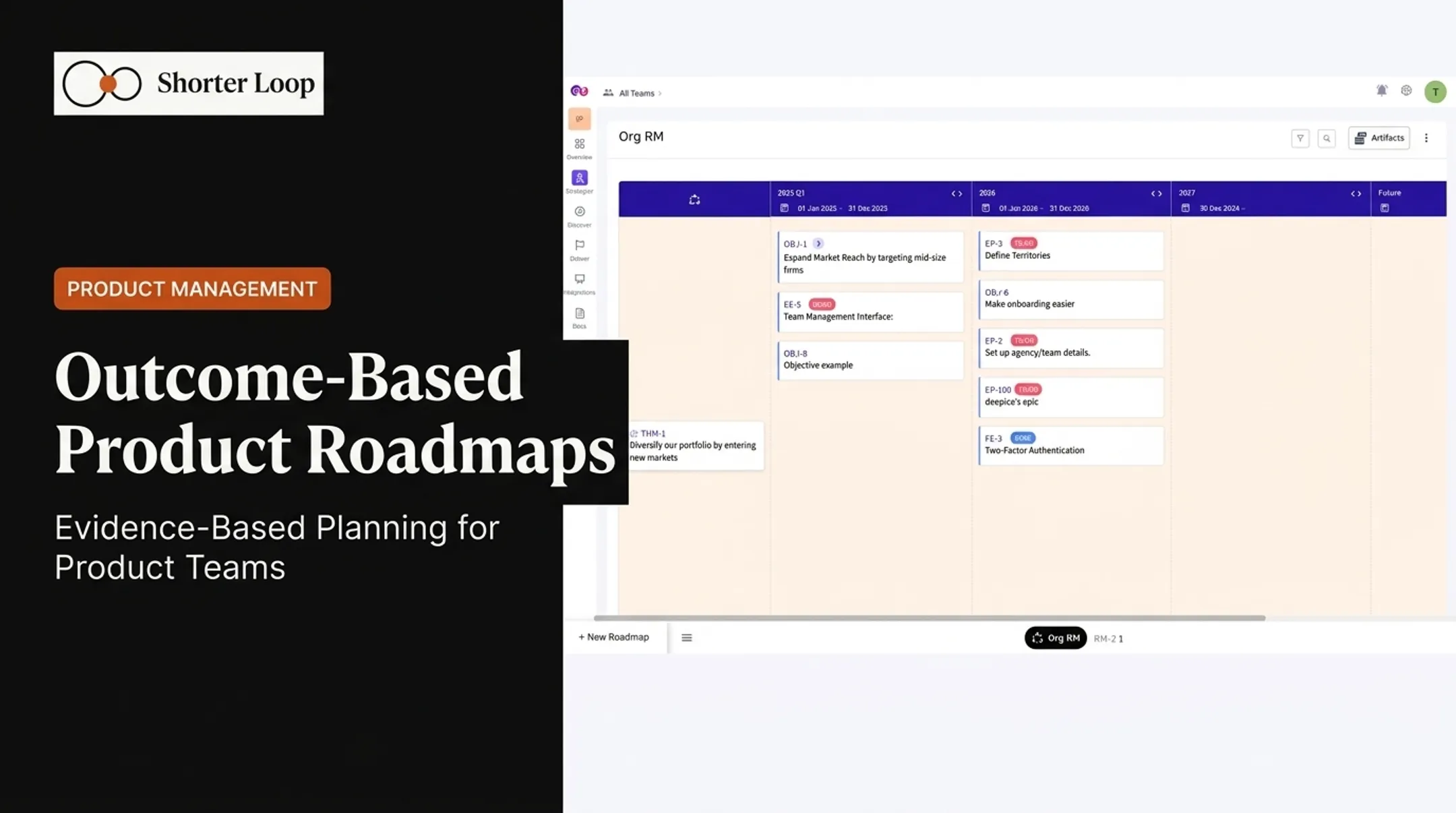
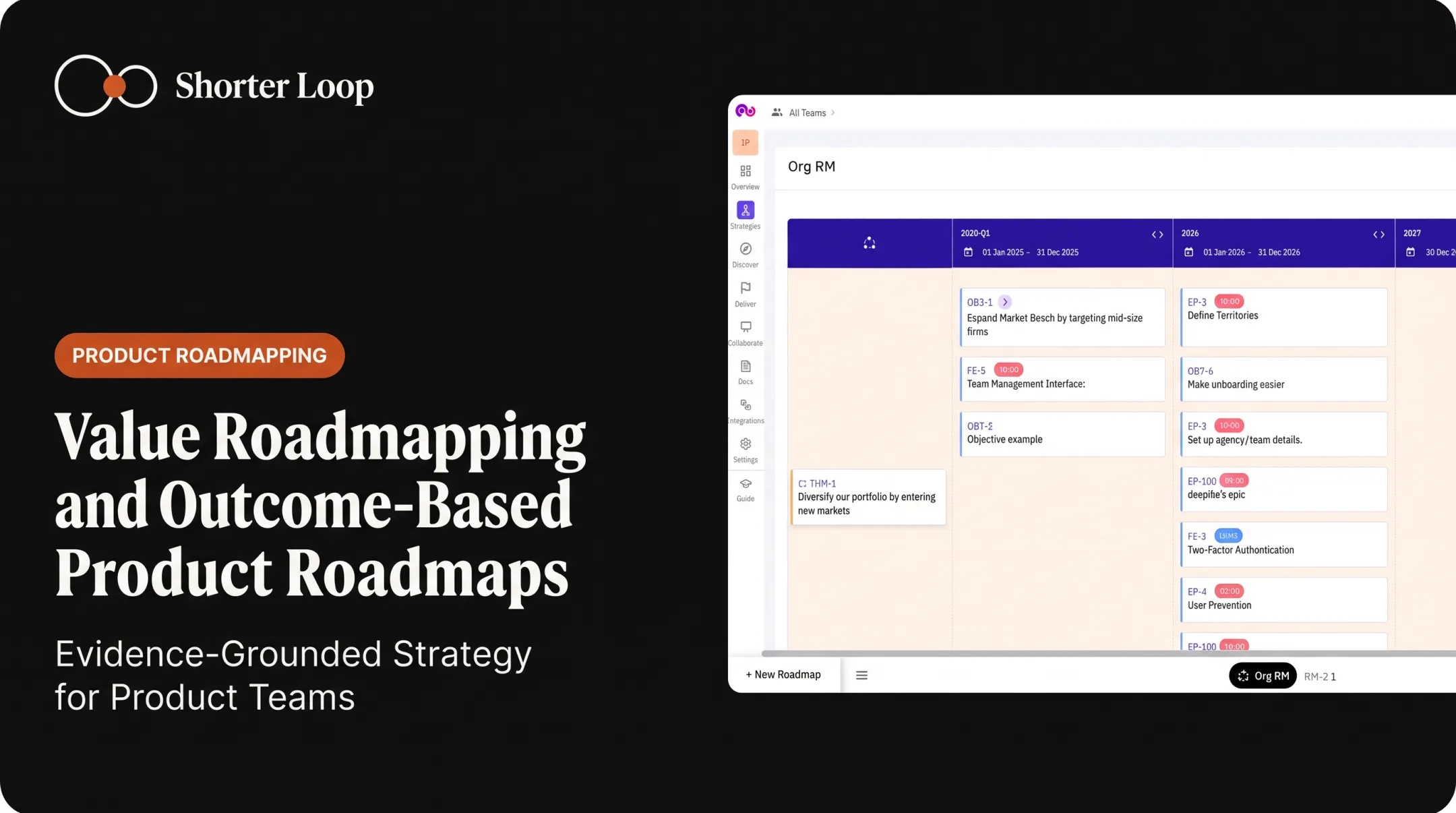
The roadmap. A roadmap is a board created from a Now / Next / Later or Timeline template. Columns are time boxes and rows are themes; drop an objective onto a theme and it becomes a lane. Cards are the opportunities, solutions, epics, and features you place on it, so the roadmap is a view of the same records rather than a second copy of them.
The evidence. Open any item and its Evidence tab lists the claims behind it, each source grouped as feedback, documents, analytics, or related work, and the overall verdict. Each claim reads as backed, evidence disagrees, untested, or untested with nothing found.
Read in that order, the three screens answer one question each: what change are we trying to create, when are we attempting it, and what makes us think it will work. A key result with no linked evidence is not an error, but it is worth knowing before the quarter starts rather than during the review.
Frequently Asked Questions
Is OKR better than KPI?
Neither replaces the other. OKRs are a goal-setting and alignment framework, while KPIs are ongoing measures of performance. KPIs are often used within OKRs: an existing metric becomes a Key Result once it's tied to a specific improvement target.
Do companies still use OKRs?
Yes, though it works better to adapt the framework than to copy another company's process wholesale. The right cadence and structure depend on your strategy and how much uncertainty you're operating under.
What is an OKR in product management?
The Objective is the product change you're pursuing; Key Results are the measurable evidence that you're getting there. Roadmap features are possible means to that end, not the OKR itself.
How do we run OKRs across several squads without the objectives colliding?
Set objectives at the level where the outcome is actually owned, and let key results stay with the squad that can move them. Collisions usually mean two teams have been handed the same metric with no agreement on who changes what. Where an objective genuinely spans squads, name one owner for the objective and give each team a distinct key result under it. Review them together, because the useful conversation is about where the teams are pulling against each other, not whether a number turned green.
Can OKRs replace a product roadmap?
No. OKRs define the outcome and success measures; roadmaps communicate the initiatives and product direction used to pursue that outcome. You need both, because they answer different questions.
How do you connect a product roadmap to OKRs?
Start with evidence and strategy, define measurable outcomes, then map roadmap themes and initiatives to those Key Results. Assign clear ownership, and revisit the links whenever new evidence changes your confidence in a bet.