
Introduction
Six months after a major product bet ships, try asking the team why they made it. Half the room shrugs. The customer evidence that justified the decision, the assumptions behind it, even the original problem statement, have quietly disappeared.
This is the real failure mode in product management. Most teams already have data. What disappears is the reasoning that connected that data to the decision.
Evidence-based product management isn't about handing control to dashboards or stripping judgment out of the process. It means making assumptions explicit, using the best evidence available at the time, and treating outcomes as new information rather than a final verdict.
This guide walks through:
- What counts as evidence
- How outputs differ from outcomes
- How to connect evidence to real decisions
- How to test product bets responsibly
- How to build a continuous learning loop that holds when someone leaves the room
Key Takeaways
- Product decisions work best as testable bets, not permanent commitments based on opinion or seniority
- Strong teams combine interviews, behavioral data, market context, and delivery learning instead of one source
- Outcomes measure real change for customers or the business; outputs only measure what got built
- The loop never closes: identify a problem, form a hypothesis, test small, inspect results, adapt
What Is Evidence-Based Product Management?
Evidence-based product management is a way of making and revisiting product decisions using observable information, explicit assumptions, measurable outcomes, and iterative learning under uncertainty. It treats every meaningful bet as a hypothesis worth checking, not a conclusion to defend.
That's a different thing from "data-driven" product management, even though the two terms get used interchangeably. Data is one form of evidence. Customer interviews, support conversations, usability sessions, experiment results, and market signals all count too. A decision backed only by analytics, with no understanding of why users behave that way, is just as fragile as one backed only by a loud stakeholder's opinion.
Where Evidence Belongs in the Product Lifecycle
Evidence shouldn't show up only at launch review. It belongs at every stage:
- Discovery: Shapes which problems are worth exploring
- Opportunity selection: Separates a real pattern from a one-off request
- Strategy and prioritization: Informs which bets align with company objectives
- Delivery: Guides scope and sequencing decisions mid-build
- Post-launch evaluation: Confirms (or contradicts) whether the bet paid off
What This Practice Is Not
Common misreadings to clear up early:
- Waiting for perfect certainty before acting
- Collecting metrics without a decision in mind
- Treating every stakeholder anecdote as equivalent to validated research
Shorter Loop's internal framing captures this well: product integrity isn't another stage gate or review ceremony, and it doesn't require documenting every conversation. It requires keeping the reasoning behind a decision connected to the evidence that produced it.
What Counts as Useful Product Evidence?
Evidence and assertion aren't the same thing. Evidence should help support, weaken, or refine a belief about a customer problem, a proposed solution, or an expected outcome. A confident claim with nothing behind it is still just an assertion.
Useful evidence sources include:
- Customer interviews and support conversations
- Sales call notes and account conversations
- Usability research and product analytics
- Experiment results and operational data
- Market research and post-launch feedback
Not all evidence carries equal weight. Judge each source by:
- Relevance to the right customer segment
- Reliability (specific past-behavior story vs. a hypothetical)
- Recency of the data
- Consistency across sources
- Proximity to the actual behavior being evaluated
One compelling customer story can feel like proof, but it rarely is. CB Insights reviewed 111 startup failure postmortems and found that 35% cited building something the market didn't need, often because a vocal minority was mistaken for the broader customer base, according to CB Insights' startup report.
FlowDesk, a fictional demo dataset Shorter Loop uses to show the product, shows the alternative. Rather than acting on a single churn interview, the team pulled together 1,100 support conversations, 60 sales call notes, and 14 churn interviews filed the same month. That broader base surfaced a pattern a single anecdote would have missed entirely: accounts with a second user added in week one retained at 91%, while single-user accounts churned at 68%.

The Principles of Evidence-Based Product Management
Every important product bet rests on assumptions. Who has this problem? How severe is it? What behavior needs to change, and why would the proposed solution create value? Most teams never write these down, which is exactly how reasoning disappears.
Make Assumptions Visible
A good decision record captures the decision itself, the supporting evidence, any contradictory evidence, a confidence level, the expected outcome, and the conditions that would make the team revisit it.
Shorter Loop builds a version of this into drafting. Before AI drafts opportunities from an objective, Shorter Loop checks the evidence behind that objective, and if the evidence is weak or contradicted it explains why and offers Draft anyway, marked as assumptions; anything drafted that way carries an Assumed badge in Product Strategy and Strategy Builder. The FlowDesk demo shows why that matters. The objective's stated cause, "onboarding is too hard," had no sources linked to it, even though the demo data holds 41 support items and 14 churn interviews that could have backed or challenged it. Until someone links them, that cause stays an untested claim.
Evidence Can Expire
New customer behavior, market shifts, or contradictory experiment results can weaken a belief that was perfectly reasonable six months ago. A decision based on sound evidence then can be a bad decision now. Teams that treat old research as permanent truth are the ones most likely to be surprised later.
Activities, Outputs, and Outcomes Aren't the Same
This distinction trips up more teams than almost anything else in product work.
| Category | What it measures | Example |
|---|---|---|
| Activity | Work done to learn or build | Running weekly customer interviews |
| Output | Something produced | Shipping a new integration |
| Outcome | Actual change in behavior or results | Customers using it, retention improving |
Shipping isn't proof of value. Pendo's analysis of 615 product subscriptions found that 80% of features are rarely or never used, according to Pendo's adoption report. Building something doesn't guarantee anyone touches it.
The FlowDesk demo data that ships with Shorter Loop makes the same point from a different angle. A guided integration setup feature improved integration completion by 18%, but retention "barely moved." The feature worked. The original belief that integration difficulty was driving churn did not hold up.
Judgment Still Matters
Evidence doesn't replace judgment; it informs it. Teams should share relevant evidence openly, actively listen for evidence that contradicts the preferred answer, and make trade-offs explicit instead of using a metric to quietly bury risk or uncertainty.
The Evidence-to-Outcome Decision Framework
A useful way to connect evidence to a real decision runs through eight steps:
- Signal or problem
- Interpretation
- Opportunity
- Hypothesis
- Experiment or delivery bet
- Expected outcome
- Observed result
- Next decision

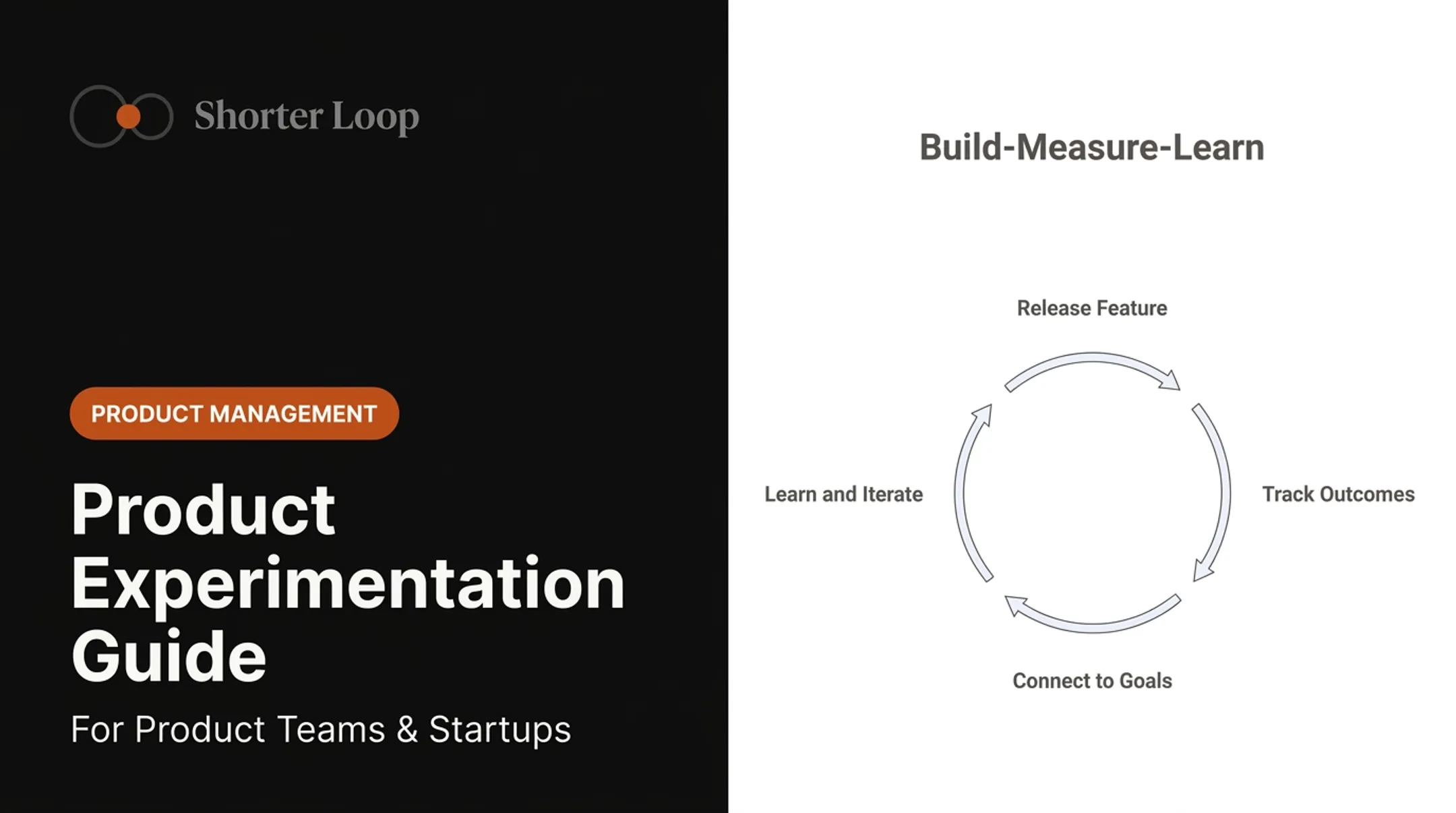
Shorter Loop frames the same loop more tightly: customer evidence, insight, strategy, product decision, delivery, outcome, and new evidence. Each cycle feeds the next.
Writing a Testable Hypothesis
A clear hypothesis names the customer segment, their specific problem, the proposed action, and the expected direction of change. A worked example: build a literature-review feature for researchers, expecting engagement to rise.
The structure is simple. It still forces the team to state what they believe will happen, not only what they plan to build.
Choosing Metrics That Mean Something
Every bet needs a primary outcome measure, a supporting behavioral indicator, a guardrail against unintended harm, and a timeframe for checking results. Shorter Loop's FlowDesk example illustrates this cleanly:
- Test: Share a scheduling link with 30 new accounts over two weeks
- Result: 22 accounts shared the link; 14 gained a second user unprompted
- Pre-written kill criterion: If fewer than half shared the link within a week, the assumption dies
That last part matters most. The team decided what failure looked like before seeing the data, not after.
Inspect, Then Adapt
Compare the observed result against the expected one, decide what was learned, and choose to persevere, modify, pause, or stop.
When the FlowDesk team shipped on November 14, the churn impact was still unknown, so the claim behind the objective stayed untested. That is the honest state most bets sit in right after launch. Record it that way, and hold off on calling it a win until the evidence comes in.
How to Apply Evidence-Based Product Management in Practice
Start With a Decision, Not a Dashboard
Name the decision the team actually needs to make, the uncertainty blocking it, the evidence already on hand, and the evidence that would change the call. Dashboards without a pending decision just generate noise.
Consolidate Scattered Customer Evidence
Pull evidence from interviews, support tickets, sales calls, and feedback portals, then separate repeated patterns from isolated asks. FlowDesk's 41 pieces of feedback showed up across three separate systems, worded twelve different ways, before anyone noticed it was the same request. Shorter Loop is built to catch that duplication early: feedback arrives from the Feedback portal, from connected apps such as Zendesk, Intercom and HubSpot, from Fireflies transcripts and from a CSV upload, and Generate Clusters on the Clusters page groups the related items so the shared problem behind them is visible.

Prioritize Without Faking Precision
Combine customer importance, strategic fit, evidence strength, risk, and learning potential. Scoring systems like RICE are useful for structuring a conversation, not for producing a number that feels more certain than it is. Multiplying guessed effort by guessed impact doesn't create data; it just dresses up an opinion.
Design the Smallest Responsible Test
Match the test to the uncertainty:
- Prototype or usability session for solution-shape questions
- Concierge workflow for early value validation
- Landing-page or fake-door test for interest signals before building
- Limited release for real-world behavior at small scale
Close the Loop After Delivery
Review whether the expected outcome actually occurred, document anything unexpected, and update confidence levels. "Whether it worked" means comparing the intended result against post-shipping evidence, not treating shipment itself as proof.
How to Introduce the Practice Across a Product Organization
Start where the pain is sharpest. Common starting points include:
- Fragmented customer evidence
- Unclear strategic alignment
- Repeated prioritization debates
- Weak post-launch learning
Shared research across roles is rarer than most teams assume: ProductPlan's 2024 survey found that only 14% of organizations had product managers, designers, and tech leads all participating in customer research together, according to ProductPlan's state report.
A gradual rollout works better than a company-wide mandate:
- Week one - Pick one important objective. If its stated cause has no evidence attached, mark it as an assumption openly.
- Weeks two through four - Gather existing evidence for one real opportunity, rather than theorizing about all of them.
- Expand from there - Add more teams and objectives once the first chain proves useful.
A connected system helps here, mainly because context tends to vanish at handoffs. Shorter Loop keeps customer evidence, assumptions, decisions, strategy, and delivery work traceable in one place. Its integrity checks run on a schedule you set and flag contradicted claims, important ideas not yet tested and evidence that may be outdated, while Sage answers questions from your own documents and feedback and shows the evidence behind each answer. To see both against your own evidence, start a 14-day free trial or book a walkthrough.

Adoption safeguards worth setting early:
- Define clear ownership for keeping evidence current
- Make evidence visible to the whole team, not just leadership
- Never turn learning metrics into individual performance targets
- Review whether the practice is improving decisions, not just generating more documentation
Frequently Asked Questions
What is evidence-based product management?
It's an approach that uses the best available customer, behavioral, market, and delivery evidence to make explicit product bets, measure outcomes, and adapt decisions as new information arrives.
What is the difference between evidence-based and data-driven product management?
Data is one evidence source among several. Evidence-based product management also weighs qualitative research, observed behavior, experiment results, and informed judgment alongside the numbers.
What counts as evidence in product management?
Customer research, product usage data, support and sales patterns, experiment results, market signals, and delivery learning all count, provided they're checked for relevance and reliability first.
Why are outcomes more important than outputs in product management?
Outputs describe what a team built. Outcomes describe whether that work actually changed customer behavior or business results. Shipped features don't prove value on their own.
How do you test a product hypothesis?
Write the hypothesis, define the expected behavior change, run the smallest experiment that can test it, set success and guardrail measures in advance, and decide beforehand what the result will trigger next.
How can a growing product team adopt evidence-based product management?
Start with a focused pilot on one real pain point, keep decision records and evidence visible, inspect results regularly, and expand the practice gradually based on what actually works.