
Introduction
As a B2B SaaS company grows from one product team to five, customer evidence starts living in more places than anyone can realistically track. A support ticket here, a sales call note there, a survey response buried in a spreadsheet.
Many product leaders already collect plenty of feedback. They struggle because they can't connect it to anything.
According to ProductPlan's 2024 report, nearly three-quarters of product professionals cited standardizing tools across teams as a reason to consolidate their stack. Nearly half pointed to lack of visibility and data silos.
"Product discovery platform" means different things depending on who's talking. Ecommerce teams use the phrase for shopper-facing search and recommendation tools. Software product teams mean something else entirely: systems that help decide what to build next.
This article focuses on the latter. We'll cover what these platforms actually are, the categories you'll encounter, the capabilities worth testing, how to evaluate vendors, and why evidence needs to stay traceable long after a feature ships.
Key Takeaways
- A discovery platform should reduce uncertainty before and during product work, not just store research notes
- Collecting feedback isn't the same as connecting it to opportunities, decisions, and outcomes
- The right platform depends on your team's discovery maturity, structure, and AI governance needs
- Check whether a platform preserves decision context after people leave or priorities shift
What Are Product Discovery Platforms?
A product discovery platform, in product-management terms, is software that helps teams continuously gather, organize, interpret, validate, and apply customer and market evidence before committing resources to building something. It's less a single tool and more a connected workflow: evidence comes in, gets synthesized into themes and opportunities, and informs a decision that eventually gets tested against reality.
The core problem these platforms address: customer interviews, support conversations, sales feedback, surveys, analytics, and product decisions often live in five different tools. When someone asks a PM "why are we building this," the honest answer is sometimes "I'm not entirely sure anymore."
How it differs from adjacent tools
- Research repositories store interviews and insights but don't necessarily connect them to strategy or delivery
- Feedback portals collect requests and votes without framing them as opportunities tied to objectives
- Roadmap and project-management tools track what's being built, not why it was chosen
- Product analytics platforms show usage data but rarely explain the customer reasoning behind a decision
The typical discovery loop runs like this:
- Collect evidence
- Spot patterns and opportunities
- Form and test assumptions
- Decide what to pursue
- Connect the decision to delivery
- Use the outcome as evidence for the next cycle
It benefits product managers and researchers directly, but also designers, engineers, and customer-facing teams who need a shared view of customer reality, not five separate versions of it.
That fragmentation has a measurable cost. Nielsen Norman Group's research found that 29% of UX and ResearchOps professionals reported their research repository had no owner, and 23% were dissatisfied with their repository tool entirely. Evidence that nobody owns tends to get collected once and never looked at again.

Types of Product Discovery Platforms and Common Use Cases
Vendor category labels are inconsistent, so it helps to think in terms of function rather than marketing copy. Most tools fall into one of four groups:
- Customer feedback and insight platforms – capture requests, interviews, support issues, and survey responses in one inbox
- Research repositories and repository-plus-synthesis tools – tag, search, cluster, and share qualitative findings across studies
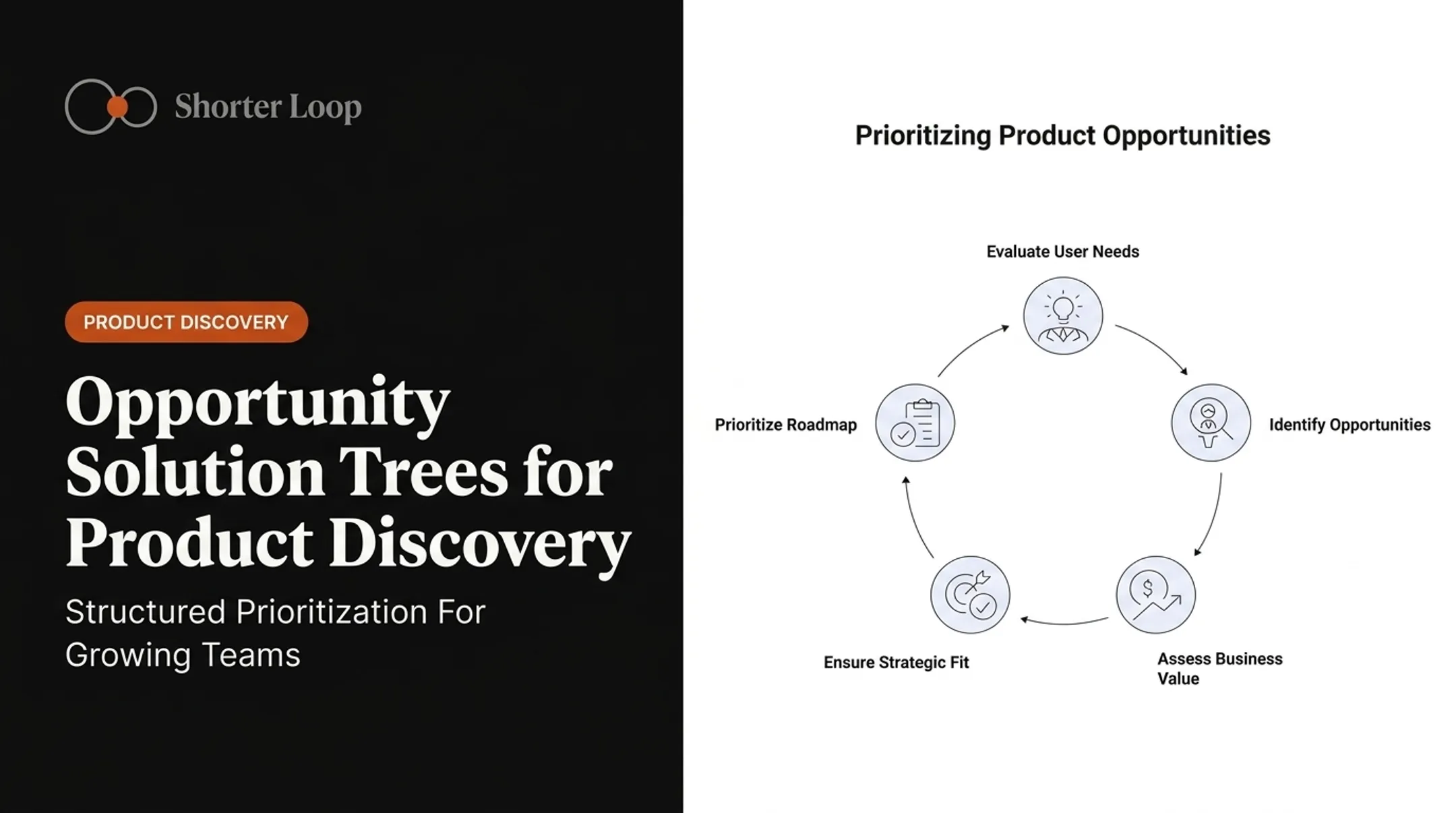
- Prioritization and opportunity-management tools – connect customer problems to potential initiatives, often built around frameworks like Teresa Torres' opportunity solution tree
- End-to-end discovery or product-ops platforms – connect evidence, decisions, strategy, planning, delivery, and outcomes in one system
Ecommerce discovery vs. B2B software discovery
These are genuinely different problems wearing the same name. Ecommerce discovery tools help shoppers find products through search, recommendations, personalization, or visual browsing.
B2B software discovery platforms help internal teams decide what products or capabilities to build in the first place. If you're shopping for one and keep getting results for the other, that's the distinction tripping you up.
Matching category to situation
- A small team with low evidence volume often just needs a solid research repository
- A scaling SaaS org drowning in feedback needs synthesis and prioritization tools to avoid duplicated research
- A multi-team company needing strategic alignment needs decision traceability across the whole lifecycle
Category labels still vary by vendor. Evaluate actual workflows and outputs during a demo, not the name on the pricing page.
What Capabilities Should a Product Discovery Platform Include?
Evidence foundation and synthesis
The platform needs to accept or connect different evidence types: interviews, support tickets, sales conversations, surveys, usage data, experiments, market research, and post-launch outcomes. From there, it should help teams move from raw feedback to clearly stated themes and opportunities. Not every request deserves equal weight; a single loud customer shouldn't outrank a pattern across forty accounts.
Assumption and opportunity management
Good platforms let teams record what they believe, why they believe it, what remains uncertain, and which research or experiment could close that gap. This matters because teams routinely run discovery, strategy, roadmapping, delivery, and feedback as five disconnected motions. Each one is defensible on its own, yet the result is often a product nobody can fully explain six months later.
Decision traceability
There should be a visible link between evidence, opportunity framing, product decisions, strategic objectives, roadmap initiatives, and delivery work. This context needs to survive personnel changes, priority shifts, and long delivery cycles. Otherwise a decision made in March becomes unexplainable by October.
Collaboration, governance, and responsible AI
Cross-functional discovery needs guardrails that keep evidence trustworthy:
- Clear permissions, shared terminology, and ownership across product, design, engineering, sales, and support
- Source attribution and duplicate detection so the same request isn't logged five times
- Review workflows that catch stale or missing evidence before a decision ships
AI can help summarize, classify, cluster, or surface connections, but outputs should stay grounded in your organization's own evidence rather than general internet knowledge. Dovetail's 2024 launch announcement describes exactly this pattern: AI-generated summaries with citations back to supporting evidence, plus human review before anything gets finalized.
Outcome feedback as the real differentiator
The strongest platforms don't treat shipping as the finish line. They help teams compare intended outcomes with what actually happened, then feed that comparison into the next discovery cycle, closing the loop instead of leaving it open.

How to Evaluate and Implement a Product Discovery Platform
Start with your organization's discovery problems, not a vendor feature checklist. Document where evidence gets collected, where decisions actually get made, where context goes missing, and which handoffs create rework or disagreement.
Build an evaluation framework around:
- Evidence coverage and source traceability
- Ease of adoption for both product specialists and customer-facing contributors
- Connections between discovery, strategy, roadmaps, delivery, and outcomes
- Search, permissions, governance, integrations, data export, and security requirements
- AI transparency, source citations, human review, and controls for sensitive customer data
Skip the generic demo. Ask each vendor to show how a real customer insight becomes an opportunity, a decision, an initiative, a delivery item, and finally an outcome review. If they can't walk that path live, the connections probably aren't real.
Implement in phases
- Define a common evidence and decision model everyone agrees to use
- Start with one product area or workflow rather than a company-wide rollout
- Establish ownership and review habits before expanding
- Expand once the team can show repeatable value, not before
Set success measures before rollout: reduced duplicated research, faster access to relevant evidence, and clearer decision rationale.
Be careful here. The same Nielsen Norman Group research found only 9% of research repositories were considered mature and thriving. A platform alone won't fix unclear decision rights or a culture that rewards shipping without inspecting outcomes.

A connected platform may simply be unnecessary for an early-stage team with low evidence volume and simple workflows. Fragmentation becomes costly once you've got multiple teams, multiple evidence sources, and decisions nobody can trace back to a reason.
Why Connected Evidence Matters for Scaling Product Teams
We built Shorter Loop around a belief we kept running into firsthand: continuous discovery only works if the evidence stays connected to assumptions, strategy, decisions, delivery, and outcomes, not scattered across a workshop deck and three separate tools.
FlowDesk, the fictional demo dataset Shorter Loop uses to show the product, is built to make this concrete. Its feedback sits in three places: 1,100 support conversations, 60 sales notes and 14 churn interviews. Read separately, none of the three points anywhere in particular.
Run Generate Clusters and 41 of those items land in one cluster, which the team saves as a single opportunity. Each of the 41 stays linked to it, so months later anyone can open the opportunity and read the conversations that produced it.
That's the loop we think matters:
- Customer evidence informs a decision
- The decision guides delivery
- The outcome becomes new evidence
- That evidence informs the next bet
Shorter Loop isn't the only way to do this, and we're not claiming it's a universal fix. But it's a concrete example of a platform built to go past research storage: connecting Discover, Strategize, Roadmap, Deliver, and Feedback into one system, with an AI advisor (Sage) that grounds its answers in your own evidence rather than guessing. The honest way to judge it is to book a walkthrough and bring your own repository problem.
Frequently Asked Questions
What is product discovery?
Product discovery is the ongoing process of understanding customer problems, testing assumptions, exploring solutions, and reducing uncertainty before committing to product work. It happens continuously, not as a one-time phase before a sprint.
What are the stages of product discovery?
Common stages include evidence collection, problem and opportunity framing, assumption testing, solution exploration, validation, decision-making, and learning from outcomes. These stages loop rather than run in a strict straight line.
What are some popular product discovery platforms?
Platforms vary by category : research repositories, feedback systems, prioritization tools, and end-to-end discovery platforms all go by the same loose label. Compare actual capabilities against your workflow rather than relying on a static "best of" list.
What are the best tools for product research?
It depends on your method. Interview tools, survey platforms, analytics software, repositories, feedback systems, and synthesis tools all serve different jobs. The right pick depends on team size, governance needs, and whether findings need to connect to downstream decisions.
What is considered a platform product?
A platform product provides shared capabilities, services, data, or infrastructure that multiple teams or products rely on. The concept overlaps with discovery platforms mainly when a company builds internal infrastructure meant to serve several product teams at once.
What are the 5 C's of product management?
One widely referenced formulation defines them as curiosity, collaboration, communication, constraints, and compassion (competencies rather than platform features). Other authors define the five C's differently, so treat it as one useful framework, not a fixed standard.