
Product discovery is the structured process of learning about customer problems, testing the claims behind your ideas, and building enough confidence to make a product decision. It's how you tell "someone asked for this" apart from "this is worth building."
This guide is written for B2B SaaS product teams, especially growing ones dealing with feedback spread across sales, support, and customer success. It covers the process itself, what counts as evidence, and the failure modes that catch experienced teams too.
Key Takeaways
- Discovery reduces uncertainty about value, usability, feasibility, and business viability.
- Run discovery continuously instead of treating it as a one-time gate before development.
- Link research, claims, decisions, and outcomes so the team can still say why each bet exists.
- Scale discovery to risk and reversibility rather than to a fixed framework or ceremony.
What Is the Product Discovery Process?
Product discovery is the process of identifying meaningful customer problems, exploring possible solutions, and testing your assumptions before and during development. The goal is enough evidence and shared understanding for your team to decide what's worth pursuing, what needs to change, and what should be rejected, not another stack of research decks.
Discovery isn't a synonym for customer research, idea collection, feature prioritization, or design. Each of those is one piece. Discovery is what ties them to an actual decision.
It's also distinct from delivery. SVPG's product model frames discovery as rapid experimentation to test whether a solution is valuable, usable, feasible, and viable for the business.
Delivery is the separate work of building, testing, and shipping what you decided to build. When the two get confused, the solution ends up being "discovered" mid-sprint, after the code is half-written.
Four questions belong at the center of any discovery effort:
- Value: Do customers want this, and will they use it?
- Usability: Can they figure out how to use it without opening a support ticket?
- Feasibility: Can your team realistically build it with the time and skills you have?
- Viability: Does it work for the business, legally, financially, and strategically?
Skip any one of these and a whole category of risk goes untested, even if the other three look fine.
A common mistake is treating the output of discovery as a feature or a roadmap slot. The output is a decision (proceed, revise, defer, or stop) backed by evidence you can point to later. "We talked to five customers and they seemed excited" isn't that evidence. A documented pattern across multiple accounts, tied to a specific problem and consequence, is closer.
That distinction matters more as a company grows and fewer people were in the original conversations. In Shorter Loop, opportunities, the feedback behind them, and the claims a decision rests on are linked records, so the decision has a trail you can follow back, rather than a Slack thread nobody can find six months later.
Why Product Discovery Is Used in B2B SaaS
B2B SaaS teams rarely lack customer evidence. They usually have too much of it, in too many places. Sales calls, support tickets, one-on-one interviews, product analytics, renewal conversations, NPS surveys, and feature request boards all produce signal, rarely in the same place and rarely in a format anyone can compare.
Without a reliable process for handling that, a few things tend to go wrong:
- The loudest request wins. The account threatening to churn gets a feature built to their exact wording, while a quieter pattern affecting a dozen other accounts goes unnoticed.
- A feature request gets mistaken for a problem. "Can you add an export button" often means "I don't trust the numbers I'm seeing," and only one framing leads to a good solution.
- The product gets built for one account. A single strategic customer's request becomes the roadmap, even when it doesn't generalize.
- Stale evidence keeps funding new work. A bet justified by research from a year ago keeps getting resourced after the market has moved.
Shorter Loop's demo data shows what this looks like. FlowDesk, a fictional demo dataset Shorter Loop uses to show the product, has 1,100 support conversations, notes from 60 sales calls, and 14 churn interviews sitting in three separate systems.
In that demo story, 11 of the 14 interviews point to the same root cause: dispatchers, a user type nobody had written a persona for, can't get into the product unless someone buys them a separate seat. The pattern only shows up when the three sources are read together.
Discovery also keeps product, engineering, design, sales, customer success, and leadership working from the same understanding of a problem, instead of five interpretations of the same support ticket.
When that shared picture is missing, the cost shows up as build work nobody needed. CB Insights reviewed 111 post-mortems of failed startups and found "no market need" cited in 35% of them. That's not a universal failure rate, but it suggests building without testing demand is a recurring pattern.
Separately, Pendo's analysis of 615 product subscriptions found 80% of tracked features were rarely or never used. Neither figure shows that discovery would have fixed those specific cases, but both point at the same risk: shipping without evidence.
Discovery shouldn't stop at the decision, either. Shipped work produces new evidence about adoption, usability, and business impact. That evidence should feed the next discovery cycle instead of sitting in a dashboard nobody revisits.

How the Product Discovery Process Works
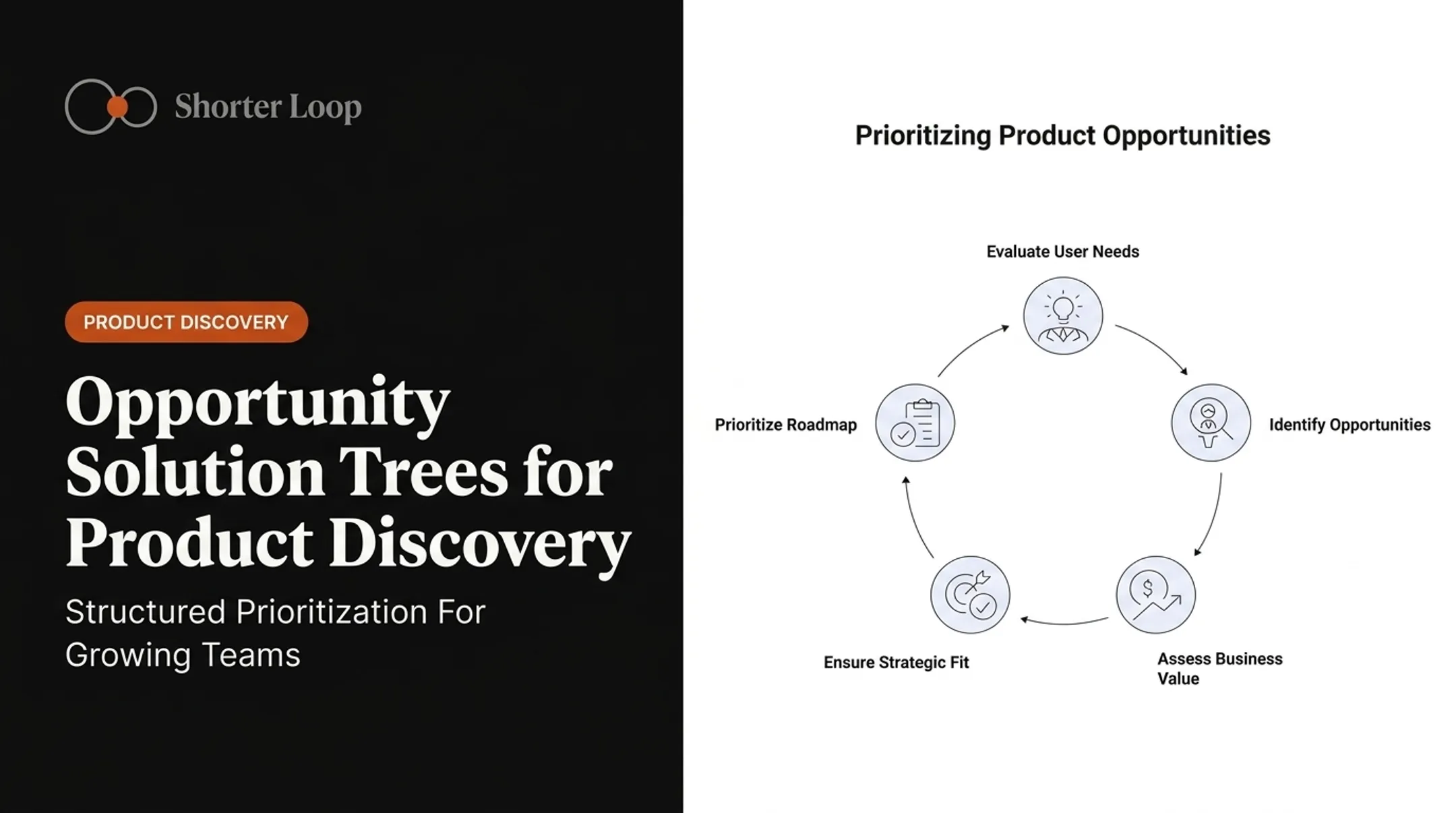
Product discovery isn't a funnel you walk through once. It's a loop. You frame the outcome, gather evidence, define the problem, state your claims, explore solutions, test the riskiest one, decide, connect the decision to delivery, and review what happened. Then you run the cycle again with what you learned.
Step 1: Frame the Outcome and Decision
Start by defining the business or customer outcome you're trying to improve, the actual decision that needs to be made, and the constraints, stakeholders, and time horizon involved.
Don't start with a predetermined feature. Record the initial request as a hypothesis, not a commitment. In the FlowDesk demo data, the original request is "add roster import." Rewritten as a testable belief, it becomes: "Fixing dispatcher access reduces churn among ops teams." That's a statement evidence can corroborate or contradict.
Step 2: Gather and Structure Evidence
Combine qualitative and quantitative sources: customer interviews, observation, support and sales themes, product behavior data, churn or renewal signals, and existing product data.
Separate raw feedback from interpreted insight by recording, for each piece:
- The source and customer context
- The recurring pattern it belongs to
- How confident you are in that pattern
- Unanswered questions it raises
Without this step, scattered feedback stays scattered. In the FlowDesk demo dataset, 41 feedback items about the same problem are spread across those three systems, and they read as 41 separate opinions until someone groups them into one pattern.
Step 3: Define and Prioritize the Problem
Turn your evidence into a concise problem statement: who experiences it, what they're trying to accomplish, what's stopping them, and what happens if it stays unresolved.
Compare competing opportunities using explicit criteria: customer impact, frequency, strategic fit, urgency, confidence in the evidence, feasibility, and cost of delay. Frameworks like RICE, opportunity scoring, or a value-versus-effort matrix can help structure that comparison. They organize judgment; they don't replace the evidence.
Step 4: Explore and Test Solutions
Generate several solution directions before committing to one. Then pick the cheapest credible way to test your riskiest claim first.
Different tests answer different questions:
- Concept conversations and workflow walkthroughs test whether the problem framing resonates.
- Prototypes expose usability and interaction issues, not demand.
- Concierge tests check a manual version of the service before automating it.
- Technical spikes reduce feasibility uncertainty, not customer uncertainty.
- Beta releases and controlled experiments test real usage at limited scale.
No single test covers value, usability, feasibility, and viability at once. Know which risk you're testing.
Step 5: Decide, Connect to Delivery, and Learn
Log the decision so anyone can retrace it later:
- Evidence that supported it
- Claims still open
- Expected outcome
- Owner and review date
- Conditions that would force a revisit
Connect the chosen direction to strategy, roadmap work, and delivery so the "why" survives the handoff. After release, treat adoption data, behavior changes, customer feedback, and business signals as inputs to the next discovery cycle, not a verdict you archive.
In Shorter Loop, the epics and features created from a decision stay linked to the opportunity and claims behind them. Delivery itself stays in Jira, Azure DevOps, GitHub, GitLab, or Asana through two-way sync; Shorter Loop doesn't replace those tools, so the sync has to be current for delivery status to be accurate. When the loop starts over, the context is on the record instead of in someone's memory.

Key Factors and Common Issues
A few factors decide whether discovery works or only looks like it's working:
- Evidence quality: Direct customer behavior and repeated patterns carry more weight than isolated opinions, internal preferences, or sales pressure.
- Evidence traceability: Keep the link between source evidence, problem framing, prioritization, decision, and outcome intact. Break that chain and nobody can explain a bet six months later.
- Team composition: Involve product, design, engineering, and customer-facing experts early enough to test value, usability, feasibility, and viability together, not in sequence.
- Operating context: Product maturity, market shifts, customer concentration, contractual constraints, and reversibility all change how much discovery a decision warrants.
- Scale and cadence: Small, reversible decisions need lightweight discovery. Expensive, strategic, hard-to-reverse bets need deeper testing.
Discovery is often misunderstood. It gets treated as a delay tactic, a hunt for confirmation, a backlog of feature requests, or a phase that ends once development starts. Common shortcuts include:
- Running interviews without synthesizing them
- Collecting feedback without deciding anything
- Scoring ideas without evidence behind the scores
- Testing a prototype without defining what success looks like
Splitting the work across disconnected tools makes this worse. When research, strategy, roadmaps, tickets, and outcomes each live in separate systems, the reasoning behind a bet gets lost between them.
Shorter Loop is a Product Integrity System: each item on the roadmap can be traced back through the claims it rests on to the evidence behind them. Each claim carries a state (backed, evidence disagrees, untested, or untested with nothing found), so a team can still answer "why does this exist?" long after the original conversation.

When the Product Discovery Process May Not Be Appropriate
Discovery shouldn't become a mandatory ceremony for every minor, low-risk, reversible change, particularly when existing evidence is already strong and delay has a real cost.
Some situations call for a lighter or different approach:
- Urgent incident response or security fixes
- Contractual commitments already agreed to
- Accessibility or regulatory obligations
- Well-understood, low-ambiguity operational work
"Not appropriate" doesn't mean "skip thinking." Even here, record the decision context, the claims you're relying on, the constraints, and the expected outcome, then revisit it once new evidence shows up.
The reverse problem happens too: discovery that keeps running after it stops producing decisions. Watch for signs it's being used inefficiently:
- Repeated research that never produces a decision
- Testing cosmetic details while the core value risk stays unknown
- Applying a framework mechanically, regardless of fit
- Demanding certainty that no amount of evidence can provide
Try the Diagnostic on Your Own Roadmap
Here's a check you can run this week. It takes about twenty minutes and usually finds something.
Pick one item currently in delivery. Not the most contentious one, just one that is genuinely being built. Then work backwards:
- Which customer problem is this for? Write it in one sentence, in the customer's language.
- What evidence says that problem is real? Name the specific interviews, tickets, or usage data, not the category they belong to.
- Who decided, and when? A decision with no owner tends to be one nobody can revisit.
- What did we expect to change, and have we checked? If the item shipped, this is the question most teams skip.
Most teams can answer the first question immediately, struggle with the second, and cannot answer the fourth at all. That pattern is the finding. It is not a sign of a careless team; it is what happens when evidence lives in one tool, decisions in another, and outcomes nowhere in particular.
What the Trace Looks Like in the Product
In Shorter Loop the same check starts on the Roadmap. Click the card for the item you picked: an opportunity or solution opens in the strategy side panel, and an epic or feature opens in the backlog quick view. Open the full page of the opportunity or solution behind it and look under the title. On an objective, opportunity, solution or experiment, a claims line there summarizes what the item rests on, reading something like "4 claims · 2 backed · 1 evidence disagrees · 1 untested".
Open the Evidence tab and the sources appear grouped as feedback, documents, analytics and related work, with the overall verdict. Click an individual claim, then Open evidence, and you get the specific tickets, calls or research behind it, each of which you can Confirm or Reject.
The answer to step 4 of the diagnostic, whether anyone checked what changed, is usually the gap. That is the one worth fixing first.
Conclusion
Discovery doesn't need certainty. It needs a level of confidence that fits the size of the decision, and reasoning you can show someone.
If the trail for your item stopped at "a customer asked for it" or "leadership wanted it," that item is a good candidate for your next discovery cycle. In the FlowDesk demo story, the dispatcher pattern was in the data all along; it just wasn't tied to a decision.
To run the trace on your own roadmap, with feedback, claims and roadmap items held as linked records, you can start a 14-day trial (no credit card) or book a walkthrough.
Frequently Asked Questions
How do you do product discovery?
Frame the outcome and decision, then gather qualitative and quantitative evidence and define the problem. State your claims, test the riskiest one with the cheapest credible method, and record the decision so it connects to delivery and outcome review.
How do we run discovery across three squads without duplicating work?
Give each squad its own outcome, and keep the evidence pool shared. Three teams interviewing the same accounts about the same workflow is the usual failure, and it shows up as three slightly different versions of one insight. A shared store of interviews, tickets, and calls that any squad can search before booking a new study prevents most of it. Review opportunities together on a regular cadence so overlapping problems surface early rather than at the roadmap meeting.
How do we stop stale evidence from driving the roadmap?
Give every piece of evidence a date and an owner, and treat age as part of the decision. A bet justified by research from a year ago deserves a fresh check before it gets resourced again, particularly if the market or the customer segment has moved. The practical habit is to review the evidence behind in-flight items on a set cadence and mark any claim nobody can still support, so it stops carrying weight it has not earned.
How much discovery is enough before we commit a quarter to something?
Enough to name the claim the bet rests on and show evidence for or against it. If the claim is still untested when planning starts, the honest options are to run a cheap check first, or to commit anyway and write down that you are committing on an assumption. The second is a legitimate call; what causes trouble is making it without recording it, because nobody six weeks later can tell which parts of the plan were tested and which were guesses.
Who owns discovery when there is no dedicated researcher?
The product manager owns the decision, and the work gets distributed. Designers run most sessions, engineers join enough of them to build intuition, and customer-facing teams supply evidence they are already collecting. What matters more than the job title is that someone is accountable for whether an answer exists before the work is scheduled, and that the answers land somewhere the next person can find them.