
The better question: what meaningful change are we trying to create for customers or the business?
Feature-heavy roadmaps look organized. They list dates, owners, and deliverables. But they often preserve the delivery commitment while losing the customer evidence, assumptions, and strategic reasoning behind each product bet. A roadmap can ship every item on time and still fail the business if nobody tracked whether the underlying problem got solved.
This gap gets more expensive as teams grow. Multiple product squads, disconnected tools, and handoffs between discovery and delivery all raise the odds that a good idea loses its "why" somewhere between the customer interview and the sprint board.
This article covers a practical alternative: define outcomes in measurable terms, connect them to evidence and strategy, keep solution choices open, and use results to guide the next decision.
Key Takeaways
- An outcome is a measurable change for customers or the business, never a feature, project, or activity.
- Roadmap initiatives are hypotheses for reaching an outcome, not guaranteed fixes.
- Strong roadmaps document evidence, assumptions, ownership, and a post-launch review loop.
- Time horizons and delivery constraints still belong on outcome-based roadmaps; they just don't replace the outcome itself.
What Is an Outcome-Based Product Roadmap?
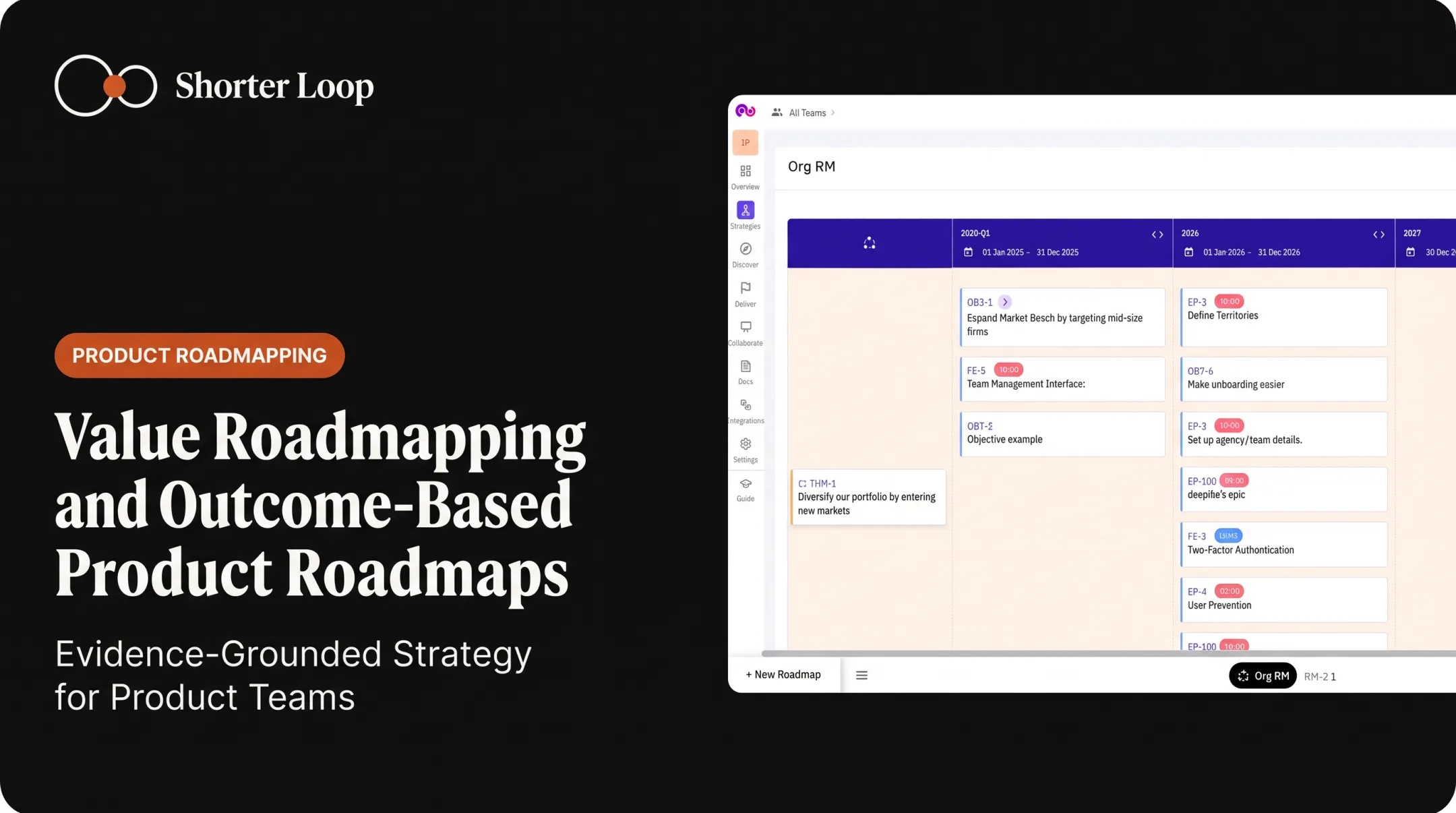
An outcome-based product roadmap organizes work around the customer and business results a team wants to influence, not around a fixed list of features. Candidate initiatives sit underneath each outcome as flexible ways to pursue it, not commitments locked in before anyone tests whether they'll work.
The distinction is easy to blur, so it helps to be precise. Product Talk draws a clean line between three layers:
- Output: what the team produces, such as a feature, integration, or project.
- Outcome: the change in customer behavior or business performance that output is supposed to cause.
- Impact: the broader value created for customers or the business over time.
Take a common example. "Build an onboarding checklist" is an output. Reframed as an outcome, it becomes "help new users reach their first meaningful success with less friction." The checklist is now one possible way to get there, not the definition of success.
The distinction is most useful in multi-team B2B SaaS environments, where strategy, customer evidence, delivery work, and results tend to be scattered across separate tools and handoffs. When outputs disconnect from the change they were meant to cause, teams lose the ability to tell whether they're actually solving the problem.

Why Feature Roadmaps Often Lose Strategic Context
Feature lists invite predictable problems:
- Stakeholders compete for slots on the list rather than debating which problem matters most.
- Teams commit to a solution before anyone tests whether it addresses the real cause.
- "Shipped" becomes the finish line, and nobody asks "did this work?"
A simple comparison shows the difference:
| Roadmap Type | Primary Focus | Flexibility | Success Criteria |
|---|---|---|---|
| Feature-based | Named capabilities and dates | Low; the list becomes an implicit promise | Feature shipped on schedule |
| Project-based | Completing a bounded initiative | Moderate; scope can flex, but the project closes regardless of impact | Project closed |
| Outcome-based | Customer or business result | High; solutions stay open until evidence narrows them | Metric moved in the intended direction |
Outcome-based planning doesn't eliminate delivery planning. It changes the level at which long-range commitments get made. Teams still commit to solving a problem by a certain time; they just don't lock in the exact feature until evidence points to one.
How to Build an Outcome-Based Product Roadmap
Building an outcome-based roadmap is a sequence, not a single decision.
- Start with an evidence-backed strategic objective. Identify the business direction, customer problem, or product health issue the roadmap needs to address, and name the evidence behind it. "Support flagged this three times" counts. A hunch doesn't.
- Define the outcome in customer and business language. Skip vague goals like "improve engagement" unless you can say whose engagement, what behavior should change, and why it matters. Roman Pichler recommends writing the goal as the positive impact sought, not the feature that might create it.
- Separate the outcome from its measurement. Pick a leading indicator that shows early progress and a lagging indicator that confirms whether the bigger result happened.
- Run an outcome quality check. Confirm the outcome is specific, measurable, feasible, tied to strategy, and bounded enough to guide real work without turning into an unstated company goal.
- Name assumptions and confidence levels before picking initiatives. If the team lacks evidence about the problem, the customer segment, or the likely solution, that's a signal to run discovery first, not to jump straight to building.
- Map candidate initiatives beneath the outcome as hypotheses. Leave room for experiments, design changes, process fixes, or several solution paths. Don't let one feature get treated as inevitable before it's tested.
Turn a Feature Request into an Outcome
Many feature requests are outcome requests wearing a costume. A simple "why" exercise gets underneath them. Ask why the requested feature matters, identify the customer or business change hiding beneath it, and phrase that change as the outcome.
Take a B2B SaaS example. "Add usage alerts" becomes "help administrators identify adoption risks early enough to support successful account use." Usage alerts might still be part of the answer. Other options under the same outcome include:
- Health-score dashboard
- Automated check-in email
- Customer success workflow trigger
This reframing doesn't have to slow engineering down. It gives design and engineering more room to find the best implementation instead of building the first idea that got requested loudest.

Connect Outcomes to Evidence, Strategy, and Delivery
A roadmap earns trust when someone can trace a straight line from intent to result:
- Strategic objective
- Customer evidence
- Problem or opportunity
- Desired outcome
- Metric
- Candidate initiative
- Decision
- Delivery result
Break that chain anywhere, and the roadmap is just guesses with due dates.
What evidence belongs in this chain?
- Customer interviews and discovery notes
- Support ticket themes
- Sales and account team feedback
- Product analytics
- Research findings and market signals
- Relevant technical evidence, such as performance limits or security constraints
For every major outcome, document an evidence-readiness checkpoint:
- Evidence source
- Customer segment affected
- Key assumptions
- Confidence level
- Questions still unresolved
That record is practical, not ceremonial. A new teammate—or a board member reviewing the plan months later—should still see why the bet was made.
Discovery and delivery work best as two connected motions, not separate phases:
- Discovery: research and lightweight experiments that reduce uncertainty first
- Delivery: turns well-supported opportunities into measurable interventions
The roadmap should preserve that reasoning—not only the approved initiative—so anyone can check later whether the original assumptions held up.
That connective tissue is easy to lose when evidence is scattered across CRM notes, support tickets, research repos, and analytics tools. The link between a customer signal and the roadmap decision it justified disappears in the handoffs.
Shorter Loop, a Product Integrity System, keeps that chain in one place. Feedback from Intercom or Zendesk and usage data from Amplitude or Mixpanel are linked to the claims they support, each claim carries a state (backed, evidence disagrees, untested, or untested with nothing found), and objectives, opportunities, and solutions link down to the epics and features that sync two-way with Jira, Azure DevOps, GitHub, GitLab, or Asana. Delivery status stays in the delivery tool: Shorter Loop doesn't replace Jira, so the integration needs to be connected for the roadmap to show current progress.

Communicate Commitments Without Creating False Certainty
Once outcomes are tied to evidence, the next failure mode is over-promising. Not everything on a roadmap carries the same certainty, and treating it as if it does creates problems later.
Separate the two categories honestly:
- Fixed constraints: contractual obligations, regulatory deadlines, launch dependencies, known technical cutoffs
- Flexible choices: specific solution, exact scope, and secondary features
Near-term work can be shared with real confidence once it is scoped. Later items should read as outcome areas, discovery work, or options—not promises.
A Now / Next / Later structure (or similar horizons) makes that distinction visible:
- Now: in motion, high confidence
- Next: being narrowed through discovery
- Later: strategic problem stays visible without a locked date or feature
The desired outcome stays stable across all three horizons, even when the plan for reaching it changes.
Measure Outcomes and Keep the Roadmap Adaptive
An outcome without a measurement plan is just a hope. Each outcome needs:
- Baseline: where the metric stands today
- Target or direction: what change counts as success
- Measurement window: how long before you check
- Data source: where the number comes from
- Owner: who's accountable for reading the result
- Decision: what the team will do based on what it finds
Leading and lagging indicators matter here. A leading indicator, such as completion of a critical onboarding step, shows early movement. A lagging indicator, such as retention, expansion revenue, or reduced support burden, confirms whether the bigger result actually materialized.
Early signals and long-term results are related, but they aren't interchangeable. A leading indicator can rise while the lagging one stays flat, which is why the measurement plan needs both.
Effects don't show up on launch day. Adoption, behavior change, and revenue impact often emerge weeks or months after release, so the roadmap should reserve time for observation, not just shipping.
Review cadence should follow decision needs, not a calendar habit. Each review asks one question: does the evidence support continuing, changing, pausing, or removing this initiative?
What to Include in an Outcome Review
A useful outcome review covers:
- Current metric status against the baseline
- Customer feedback collected since launch
- Experiment results, including anything that didn't hold up
- Unintended effects the team didn't plan for
- New evidence that's surfaced
- Confidence in the original assumption, updated
In Shorter Loop there is no separate "outcome review" screen: the review happens on the item itself. Its Evidence tab shows the claims behind it, the sources grouped as feedback, documents, analytics and related work, and the overall verdict, so the record of what changed sits with the work rather than in a deck.
FlowDesk, a fictional demo dataset Shorter Loop uses to show the product, includes a review like this for a guided-integration-setup bet. The bet rested on a claim that onboarding friction drives churn, and no evidence was linked to that claim, so it was still untested. In the demo data, integration completion rises 18% after the release, while 30-day retention barely moves. Once that result is linked to the claim, the claim's state changes to evidence disagrees: completion went up, but the retention the claim predicted didn't.

That's a finding, not a failure. It's only visible if the original evidence stays attached to the delivered work and the launch isn't treated as the finish line.
A successful review can lead to scaling the approach, iterating on it, trying a different solution, redefining the outcome, or stopping the work outright. Whatever gets decided, record the decision and the reasoning behind it. Without that record, the same debate tends to come back next quarter, minus the evidence that settled it the first time.
Common Failure Modes in Outcome-Based Roadmaps, and How to Avoid Them
Outcome roadmaps can drift back into old habits. Watch for these patterns:
- Feature laundering, as we call it here. A feature gets renamed with outcome language but still names one solution. Ask: does this allow multiple solutions, or only one deliverable? One answer means it's a feature in disguise.
- Executive-preference outcomes. A senior stakeholder picks an outcome they like, not one customer and product evidence support. Document the assumption and test it before committing engineering time.
- Too many outcomes at once. Every added outcome dilutes focus, ownership, and measurement. A handful of important priorities beats a long list of things labeled "important."
- False precision and vanity metrics. A metric should show whether you created meaningful value, not just something easy to graph. Ticket-closure and login counts rarely answer that on their own.
- Treating the roadmap as permanent. New evidence should be able to kill or reshuffle planned work. Suppose a mid-quarter review shows that most churning accounts had finished onboarding. The epics built on "onboarding causes churn" now rest on a claim the evidence disagrees with, and the team can stop them before coding starts rather than after they ship.
Conclusion: Audit One Roadmap Item
An outcome-based roadmap is a shared account of the change the team is trying to create, plus a plan for learning whether that change actually happened. It stays useful only while the reasoning behind each item is still attached to it.
Before your next planning cycle, audit one roadmap item already on your board. Ask what customer or business outcome it's supposed to support, what evidence justifies it, and how you'll know, concretely, whether it worked. If you can't answer all three, move the item back to discovery and write down the claim it rests on before it takes more engineering time. If you want that claim, its state, and its evidence kept next to the item, you can start a 14-day trial of Shorter Loop (no credit card) or book a walkthrough.
Frequently Asked Questions
What do I do when leadership asks for dates on an outcome-based roadmap?
Give them dates for the things that have them. Commitments already in delivery have real timelines, and withholding those reads as evasion. For work still in discovery, commit to a decision date instead of a ship date: when the team will know enough to say yes or no. That gives leadership something to plan around and keeps you from promising a scope nobody has validated yet.
What is an outcome-based approach?
It means organizing decisions and work around a measurable customer or business result rather than treating a feature or project as the goal itself. The output still matters, but only as a means to the intended change.
What are some examples of outcome-based metrics?
Common categories include activation, retention, task completion, expansion revenue, support burden, and customer value. The right metric depends on your specific product strategy and the customer problem you're solving.
Can you give me a good example of a roadmap?
A strategic objective like "reduce early churn" might lead to the outcome "help new admins complete their first successful setup," measured by 30-day retention. Several candidate initiatives sit underneath it, which is what makes it outcome-based rather than a feature list.
How is an outcome-based roadmap different from a feature-based roadmap?
A feature-based roadmap leads with planned outputs and dates. An outcome-based roadmap leads with the intended impact and keeps the solution open until evidence supports a specific choice.
How do you measure whether a roadmap outcome has been achieved?
Set a baseline, define what change counts as success, pick a measurement window, and gather relevant customer and business evidence. Then hold a review that decides whether to continue, adjust, or stop the initiative.