
Both artifacts describe future product work, but they answer different questions. A roadmap answers "why are we heading this direction?" A backlog answers "what do we build next?"
For a growing product team, mixing up the two isn't just a semantics problem. It produces bloated backlogs nobody trusts, roadmap commitments that break the moment plans change, and decisions nobody can trace back to what customers need.
This article defines each artifact, compares them side by side, and shows how to keep them connected without collapsing one into the other.
Key Takeaways
- Product roadmaps set strategic direction, desired outcomes, and longer-horizon priorities
- Product backlogs hold living, prioritized work: stories, bugs, technical debt, and discovery tasks
- Roadmaps align stakeholders; backlogs drive day-to-day execution
- Keep them distinct but traceable so teams can see why work exists and what happened after it shipped
Product Roadmap vs Product Backlog: Quick Comparison
| Dimension | Product Roadmap | Product Backlog |
|---|---|---|
| Purpose | Communicates direction and rationale | Organizes work to execute that direction |
| Detail level | Themes, initiatives, outcomes | User stories, bugs, tasks, acceptance criteria |
| Horizon | Quarters to years, flexible | Days to weeks, continuously refined |
| Audience | Executives, sales, cross-functional stakeholders | Product, design, engineering, delivery teams |
Focus and Purpose
A roadmap explains the product's direction: the strategic priorities, the customer or business outcomes being pursued, and the reasoning behind major bets. A backlog does something different. It organizes the specific requirements, experiments, fixes, and technical tasks needed to make progress toward those priorities.
Level of Detail
Roadmaps stay high-level: themes, goals, capabilities. They should never look like a spreadsheet of user stories. Backlogs go the opposite direction. Items need enough detail for prioritization, estimation, and eventual implementation.
Planning Horizon and Update Cadence
Roadmaps cover a longer, more flexible horizon and get revisited when strategy, market conditions, or customer evidence change. Roman Pichler recommends reviewing a roadmap at least once every three months, though meaningful new evidence should trigger a review sooner. Backlogs, by contrast, get refined continuously as teams learn more about scope and feasibility.
Audience and Decision-Making Role
Roadmaps serve executives, product leadership, sales, and customer-facing teams who need strategic context, not implementation detail. Backlogs serve the people deciding what to build, test, or fix next: product, design, and engineering.
How They Connect
The flow runs in both directions:
- Customer evidence and outcomes inform roadmap goals
- Roadmap goals shape initiatives and backlog priorities
- Delivery results and new evidence feed the next roadmap review

In Shorter Loop, that loop runs through linked records rather than two separate documents. Objectives and opportunities sit above the epics and features in the backlog, a roadmap board is a view of those same records, and epics sync two-way with Jira, Azure DevOps, GitHub, GitLab, or Asana, where delivery status stays. Shorter Loop includes a roadmap, built from a Now / Next / Later or Timeline template; it is one view of work that stays traced to its evidence. If all you need is a presentation-ready roadmap slide, a dedicated roadmapping tool will be the better fit.
What Is a Product Roadmap?
A product roadmap is a strategic communication artifact. It shows where a product is heading, why that direction matters, and which outcomes deserve attention over time — not a fixed list of features with delivery dates attached.
Core contents typically include:
- Product vision or strategic context
- Target customer problems
- Desired outcomes and high-level initiatives
- Dependencies, assumptions, and confidence levels
Scrum.org's Kurt Bittner makes a sharp distinction here: a feature-based roadmap shows what is being built, but not why. Outcome-focused roadmaps express the customer benefit instead, leaving the "how" open for discovery.
A roadmap theme is not a wish list item. For a theme like "improve enterprise onboarding," spell out:
- The outcome you want (faster time-to-value, fewer support tickets)
- The customer problem it addresses
- Room to discover the solution through research and design
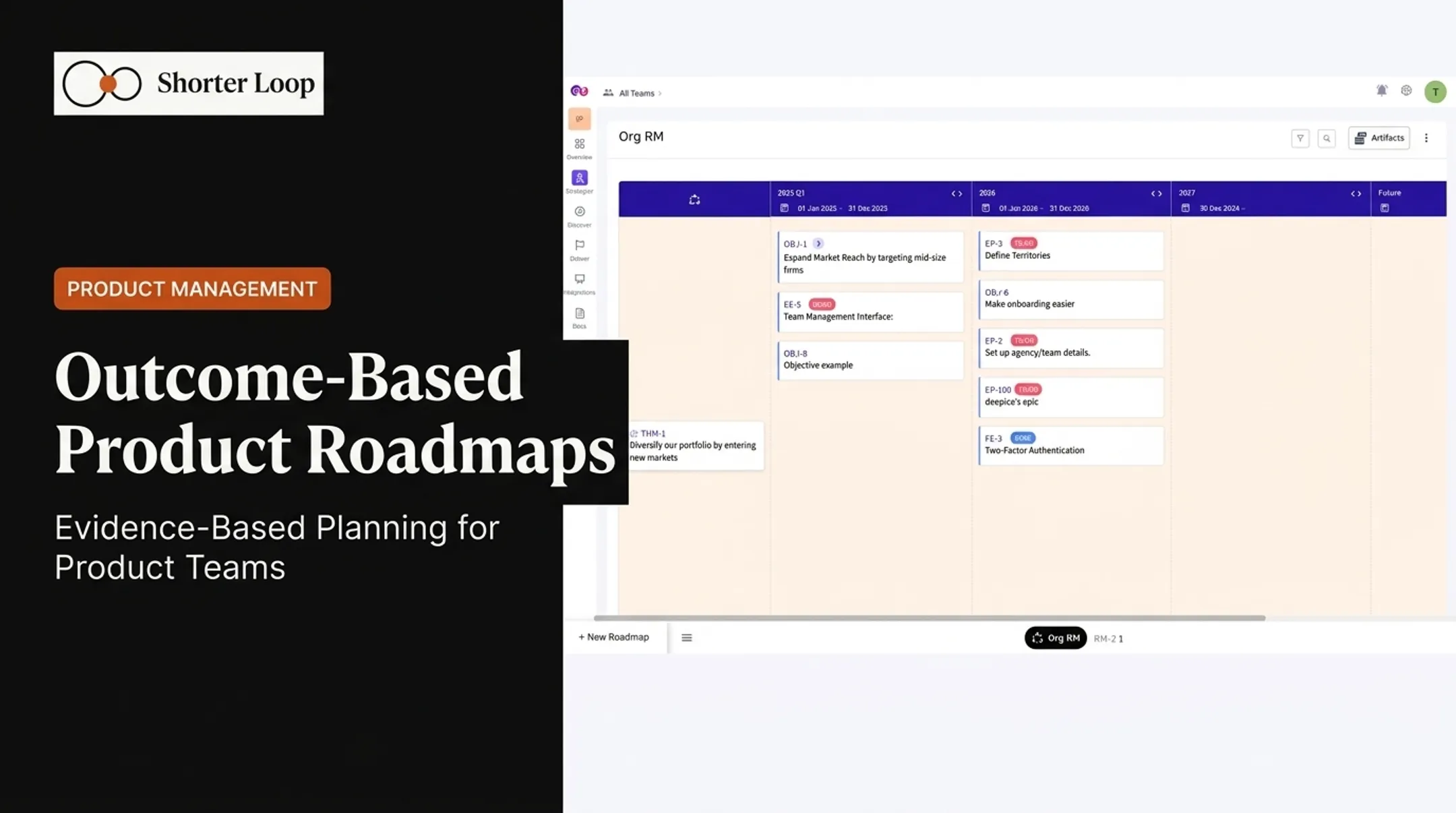
Here's how that looks in Shorter Loop's demo workspace, which uses fictional demo data to show the product: a Q3 roadmap outcome titled "Fix Enterprise Retention" groups work under objectives such as "Increase Net Retention," "Expansion Revenue," and "Advanced Analytics," with items such as an Email Scheduler Engine and an AI Insights feature mapped underneath. The outcome comes first. The initiatives follow.
Use Cases of a Product Roadmap
Product leaders lean on roadmaps to:
- Align multiple teams around shared outcomes
- Coordinate dependencies across product areas
- Create a common reference point during planning discussions
- Communicate direction to sales, support, and leadership without exposing task-level detail
An evidence-based roadmap differs from a feature wish list in one key way: every theme should trace back to customer feedback, research, or a claim stated openly as untested.
In FlowDesk, a separate fictional demo dataset Shorter Loop uses to show the product, 41 feedback items from support conversations, sales-call notes, and churn interviews point to the same problem. A signal that consistent can justify a roadmap theme, not just a backlog request.
Update the roadmap when evidence changes the bet—not when the calendar flips or a task ships.
What Is a Product Backlog?
The 2020 Scrum Guide defines the Product Backlog as an "emergent, ordered list of what is needed to improve the product." It's the single source of work for the team, not a graveyard for every idea anyone has ever suggested.
A useful backlog item includes:
- Clear problem or user context
- Expected value and relevant evidence
- Acceptance criteria where appropriate
- Known dependencies and uncertainty
The product manager or product owner typically orders the backlog, while design, engineering, and customer-facing teams contribute context and challenge assumptions along the way.
Refinement is the ongoing work that keeps a backlog useful: removing obsolete requests, combining duplicates, breaking down near-term items, and clarifying dependencies so the top of the backlog stays ready for prioritization.
FlowDesk shows this at the backlog level too. Its quarterly backlog starts with six epics and roughly 200 smaller items, all marked "unscored." After a scoring pass on value and effort, a visible cutline records what the team intends to fund with the capacity available for the quarter, and work below the line stays visible with its reasoning. The top epic splits into two features and three user stories, each still linked back to its original objective and supporting evidence.

That link matters. Without it, a backlog becomes disconnected from why the work exists in the first place.
Use Cases of a Product Backlog
Backlogs support the tactical, day-to-day decisions a roadmap can't handle:
- Sprint or iteration planning and capacity conversations
- Sequencing and estimation for near-term work
- Delivery tracking and daily trade-offs
Not every idea belongs near the top. Distinguish between:
- An untested request someone submitted last week
- A discovery task meant to test an assumption
- A ready-to-build item with clear acceptance criteria
- Work that's been deliberately deprioritized or rejected
Backlog bloat tends to grow with the number of people who can file requests. The fix is regular pruning, plus links from important items back to the roadmap outcome or evidence behind them. Otherwise, every customer request turns into a permanent commitment nobody remembers agreeing to.
Product Roadmap vs Product Backlog: What Is Better?
Neither wins in isolation. A roadmap is better for strategic alignment. A backlog is better for managing execution detail. Asking which one is "better" is like asking whether a map or a compass matters more: you need both, for different reasons.
Situational guidance:
- Choose a roadmap when the audience needs to understand direction, outcomes, or strategic trade-offs
- Choose a backlog when the team needs to decide what to refine, build, or sequence next
- Use both when multiple teams need to trace customer evidence and strategy through to delivery, without turning the roadmap into a rigid feature promise
The healthy relationship starts with a meaningful goal, derives initiatives and backlog items from it, and lets delivery learning feed back into future roadmap decisions.
Common failure modes:
- A roadmap filled with user stories becomes a disguised backlog
- A backlog with no strategic links becomes a request graveyard
- A roadmap and backlog that tell different stories erode trust between product, sales, and engineering
Two related patterns are worth naming. In an annual roadmap trap, a plan set in January gets defended all year regardless of new evidence. In a backlog black hole, requests go in and nothing comes back out, so customers and account teams stop submitting them.
Worked Example: Connecting Strategy to Execution
Suppose a B2B SaaS team is pursuing one outcome: reducing friction in enterprise onboarding. Evidence from support tickets, sales call notes, and churn interviews shows a pattern: churning accounts had already completed onboarding, which suggests the problem sits elsewhere in the customer journey.
That evidence reshapes the roadmap theme. Discovery produces candidate initiatives. The backlog then contains the specific research, design, and engineering tasks needed to test each one — including a two-week test sprint before anything gets committed to a full build cycle.

The practical takeaway: any important backlog item should trace back to a roadmap goal, and forward to the evidence or outcome produced after it ships. If a team can't answer "why does this exist?" and "what happened after we built it?", the connection between strategy and execution has already broken.
Shorter Loop, a Product Integrity System, keeps that thread as linked records. Feedback and research link to the claims a roadmap goal rests on, each claim carries a state (backed, evidence disagrees, untested, or untested with nothing found), and backlog epics sync to your delivery tool while staying linked to the goal above them.
You Inherited a Jira Backlog and a Slide Roadmap
A common week one: 400 open Jira issues and a roadmap deck someone else built, with no obvious relationship between them.
What to do first, in order:
- Do not reorganize the backlog. It is a symptom. Leave it.
- Take the roadmap deck and ask of each item: which customer problem is this for? Write one sentence each. Items you cannot answer for are the real finding.
- For the three largest items, find the evidence. Not the category of evidence, the actual tickets, calls or data. An hour is usually enough to learn which bets are supported and which are inherited belief.
- Then connect the two. Each roadmap item should point at the epics delivering it, and each epic back at the item. Until that link exists, the backlog and the roadmap are two unrelated documents that happen to share vocabulary.
Only after that is reordering the backlog worth anyone's time, because now the order means something.
Conclusion
A quick check before your next planning meeting: pick three items from the top of your backlog. For each, can someone name the roadmap outcome it supports and the evidence behind that outcome in under a minute? If not, either the item doesn't belong near the top or the link between roadmap and backlog has broken.
Fix the link before the ranking. If you want to see how Shorter Loop keeps those links as records, book a walkthrough or start a 14-day trial (no credit card).
Frequently Asked Questions
What is the difference between a product roadmap and a product backlog?
A roadmap communicates strategic direction and outcomes at a high level for stakeholders. A backlog organizes detailed work items for the delivery team. One explains "why," the other organizes "how."
What are the five types of backlogs?
Terminology varies by framework, but teams commonly reference product, sprint, release, bug, and technical-debt backlogs. These aren't an official Scrum standard. Scrum formally defines only the Product Backlog and Sprint Backlog.
Is backlog the same as WIP?
No. A backlog holds work that hasn't started yet, while work in progress (WIP) means items the team is actively working on. An item can sit in the backlog for months before it ever becomes WIP.
What is the 20-30-50 rule in Agile methodology?
It's an informal practitioner heuristic, not a Scrum Guide requirement, and descriptions of it vary. If someone cites it, ask which version they mean and what problem it's meant to solve for your team before adopting it.
Should the product roadmap come before the backlog?
Generally, yes. Strategic goals should guide backlog prioritization. But it's not strictly one-directional: discovery, delivery learning, and new customer evidence can and should prompt roadmap updates too.
How do you keep a product roadmap and backlog aligned?
Link backlog items to the roadmap outcome they support, review the roadmap on a regular cadence (at least quarterly), and refine the backlog continuously. Update both whenever new evidence changes the underlying assumptions.