
A product strategy is the set of choices that defines who your product serves, what problem it solves, and how it creates value others don't. As an organization grows, the customer evidence, the reasoning, and the delivery work tend to end up in different tools, and the original bet gets harder to see.
This guide is for the person who owns product strategy at a growing company. It starts with one worked strategy and the roadmap items that trace to it, then covers the elements, a five-step process for keeping strategy tied to the work your team ships, and, last, the classic strategy types.
Key Takeaways
- A product strategy connects your customer's needs and your market choices to your product direction and business goals.
- The core elements clarify your target customer, the problem you're solving, your value proposition, your business goals, and the bets that follow from them.
- Useful strategies make deliberate trade-offs: which customers to serve, what advantage to build, and what to leave undone on purpose.
- Your product strategy should guide your roadmap and execution, and it needs updating as you gather new evidence.
One Strategy, Worked Through
Before the definitions, here is what a strategy looks like filled in. The example uses FlowDesk, Shorter Loop's fictional demo dataset.
- Segment: operations managers at mid-sized logistics operators, 50 to 500 staff.
- Problem: rosters change mid-week and the people reading them do not reliably see the change.
- The bet: make the schedule shareable and changes visible, rather than building a full workforce-management suite.
- Explicit non-goal: payroll. Customers ask for it; it is a different product and saying so protects the quarter.
Three roadmap items trace to that: a shareable schedule link, read receipts on changes, and an audit trail. Each one carries the claim it rests on, and each claim carries its state. The point of writing it this way is that someone can disagree with the bet, which is impossible when a strategy is a list of adjectives.
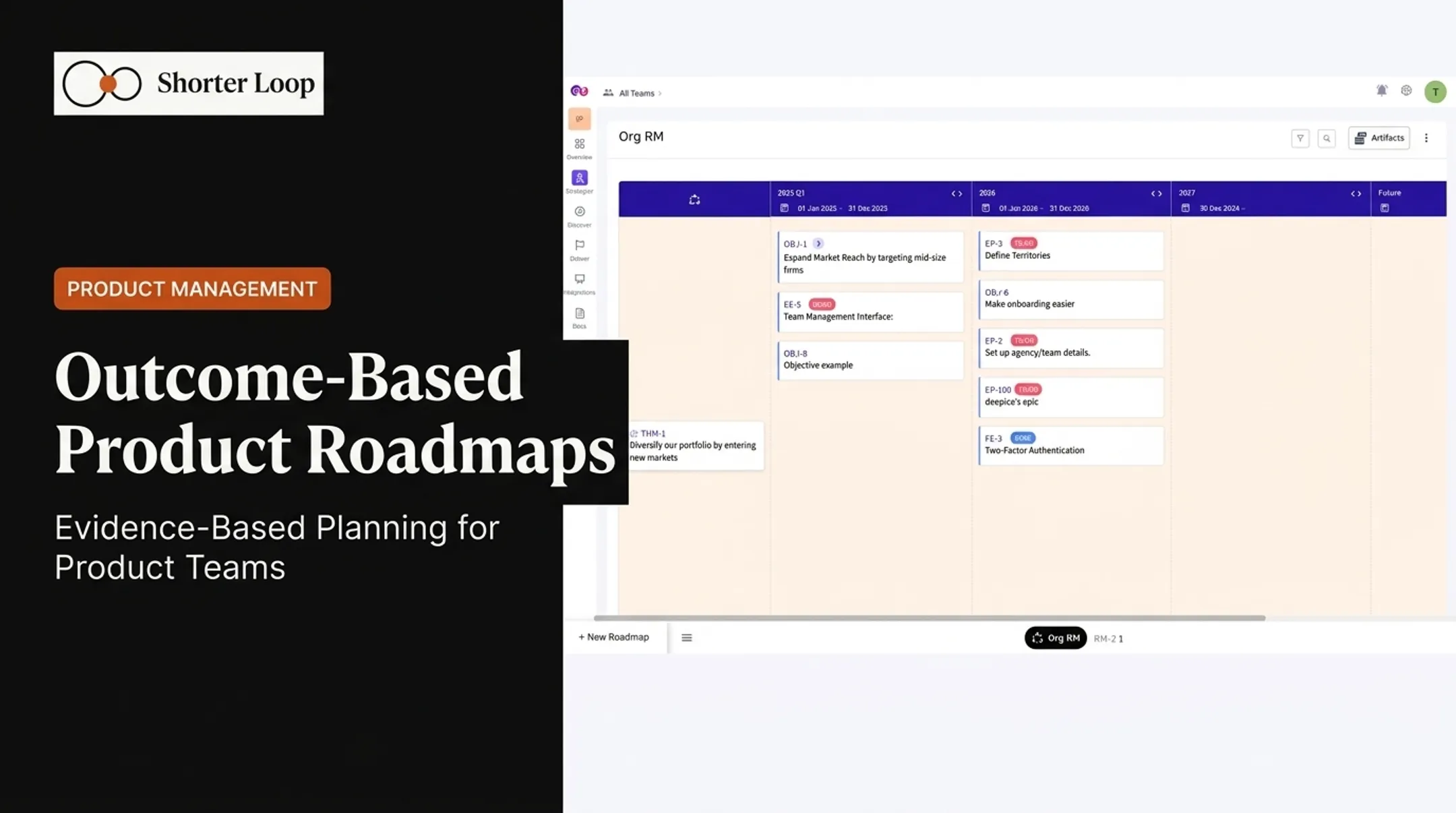
Where this lives in the product. In Strategy > Product Strategy, switch the table to Tree and you see the objective at the top, the opportunities beneath it, and the solutions under those. Each item's claims line sits under its title, and its Evidence tab lists the sources behind them. To lay out your own strategy that way, start a 14-day trial; there's no credit card to enter.
What Is Product Strategy and Why Does It Matter?
Product strategy is your high-level, evidence-informed approach for deciding what a product should achieve, for whom, and how it will create value for both customers and the business. It's the connective tissue between your vision and your execution plan.
Many teams confuse strategy with other artifacts. Here's how they differ:
| Artifact | Question Answered | Role in Your Organization |
|---|---|---|
| Vision | What future are we trying to create? | An inspiring, long-term direction that guides the company for years. |
| Strategy | How and for whom will we pursue that future? | A set of deliberate choices and rationale, including what you will not do. |
| Roadmap | What is the current plan? | A communication tool showing the sequence of work; its existence doesn't prove a strategy. |
| Backlog | What work is proposed or selected? | A list of tasks; a long backlog might signal a failure to solve the most important problems. |
For a growing B2B SaaS team, a written strategy gives everyone the same criteria for decisions. When two requests compete for one slot, the strategy says which segment and which problem come first. Without it, the loudest customer request or a competitor's latest release tends to set priorities by default.
A useful strategy makes those choices explicit:
- Which customer segments you target
- Which problems matter most to them
- How you plan to differentiate
- What you will deliberately not pursue
That last call, what you refuse to chase, is often the hardest part, because every excluded request has someone arguing for it.
The Essential Elements of a Product Strategy
A product strategy holds together when five elements tell one consistent story: who you serve, the problem you solve, why you win, what business outcomes matter, and which bets you will make.
Those elements are:
- Target market and customer
- Customer problem and desired outcome
- Product value proposition and differentiation
- Business goals and success measures
- The choices you made and the initiatives that follow
To keep the examples concrete, this article uses FlowDesk, a fictional demo dataset Shorter Loop uses to show the product. FlowDesk is a fictional company used as demo data; in the demo, it's a shift-scheduling tool for logistics operators.
Target Market and Customer
Define who the product is for: customer segments, user roles, and use cases. A strategy aimed at "everyone" weakens the value proposition and makes prioritization guesswork. You can't be the best solution for everybody.
To ground this choice in reality, look for evidence in:
- Customer interviews and behavioral data
- Support tickets and sales call patterns
- Market research on segment size and willingness to pay
In the FlowDesk demo data, the original target is operations managers. The churn interviews in the dataset show that dispatchers are the primary daily users. That evidence leads to two personas: the manager who buys and the dispatcher who uses the product every day. Each persona needs its own problem statement and its own measure of success.
Customer Problem and Desired Outcome
State the specific job, pain point, or unmet need your product addresses. Separate the underlying problem from the feature request. A customer might ask for a "CSV export," when the real need is "I need to share performance data with my boss who doesn't have a login."
To test if a problem is strategically important, ask:
- How frequent and severe is it? Minor annoyance or major roadblock?
- What are the current workarounds? Clunky spreadsheets, a competitor's tool, or something else?
- Is the segment willing to change? How much effort does switching take?
In the demo data, the first explanation offered for high churn is a difficult onboarding process. It's recorded as a claim with no evidence attached, so its state is untested. The usage data in the dataset shows a different pattern: accounts with only one user churn far more often. That's a correlation, not an established cause, so the demo treats it as a hypothesis worth testing. The desired outcome shifts from "easier onboarding" to "getting more of the depot team using the tool."
Product Value Proposition and Differentiation
Your value proposition explains how your product creates value and why a customer should choose it over alternatives. Those alternatives aren't just direct competitors; they include manual processes, internal tools, or doing nothing at all.
Keep it to a short statement of the capability, experience, or service behind your position, not a feature list. In the demo, once the dispatcher persona is named, the promise is rewritten: not only scheduling efficiency for managers, but access for the whole depot team. Whether competitors make the same promise is something a real team would need to check, not assume.
Business Goals and Success Measures
Your product goals should connect the value you create for customers to your company's objectives, whether that's growth, retention, or market expansion. A common mistake is to confuse outputs with outcomes.
- Output: "Ship the new reporting dashboard." (Work completed.)
- Outcome: "Cut the time managers spend on weekly reports by 50%." (Change you want.)
In the FlowDesk demo, the objective is to reduce first-90-day churn from 22% to 12%. The leading indicator is the share of new accounts that add a second user in week one, chosen because of the single-user pattern above. An outcome goal like this keeps the conversation on the problem rather than on the feature list.
In Shorter Loop, objectives are linked to the opportunities, solutions, and epics created for them, and delivery status comes back from Jira or another delivery tool through two-way sync. After a release, you can see which objective the work was meant to move and compare that with the metric. The link shows what was intended. It doesn't, by itself, show that the release caused any change in the metric.

Choices and Initiatives
Translate the strategy into a few high-level initiatives or "bets." These are focused areas of work, not feature lists, tied to strategic goals. Each bet should map to a customer problem and an expected outcome.
When prioritizing these bets, you can use frameworks like RICE (Reach, Impact, Confidence, Effort) to guide your decisions. Document the options you reject or defer, too. Visible "non-goals" keep the team focused and limit scope creep.
How to Build a Product Strategy and Tie It to the Roadmap
Develop product strategy through an ongoing process of evidence review and revision.
- Start with an Evidence Review: Read customer interviews, support themes, usage data, sales input, and competitive analysis together. The FlowDesk demo dataset, for example, contains 1,100 support conversations, 60 sales-call notes, and 14 churn interviews. Read side by side, they point to the single-user account pattern described above.
- Write the Strategy as Testable Statements: Put your vision, target market, customer problem, and value proposition in writing as claims someone could check. A one-page template with a line for each helps you start from the problem, not a solution.
- Choose Which Segments and Problems to Focus On: Based on your evidence, pick the segments, use cases, and differentiators you will work on, and name what you are leaving out. In the demo, the choice is multi-user use for logistics teams, with access for the whole depot as the differentiator.
- Convert Strategy into Goals and Initiatives: Translate your choices into a small set of outcome-oriented goals (like reducing churn), then map those goals to high-level roadmap initiatives. The roadmap connects back to strategy; it is not the strategy itself.
- Create Feedback Loops: Track outcomes after you ship and check whether each bet produced the expected result. In the demo data, once the guided setup work ships, integration setup completion rises 18% while retention barely moves. That result contradicts the onboarding claim (that setup difficulty was behind churn), and it becomes input for the next decision.

Product Strategy Document Structure
Keep the strategy document concise, current and easy to revisit during planning. It should include:
- Executive Summary: A one-paragraph overview.
- Vision: The long-term future you're building.
- Target Customer and Market: Who you are serving.
- Problem and Desired Outcome: The need you are addressing.
- Value Proposition & Differentiation: Why you will win.
- Business Goals and Measures: The outcomes you're aiming for.
- Initiatives: The high-level bets you're making.
- Non-Goals: What you are explicitly not doing.
- Claims and Evidence: The key claims your strategy rests on, and the evidence for and against each one.
Collaboration and Product Integrity
A product strategy can't be written in a silo. It needs input from engineering, design, sales, marketing, and leadership. It also shouldn't be a popularity contest. The job is to weigh different evidence and constraints and arrive at a consistent set of choices.
As organizations grow, the reasoning behind a decision often gets lost in handoffs between teams and tools. Six months after a big launch, can anyone say why the bet was made, or whether the original evidence still holds?
Shorter Loop is a Product Integrity System: it's built so that any item a team is building can be traced back through the claims it rests on to evidence that still holds. Each claim carries one of three states (Backed, Evidence disagrees, or Untested) linked to the evidence behind it. Shorter Loop doesn't replace your delivery tool; it syncs both ways with Jira, Azure DevOps and GitHub, which keep the delivery status.
Product Strategy Examples and Types
Product strategies aren't one-size-fits-all. The right approach depends on your market, customers, and competition. Two useful lenses are competitive posture (how you win) and growth direction (where you grow).
Competitive Posture Strategies
Loosely adapted from Michael Porter's three generic strategies (cost leadership, differentiation, and focus), these postures describe how a product creates a defensible advantage. Quality and innovation are two common forms of differentiation.
- Cost or Efficiency: Win on lower total cost through pricing, operational efficiency, or a simpler product, often with a narrower feature set. Example: one flat price per account or product instead of complex per-seat tiers.
- Focus or Niche: Serve one segment or use case better than anyone else, such as email marketing built only for independent authors. Check that the niche is large enough to sustain the business.
- Quality, Experience, or Service: Lead with reliability, usability, support, or a consistent experience customers will pay for. Workday's single software version and unified architecture is a classic enterprise example (McKinsey, 2021).
- Innovation or Technology: Differentiate with proprietary tech, unique data, or a new workflow that solves a real problem. For example, Sage, the AI inside Shorter Loop, answers from the product's own documents, feedback and strategy, and says so when it cannot verify a point.
Product-Market Growth Strategies
First outlined by Igor Ansoff in a 1957 Harvard Business Review article, this framework helps you decide where to focus your growth efforts.
| Growth Direction | Product / Market | Strategic Question |
|---|---|---|
| Market Penetration | Existing / Existing | How can we increase usage of our current product in our current market? |
| Market Development | Existing / New | How can we adapt our current product for a new customer segment or geography? |
| Product Development | New / Existing | What new products can we build to better serve our existing customers? |
| Diversification | New / New | What new products can we build for entirely new markets? (The riskiest option) |
A team might pursue product development inside its existing niche while differentiating on customer experience. Posture and growth direction stack: pick how you win, then where you grow next.

A practical test for your current strategy: list the three claims it depends on most, such as "dispatchers are our daily users" in the demo. For each one, write down the evidence that supports it and the last date anyone checked. Any claim with no evidence, or none from the past two quarters, is the first thing to test before the next planning cycle. If you'd like to run that test with your own evidence, start a 14-day trial (no credit card) or book a walkthrough.
Frequently Asked Questions
What is a product strategy?
A product strategy is the set of high-level choices that connect customer needs and market opportunities to your product's direction and business goals. It defines who you serve, what problem you solve, and how you win, guiding your roadmap and execution.
What are the four major elements of a product strategy?
Many sources list four: the target market and customer, the customer problem or need, the value proposition and differentiation, and the business goals. This article adds a fifth, the choices you made and the initiatives that follow, because the first four don't yet say which bets you'll make.
What does a product strategy document look like?
It's a short, regularly updated document that records the choices you made: your vision, target customer, problem, positioning, goals, initiatives, and key claims. It also lists non-goals and links decisions back to their supporting evidence.
How do I keep the roadmap tied to the strategy as the company grows?
Make every roadmap item answer a named opportunity under an objective, and write down the claim it rests on. In Shorter Loop's Product Strategy, the Tree view shows each objective with its opportunities and solutions beneath it, and each item's claims line shows how many of its claims are backed, how many the evidence disagrees with, and how many are untested. A roadmap item with no opportunity above it is the one to question before it ships.
What are examples of product strategies?
Common examples include a niche strategy (own one vertical), a cost strategy (simpler product at a lower price), a quality strategy (win on reliability and UX), and a technology strategy (unique tech that solves the problem).
What is a product development strategy?
A product development strategy creates new or significantly improved products for your existing market. It ties customer problems and evidence to product goals, initiatives, and testing steps so you better serve the customers you already have.