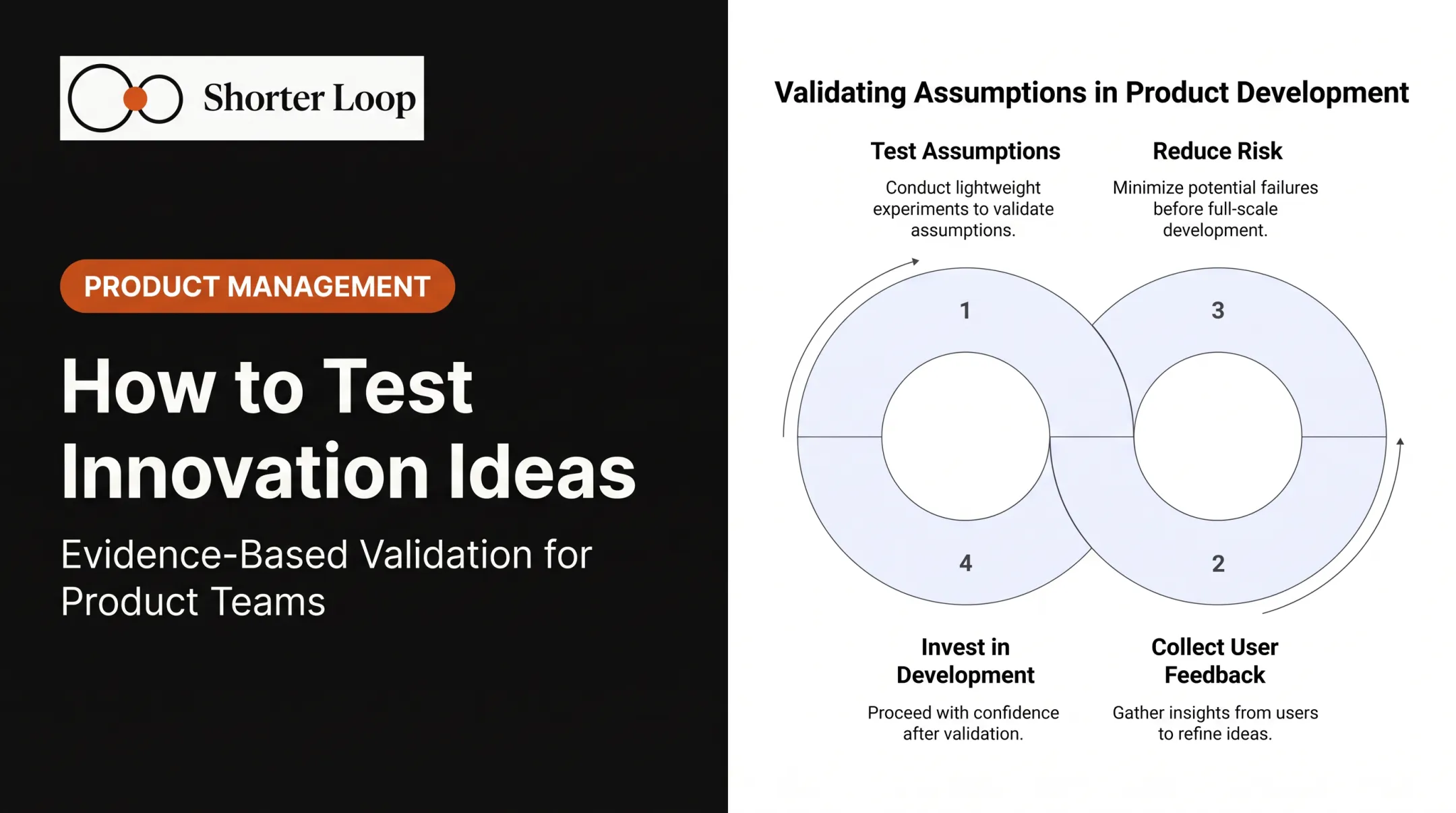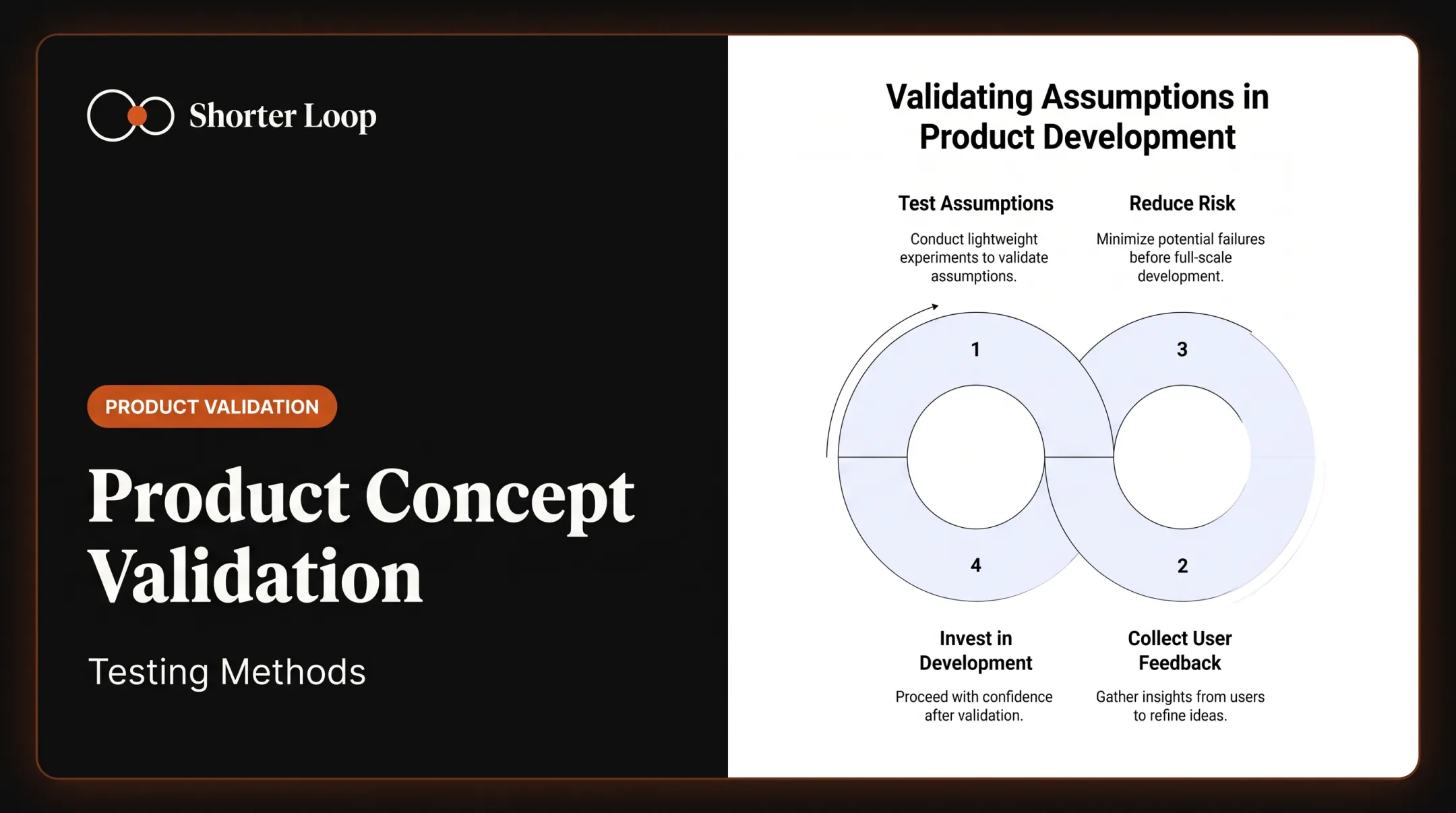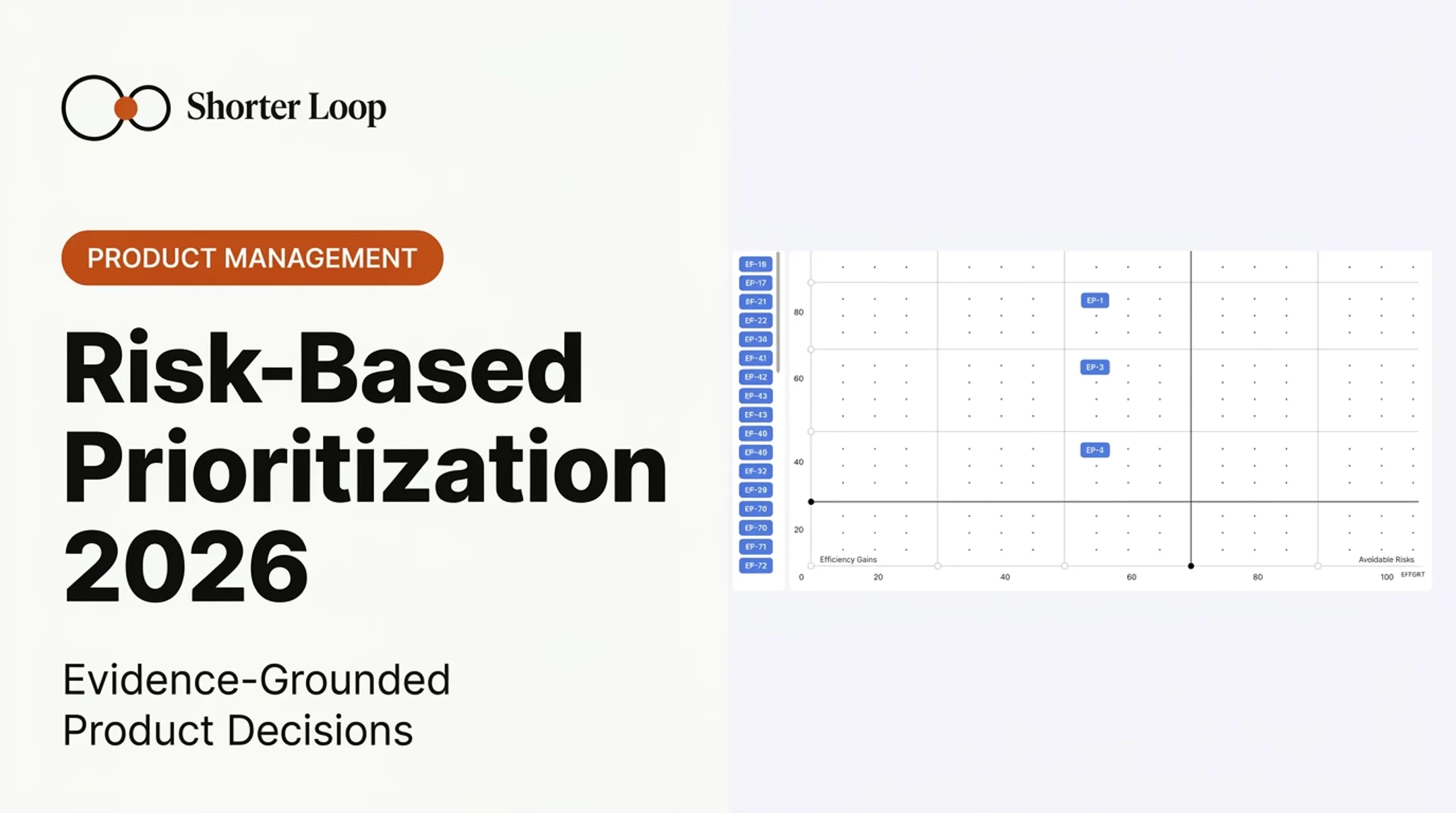

Introduction: Why assumption testing matters in product decisions
A feature often gets approved because it feels obviously true, and nobody checks. That gut feeling has a price tag.
According to CB Insights' analysis of startup failure post-mortems, "no market need" was the second most commonly cited reason founders gave for shutting down. When that failure mode shows up inside a product org, the cost lands on wasted sprints, missed quarters, and roadmaps that looked full while delivering little.
Assumption testing exists to catch this earlier, before a roadmap gets built around a belief nobody bothered to check. It won't guarantee success. But it exposes the riskiest beliefs, the ones with the least evidence, before they consume months of design, engineering, and go-to-market effort.
This article walks through a practical workflow: define your assumptions clearly, prioritize the ones that could sink the initiative, pick the smallest test that answers the question, interpret the evidence honestly, and carry that learning into the next decision.
Key Takeaways
- Assumptions differ from facts, opinions, hypotheses, and risks. Know which one you're dealing with before testing anything.
- Prioritize by impact and uncertainty; how easy an assumption is to check comes last.
- Match test fidelity to the question: interviews for problems, prototypes for usability, demand tests for willingness to act.
- Write pass/fail criteria before the test starts, never after you've seen the results.
- Keep evidence linked to the decision it produced, so nobody has to reconstruct the reasoning six months later.
What assumption testing means in product management
An assumption is a belief that has to be true for a product idea, strategy, or initiative to work. An opinion is something someone thinks—and if it's wrong, the outcome can still hold.
That split decides what you bother to test.
Vague beliefs don't produce useful tests. "Customers will like this feature" isn't testable. Rewrite it as: dispatchers at mid-size logistics companies will share a schedule link with a second team member within the first week of signup. Now there's a segment, a behavior, a context, and an expected outcome.
Once beliefs are specific enough to test, teams still blur three nearby terms:
- Assumption: what must be true for the idea to succeed
- Hypothesis: what the team expects will happen, stated as a specific prediction
- Risk: what could prevent the idea from working if the assumption turns out false
The four common product assumption categories
Most product bets rest on four kinds of assumptions, sometimes called the four big risks:
- Value (desirability): Will customers actually want this? A scheduling tool assumes dispatchers, not just their managers, care enough to use it daily.
- Viability: Does it work for the business? Assuming growth comes from paid seats, when the people who use the product every day won't pay for one, is a viability assumption.
- Feasibility: Can engineering build it with current time, skill, and technology? Assuming an import wizard can be built in a sprint is a feasibility bet.
- Usability: Can people actually figure it out? Assuming a new workflow is "intuitive" without watching anyone attempt it is a usability gamble.
Add a fifth when the stakes involve sensitive data, automation, or AI-generated recommendations: ethical and compliance assumptions. Assuming an AI recommendation won't need a disclosed limitation, or that automated decisions don't require human review, deserves its own test.

Use these categories to check coverage, then match the testing effort to the risk of each assumption. A low-stakes usability question might need one hallway test. A viability assumption tied to pricing might need weeks of data.
Product assumption testing versus statistical assumption testing
The same phrase covers two different practices. Product assumption testing checks beliefs about customers, markets, and decisions. Statistical assumption testing checks whether a dataset or model meets the conditions a method requires—like linearity in a regression. Statistical assumption testing is a different subject with its own literature; this article is about the product kind.
How to identify and prioritize the assumptions worth testing
Every product bet hides multiple assumptions inside it. Unpack a single feature idea and you'll usually find beliefs about:
- The customer problem and how frequently it occurs
- The target segment and whether it's the right one
- The expected behavior change
- Whether the proposed solution actually addresses the problem
- The business value it creates
- Whether it can be delivered within technical constraints
- The outcome the team expects to see afterward
Not all of these deserve equal attention. Use an impact-uncertainty framework: prioritize assumptions that could invalidate the whole initiative and where the team has the least reliable evidence.
Strategyzer's Assumptions Mapping approach plots importance against evidence and recommends near-term experiments on assumptions that are both critical and short on evidence.
Evidence quality matters as much as evidence quantity. A repeated behavior pattern across dozens of customers beats one enthusiastic sales call. An internal opinion, however confident, isn't evidence at all.
A testable assumption needs five things:
- A precise statement (not "customers want this")
- A defined target audience
- A specific context
- A minimum evidence threshold for success
- A decision that follows automatically from the result
Watch your segments. FlowDesk, a fictional demo dataset Shorter Loop uses to show the product, models a scheduling company that names operations managers as its only target group. In the demo data, 11 of the 14 churn interviews show that dispatchers are central to daily use, a different segment with different needs. Testing only against the aggregate would miss that split.
Here's a compact prioritization example from the same demo data. The FlowDesk workspace weighs an import wizard feature against three candidate assumptions:
- "The problem is frequent" (import friction happens often)
- "The proposed workflow is understandable" (users can complete it unaided)
- "The feature can be delivered within constraints" (feasibility)
The feature scores a value of 80, an effort of 20, and an ROI of 4.0. On paper, a clear win. But that value score rests entirely on a claim nobody has tested: that setup difficulty causes churn.
The sensible move is a two-week test of that claim before committing engineering capacity. If the diagnosis is wrong, two weeks of testing is a much smaller loss than a build aimed at the wrong problem.

Assumption testing methods: choosing the smallest credible experiment
The rule of thumb: use the lowest-fidelity method that can answer the question credibly, then increase fidelity only if the evidence supports going further. A five-minute conversation shouldn't be replaced by a six-week build if it doesn't have to be.
Customer and contextual research
Problem interviews, support ticket review, sales call notes, and shadowing (sitting with users and watching them work) test whether the problem is real, how often it happens, and what workarounds already exist.
Ask about specific past incidents, not hypotheticals. "Tell me about the last time this happened" beats "Would you like a feature that does X?" every time. Leading questions about a proposed solution produce agreeable nods, not evidence.
Concept, prototype, and usability tests
Sketches, clickable prototypes, and scenario tests check comprehension, workflow fit, and whether people can complete a realistic task without coaching. A useful rule: put a low-fidelity click-through prototype in front of a real user before anyone writes custom code.
Watch for:
- Unexpected interpretations of the interface
- Hesitation or visible confusion
- Workarounds participants invent on the spot
- Abandonment before task completion
Demand and willingness-to-act tests
Smoke tests, landing pages, fake-door buttons, dry-wallet tests and concierge or Wizard-of-Oz setups measure observable actions that indicate demand.
Ethical guardrails matter here:
- Never misrepresent a capability that doesn't exist
- Disclose limitations promptly if someone tries to use the "feature"
- Don't collect real payment for something you can't deliver
- Define in advance what counts as meaningful evidence (a click isn't the same as a commitment)
The FlowDesk demo data includes a shared-schedule-link test that shows the discipline. The test tracks 30 new accounts over two weeks and sets a failure criterion before it begins: fewer than half sharing the link within a week means the assumption is wrong. In the demo record, 22 of 30 share the link and 14 gain a second user without prompting, so the result clears the bar the test set in advance. That supports the assumption so far; it does not settle it.
Quantitative and behavioral evidence
Surveys, choice-based comparisons, product analytics, and controlled experiments answer different questions and shouldn't be treated as interchangeable. Stated preference tells you what people say. Usage and retention data tell you what they actually do.
In the same demo data, accounts where a second person logged in during week one renewed at 91%, versus 32% for accounts that stayed single-user (a 68% churn rate). That's behavioral evidence, which is stronger than a survey response. It's still a correlation, though: accounts that add a second user may differ in other ways, so it supports the sharing claim without settling it.

Technical and operational feasibility tests
Research spikes, technical prototypes, data-quality checks, and service blueprints test whether an idea can be delivered reliably. Feasibility evidence should connect back to the customer and business assumptions, not stand alone as proof the product is worth building. An engineering team can show something is buildable in a day and still be wrong about whether anyone needs it.
How to run a test and turn evidence into a decision
Before you run the test, write down:
- The test objective and the specific assumption statement
- The target audience and context
- The method, owner, and timeframe
- What evidence you'll collect
- The decision rule tied to each possible outcome
Then run the test with discipline:
- Recruit participants who actually represent the intended segment, workflow, or buying role
- Document exclusions and sampling limits openly
- Keep discovery (open-ended: "what's happening here?") separate from validation (focused: "is this specific assumption true?")
- When results arrive, compare participants and data sources for contradictions, segment differences, and what people did—not only what they said
Mixing discovery and validation muddies both. When the evidence is in, make an explicit call:
- Continue as planned
- Revise the assumption
- Change the solution
- Run another, more focused test
- Narrow the target segment
- Pause the initiative
- Stop pursuing the idea entirely
Record the assumption, the evidence, your interpretation, the decision, the owner, and the eventual outcome. Skip that step and the next team inherits a decision with no memory of why it was made.
Maintaining a continuous evidence loop
A test result isn't the end of the story. Outcomes after delivery become new evidence that can confirm, weaken, or overturn the original assumption. A feature that tested well in a two-week experiment can still underperform once it ships broadly—that gap belongs in the record.
In Shorter Loop, an assumption is recorded as a claim linked to the opportunity or solution it supports, and experiments and the Evidence tab hold what each test found. Each claim carries one of three states (Backed, Evidence disagrees, or Untested), so a product manager can see which parts of a plan still rest on belief and which have evidence behind them. When the evidence behind a claim is thin, Sage, the AI inside Shorter Loop, says so instead of guessing.

Shorter Loop works alongside customer research and the product manager's judgment, and it makes the reasoning last longer: the claim, its state and its evidence stay attached to the item after the meeting where the decision was made.
Common assumption-testing mistakes and how to avoid them
Six mistakes account for most weak assumption tests:
- Confirmation bias. Favoring feedback that agrees with the plan while dismissing contradictions. Write down what result would disprove your solution before you test.
- Leading questions. Asking "Why did you have difficulty with the navigation?" assumes a problem exists. Use neutral prompts—Nielsen Norman Group asks what was easy or difficult, without presupposing the answer.
- Solution-first research. Pitching an idea and gauging enthusiasm doesn't confirm the problem is real. Confirm the problem before you test a solution.
- Mistaking polite interest for demand. "That sounds interesting" is not a purchase, a signup, or a second login. Require behavior—signups, payments, or return use—not compliments.
- Testing the wrong risk. Spending cycles on low-impact assumptions while the riskiest one goes untouched. Rank assumptions by cost of being wrong, test those first, and never treat one interview or one metric as conclusive.
- Shipping without success criteria. Building a feature and hoping results justify it afterward isn't assumption testing. Define what success looks like before you start.
A failed test still has value when the team records what got disproven, what remains uncertain, and how the direction changes next.
A First-Week Assumption Audit
If you have moved from support, sales engineering or another domain role into owning the roadmap, you already know the customer well, and that knowledge is exactly where unexamined beliefs tend to sit. This is a useful first week. Take the roadmap as you inherited it and, for each item in the current quarter, write one sentence: this is here because we believe X. Do not research anything yet; just write what the team believes.
A worked example from a B2B payroll product. Three items in the quarter came out as:
- Bulk employee import is here because onboarding friction is why mid-market accounts churn in month two.
- The approvals redesign is here because two enterprise accounts asked for it in QBRs.
- The audit log is here because procurement keeps raising it in security reviews.
Now mark which sentences someone could show you evidence for within an hour. In this case the third had a procurement checklist behind it, the second had two named accounts, and the first, the largest piece of work in the quarter, had nothing but a sales engineer's remark. That is the assumption worth testing first, and you found it in an afternoon without re-running discovery.
If you want to run that check in Shorter Loop, add it as an Experiment under the solution it tests and set its criteria before it runs; the solution's Evidence tab shows its claims and the evidence behind them. You can try that on one assumption in a 14-day trial.
Conclusion: Test the Assumption That Would Change the Plan
Treating assumption testing as a one-time gate before launch approval leaves the riskiest beliefs unchecked until course-correcting gets expensive. A practical rule: no roadmap item enters a sprint while its riskiest claim has no evidence behind it.
A small experiment to start: take the next item on your roadmap and list the three claims it rests on. Next to each, note whether any evidence backs it yet; in Shorter Loop's terms, a claim with no evidence is still untested. Pick the unbacked claim that would waste the most time, budget, or engineering capacity if it turned out wrong, and design the smallest test that could contradict it before the next planning meeting.
If you want those claims, their states, and the evidence behind them kept next to the roadmap item, Shorter Loop records them as linked objects, from the original customer evidence to what happened after launch. You can start a 14-day trial (no credit card) and run that exercise on a real item.
Frequently Asked Questions
What is assumption testing?
Assumption testing is the practice of checking whether a belief about customers, the market, or a solution holds up before committing significant resources. Common methods include interviews, prototypes, usability sessions, demand experiments, and product analytics.
Who owns the assumption log when several teams share a product?
Keep ownership at the item level instead of appointing one librarian. Each assumption belongs to the objective, opportunity, or solution it supports, and whoever owns that item owns the test and the decision that follows it. One person, usually the product lead for the area, reviews the whole set once a month: retiring assumptions that have been answered, flagging the ones two teams are each quietly relying on, and making sure a test has an owner and a date. In Shorter Loop the claims behind an item sit on its Evidence tab with their state (Backed, Evidence disagrees, Untested), and Settings > a product > Evidence gives that reviewer one count for the whole product to work from.
How many assumptions should we test in a quarter?
Fewer than feels comfortable. Two or three well-chosen tests, each attached to a decision that is actually waiting on the answer, beat a dozen that nobody reads. Pick by what would change the plan if it came back negative; an assumption whose failure changes nothing is not worth a test.
What are the three main types of assumptions?
Classifications vary by framework, but a widely used set in product management is desirability, feasibility, and viability. Usability and ethical assumptions are often tracked as additional, separate categories.
What does 'underlying assumption' mean?
An underlying assumption is an unstated belief that supports a decision without anyone naming it. Once you surface it—for example, that users will read onboarding instructions before starting a task—you can actually test it.