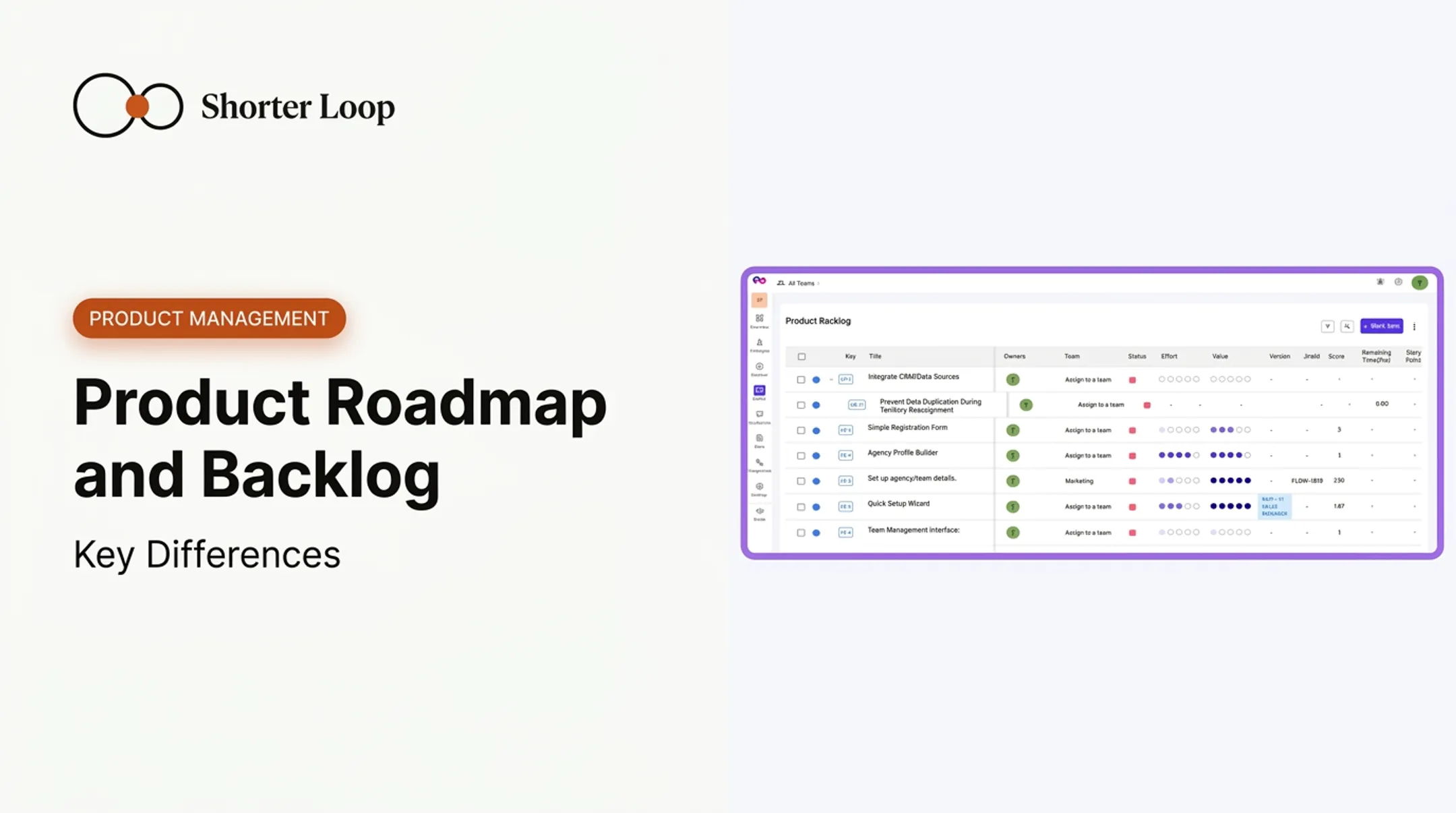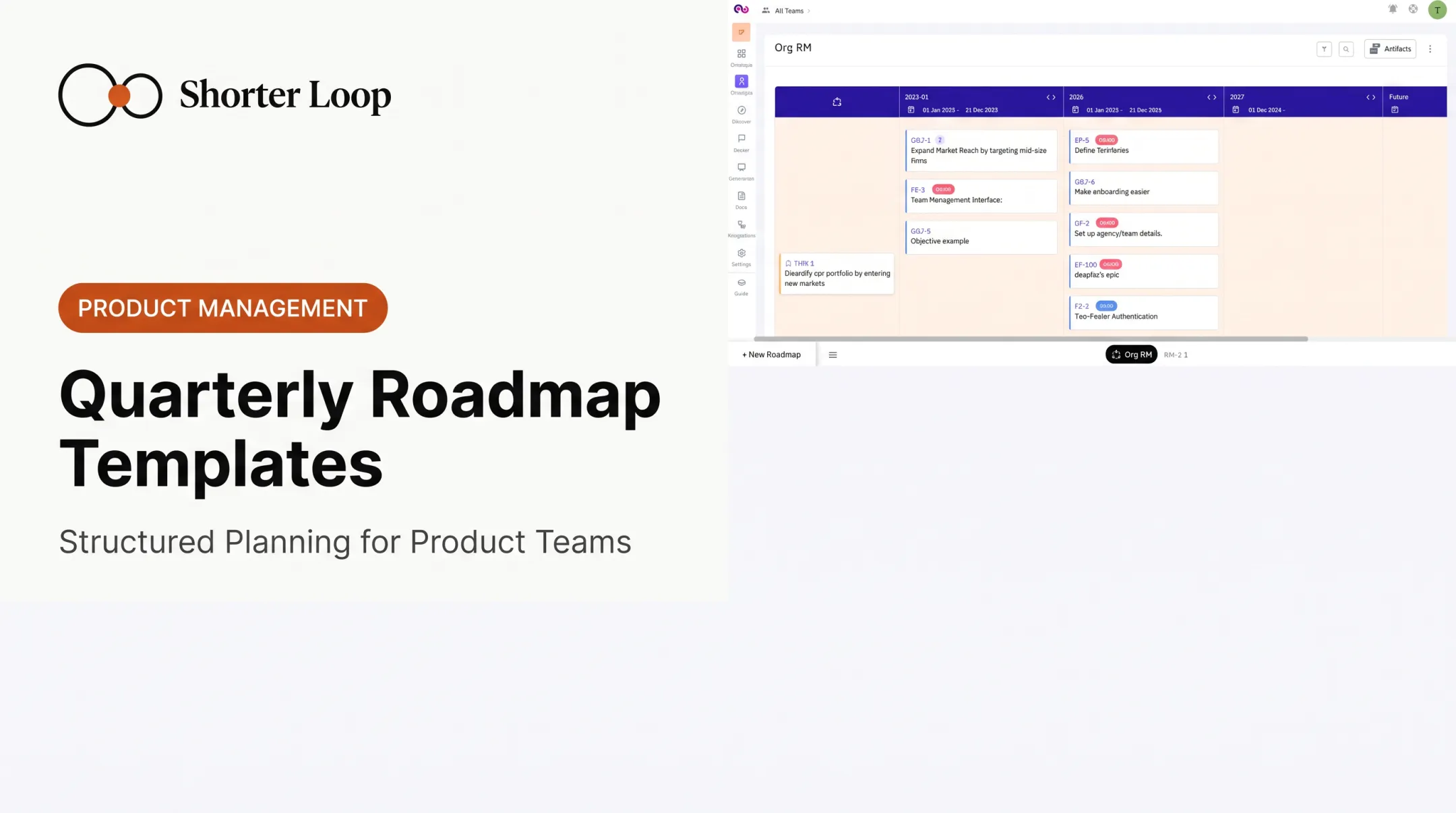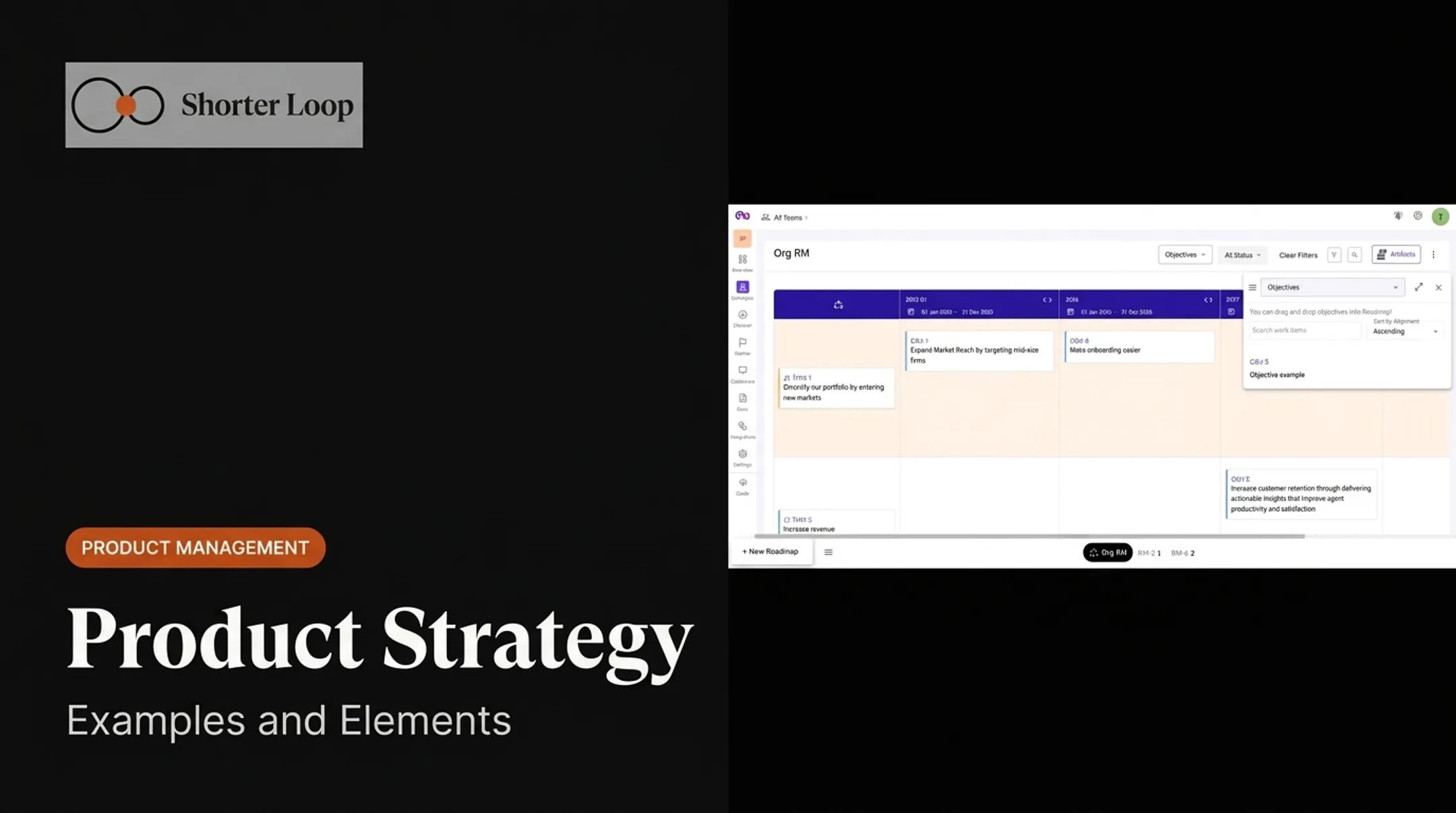

That situation usually starts with three planning layers that have blurred together. When vision, strategy, and roadmap aren't kept distinct, a team can build features nobody asked for, chase sales requests instead of customer problems, and ship quarter after quarter without moving a business metric. Product leaders call this the feature factory: a team that's busy, but can't show what its work changed.
This article is for the leader who has to keep that traceability intact while several teams add to the roadmap. It starts with a two-question test you can run on every item and a rollup across squads, then covers what each layer is for and how the three connect.
Key Takeaways
- Product vision answers why the product exists and stays stable for years, not sprints.
- Strategy defines how you win: target customers, differentiation, and measurable goals.
- A roadmap turns strategy into what and when, organized as themes and milestones.
- Without a vision, teams lack a shared destination. Without a strategy, a roadmap has no basis for saying no, and it fills with unconnected requests.
Start With the Two-Question Test
Before any of the definitions below matter, run this on your current roadmap. Take each item and ask:
- Which strategic goal is this for?
- What evidence says the problem is real?
An item that answers both is connected work. An item that answers only the first is a bet on an unchecked assumption, which is fine as long as everyone knows that is what it is. An item that answers neither is a request that got scheduled.
Most teams find the second question harder, and that is the useful result. The gap is rarely between vision and strategy; it is between a roadmap item and the customer evidence somebody cited months ago and nobody has seen since.
A Rollup Example Across Teams
Running that test on one roadmap is straightforward. The harder version is rolling several teams up to one strategy without the links quietly breaking.
Take a company with one vision, three strategic pillars, and four squads:
| Squad | Objective | Strategic pillar | Roadmap items | Items with evidence linked |
|---|---|---|---|---|
| Onboarding | Cut time to first value | Self-serve growth | 6 | 5 |
| Integrations | Make data trustworthy | Enterprise readiness | 4 | 4 |
| Reporting | Reduce manual exports | Enterprise readiness | 5 | 2 |
| Platform | Keep the system reliable | (none named) | 7 | 1 |
Read down the last two columns and the gaps appear. Reporting has five items and evidence behind two of them, so three bets rest on assertion. Platform has seven items and no named pillar at all, which is common for infrastructure work and still worth stating, because "it keeps the lights on" is a strategic choice rather than an exemption from one.
The rollup is useful precisely because it is uncomfortable. It does not tell you Reporting is wrong; it tells you where someone should go and check before the next planning cycle locks capacity. A pillar with no squad against it, or a squad with no pillar above it, is the other signal worth acting on.
Vision, Strategy and Roadmap in Short
| Layer | The question it answers | How long it usually holds | Who usually owns it |
|---|---|---|---|
| Product vision | Where are we going, and why does this product deserve to exist? | Years; it changes when the company changes direction | Founders and executive leadership |
| Product strategy | Which customers, which problems, and what are we choosing not to do? | Often around a year, reviewed more often; varies by company | Product leadership with cross-functional heads |
| Product roadmap | What is happening now, what comes next, and what is still directional? | A rolling window of months; how far ahead depends on the team | Product managers and delivery teams |
Each layer moves at its own speed, which is why merging them causes trouble: a roadmap that changes every few weeks can't also be the team's source of long-term purpose. A vision written as a feature checklist shows up later as a roadmap where every item can be justified and none can be ruled out.
A worked example keeps the middle row from staying abstract. FlowDesk, a fictional demo dataset Shorter Loop uses to show the product, is a shift-scheduling tool for mid-size logistics operators. Its strategy starts with one customer segment, then the demo evidence shows dispatchers using the product daily while operations managers pay for it. The strategy splits into two personas, and the value proposition moves from "publish schedules without spreadsheets" to access for the wider depot team, which raises a harder revenue question: would seat-based revenue hold up once dispatchers got access at no extra charge? The objective attached is to cut first-90-day churn from 22% to 12%. These figures are illustrative demo data, not results from a real customer. The objective is measurable, and still a bet, because nothing in it says which work will move the number.

On the roadmap side, that demo groups its work under three themes: reducing churn, platform setup, and depot experience, so a reader can see which business reason each feature serves. Horizon formats such as Now / Next / Later, widely credited to product coach Janna Bastow, communicate priority without pretending to certainty, as long as the team agrees what each horizon means. Without that agreement the horizons become a vague timeline in disguise.
How Product Vision, Strategy, and Roadmap Connect in Practice
The three layers depend on each other. Each one narrows the one above it.
Vision sets direction. Strategy turns that direction into target customers, differentiation, and goals. The roadmap converts strategic pillars into themes, then into backlog stories engineers build.
Put as a chain: evidence becomes strategy, strategy becomes a roadmap, roadmap becomes work, and work becomes an outcome.

When that chain breaks, teams fall into recognizable traps. Melissa Perri named one of the most damaging in her 2014 essay: the build trap, where ideas from executives or product managers get scheduled before anyone confirms customers actually want them.
Two related patterns are the feature factory described above and the absence of shared understanding, where each function holds its own version of the plan.
What disconnected planning looks like:
- Sales asks for custom features that never touch the strategic roadmap
- Two engineering teams build competing solutions to the same problem without knowing it
- Leadership can't explain why a given feature made the cut
- Roadmap items ship on schedule but move no metric anyone tracks
The FlowDesk demo data includes a version of this. Two epics rest on the same churn explanation, and that explanation is still untested: no evidence has been linked to it. Because both epics state that explanation, each one's Evidence tab shows the claim as untested, which is the cue to check it before either team starts building.
More meetings don't fix this. What helps is a feedback loop where delivery results and customer discovery feed evidence back into strategy and roadmap decisions as they arrive, not only at quarterly planning.
In Shorter Loop, objectives, opportunities, solutions, and epics are linked records, and each claim carries one of three states (Backed, Evidence disagrees, or Untested) tied to the evidence behind it. A product manager asked "why does this exist" can open the epic and follow it back to the claim and the evidence. Shorter Loop doesn't replace Jira: delivery status stays in your delivery tool, such as Jira, Azure DevOps, or GitHub, and comes back through two-way sync, so the link is only as current as that integration. On the roadmap itself, columns are time boxes, rows are themes with objective lanes inside them, and the cards are the opportunities, solutions, epics and features you place there; the Roadmap guide in the Shorter Loop help center walks through setting one up.
Applying It: Tracing Strategic Alignment from Vision to Delivery
Suppose a B2B SaaS company has grown quickly, and the product organization has drifted away from direct customer contact. The symptoms often look like this.
The challenge:
- Sales promises custom features to close deals, bypassing the roadmap
- Engineering works straight off backlog tickets with no visible link to strategy
- Leadership can't tell which initiatives are connected to the metrics it reports
- Showing product impact to the board means pulling numbers from several tools by hand
The change to aim for is simple to state: every roadmap initiative is checked against the strategic OKRs and the vision before it earns a spot in a sprint.
One way to make that check possible is a layered structure. Board-level themes break into objectives, objectives into opportunities, opportunities into solutions, and solutions into epics and features. With each level linked to the one above, a leadership objective can be followed down to the work in the current sprint.
What to watch for once the links are in place:
- Whether sprint goals conflict less often, which you can check by counting reprioritizations mid-sprint
- Whether duplicate work shows up earlier, for example two epics resting on the same untested claim
- Whether shipped features map to problems whose claims are backed by evidence rather than to claims nobody has checked
Treat these as things to measure, not results to expect. Other changes, such as a reorganization or a new sales motion, can move the same numbers.
A simple illustration shows why ranking isn't enough. Suppose an item with an ROI score of 3.0 ships and its target metric moves, while a higher-scored epic (ROI 4.0) is never built. Nobody learns whether the 4.0 was right. A score is a forecast, and only work that ships, measured afterward, shows whether the forecast held.

Your move: Audit your current planning artifacts this quarter. Put your vision, strategy doc, and roadmap side by side. If you can't trace a single roadmap item back to a strategic goal and a piece of customer evidence, that's your starting point.
Conclusion
A practical rule: every roadmap item should be able to answer two questions, "which strategic goal is this for?" and "what evidence says the problem is real?" If an item can answer only the first, it rests on a claim nobody has checked. If it can answer neither, it probably belongs back in the backlog.
Pick three items from your current Now column and run that test this week. If you want to see the links between objectives, claims, and epics in a working product, start a 14-day trial (no credit card) or book a walkthrough.
Frequently Asked Questions
How do we keep roadmap items traceable to strategy when several teams contribute?
Give each team an objective rather than a slice of the roadmap, and require every item to name the objective it serves and the evidence behind it. Then review the rollup, not just the individual roadmaps: a strategic pillar with no team against it, or a team with no pillar above it, is the signal worth acting on before capacity gets locked for the quarter.
How do we check whether a roadmap item supports the strategy?
Name the strategic objective, the customer problem and the evidence supporting the proposed work. If one is missing, identify what the team needs to learn before committing further capacity.
How should several teams review alignment together?
Review each team's objectives and proposed work against the shared strategic goals. Identify duplicated bets, uncovered goals and conflicting dependencies, then record the decisions and their owners.
How often should a product vision, strategy, and roadmap be updated?
Vision stays steady for years unless the company pivots entirely. Many teams review strategy each quarter and revise it about once a year, though the right rhythm depends on how fast your market moves. Roadmaps usually change more often, as delivery data and customer feedback come in.
Can you create a product roadmap without a product strategy?
You can, but it turns into a feature checklist with no way to judge priority. Without a strategy behind it, a roadmap can deliver the wrong product efficiently.
Who owns the product vision vs product strategy vs product roadmap?
Executive leadership and founders own the vision. Product leaders and PMs own the strategy, working across marketing, sales, and engineering. PMs and delivery teams own the roadmap and its day-to-day execution.