
Introduction
Product teams have more ideas than capacity, and the hard part is choosing between them. In one Shorter Loop demo workspace (fictional data Shorter Loop uses to show the product), 1,100 support conversations, 60 sales-call notes, and 14 churn interviews feed a backlog of six epics and roughly 200 smaller items. Treating all of it as equally urgent is still guesswork, just with more inputs.
One question cuts through most of it: how much of your roadmap rests on a claim nobody has checked? Take the items committed for this quarter, write down the single thing that has to be true for each one to pay off, and mark which of those things anyone has actually tested. Teams running this the first time are usually surprised by the answer.
This article covers how to prioritize when the evidence is weak: the factors worth weighing, a workflow built around naming the claim under each item, how to find the unchecked claims already sitting in your plan, and how to keep the reasoning behind a bet from going stale.
Key Takeaways
- Weigh the risk of not acting against the risk of acting, and show which bets rest on checked claims and which do not
- Consider impact, likelihood, strategic fit, urgency, dependencies, how easily the work can be undone, and the cost of delay
- Keep prioritization continuous: feed outcomes back into the next decision cycle
- Use one method your team applies consistently, explains clearly, and revisits when evidence changes
What Does Your Roadmap Rest On?
Risk-based prioritization starts from what you actually know and what it would cost to be wrong, and uses that to decide what to check before you commit. For each problem, opportunity, or initiative you ask what has to be true for it to pay off, whether anyone has checked that, and what follows from acting, waiting, or committing anyway on weak evidence. Feature voting answers a different question.
A feature with 40 votes might feel urgent. But votes don't reveal whether those customers represent your most valuable segment, whether the underlying problem is severe, or what happens if you get the fix wrong.
Silicon Valley Product Group's product-risk taxonomy frames this more usefully: before committing to a solution, teams should test it against value, usability, feasibility, and business viability risk, not how many people asked for it.
Three Risk Questions Every Team Should Ask
Before you commit capacity to anything, ask:
- What happens if we don't address this? Some problems get worse every week they sit; others can wait for months without harm.
- What could go wrong if we pursue this bet? Every commitment displaces something else.
- How confident are we in our evidence and assumptions? A claim backed by 14 churn interviews carries different weight than one built on a single Slack comment.
Where This Shows Up Across Levels
Risk-based thinking applies differently depending on where you're standing:
- Strategic: Which customer or market problems deserve investment at all?
- Portfolio: Which initiatives get capacity across competing teams?
- Delivery: Which unresolved assumptions or dependencies could derail work already in motion?
In our reading, faster AI-assisted experimentation raises the stakes on all three. It shortens the time to ship, and that applies to the wrong thing as much as the right one.
Distributed teams and growing volumes of customer input make it easier for the why behind a decision to disappear between tools and handoffs. The goal is not to avoid risk. It is to make deliberate bets that match your strategy, the available evidence, and how much uncertainty you can accept.
What to Weigh Besides the Claim
Not every factor deserves equal weight, but skipping any of them tends to create blind spots.
Customer and business impact. Which workflows, revenue areas, or retention drivers does this problem touch if left unresolved? A workflow issue affecting your highest-spend accounts carries different weight than a cosmetic complaint from a trial user.
Likelihood and evidence strength, assessed together. How likely is the stated problem to be real, and is that judgment based on recent interviews and usage data, or an isolated opinion? In Shorter Loop, each claim carries one of three states (Backed, Evidence disagrees, or Untested), set from the accepted evidence linked to it, so this distinction stays explicit instead of being folded into a single fuzzy score.

Urgency and time horizon. Some problems get materially more expensive to fix the longer they sit. Others can be safely monitored. Cost of delay captures this: a fixed-date revenue commitment behaves nothing like a slow technical debt accumulation, even if both eventually matter.
Strategic alignment and opportunity cost. A genuinely valuable request can still rank lower if it doesn't support current objectives or would bump a more important bet.
How easily it can be undone, what it depends on, and how far the damage spreads. Weigh irreversible decisions (pricing changes, architectural commitments) more carefully than reversible experiments. Check whether one decision affects multiple teams, products, or customer segments before treating it as isolated.
Effort and capacity, without letting ease dominate. An easy build isn't automatically a smart one if it doesn't reduce meaningful uncertainty.
Document the assumptions behind each factor. A reasoning trail lets stakeholders challenge the logic instead of arguing over an unexplained number.
A Workflow for Deciding on Weak Evidence
A repeatable workflow beats a one-off exercise. Here's a version teams can run consistently:
- Agree what decision you are making and how much risk you are willing to carry. State the objective, customer segment, planning horizon, and what kind of uncertainty you're willing to accept.
- Build a unified inventory. Maintain a shared inventory of opportunities, problems and assumptions, including each item’s source, affected outcome, owner and evidence links.
- Name the claim under each item and its state. Write the one thing that has to be true for the item to pay off, then mark that claim backed, untested, or something the evidence disagrees with. Note the date of the evidence while you are there: a backed claim resting on year-old research deserves the same look as an untested one.
- Say what kind of decision each item is. Immediate mitigation, discovery work, strategic investment, routine delivery, and deliberate acceptance are different calls with different owners and different evidence bars. Holding them on one undifferentiated list is what lets an untested bet pass as a scheduling question.
- Choose the smallest responsible next action. That could be a customer interview, an instrumentation change, a prototype, or a full delivery commitment.
- Assign ownership and define success. Name who decides, what evidence would change the priority, and what result signals the bet worked.
- Review on a cadence and after trigger events. Revisit priorities when you get new customer evidence, hit a major incident, make a strategic shift, or see a competitor move.

This is where the reasoning tends to leak. A team scores an item in January, ships in March, and by June nobody remembers what evidence justified it.
In Shorter Loop, each opportunity, solution, and epic is linked to the claims it rests on, and each claim is linked to its evidence. Six months after a bet is made, the epic still shows what supported it and the current state of each claim. When new evidence changes a claim, review the opportunities, solutions and roadmap items that rely on it. Record whether the evidence changes the priority or the decision to proceed. Delivery itself stays in Jira or your other delivery tool, synced both ways, so the link is only as current as that integration.
Find the Unchecked Claims Already in Your Plan
The question at the top of this article is answerable in an afternoon. Walk the roadmap item by item, write the claim each one depends on, and mark whether anyone has checked it. The output is a count, not a ranking: how many committed items rest on something nobody has tested.
Run a regular review of the claims behind important product decisions. For each claim, inspect the supporting evidence, its age and relevance, and the work that depends on it. Record the next action and the person responsible for following it through.
Read the "work started without validation" findings first. Each one is a team already spending capacity on a claim nobody has settled, which is the most expensive version of the problem.
A Worked Example
Suppose a backlog has two competing items. Both come from the same demo workspace.
The first is an export automation feature that shows up in requests constantly. One Intercom conversation in the demo data describes a manager spending two hours a week manually exporting reports to PDF.
The second is an onboarding fix that is less visible. In the demo data, 22% of new accounts churn within 90 days. Onboarding friction is recorded as the cause, but that claim's state is untested: no evidence is attached to it yet.
Request volume alone would send the export feature straight to the top. Looking at the claim under each item changes that. The export request rests on something the evidence already supports: people are spending hours on manual exports, and it is well documented. The onboarding fix rests on a claim nobody has checked, and it is the one with the larger consequence if it turns out to be true. So the onboarding item neither enters the next sprint nor gets dropped: it gets the cheapest check that could settle it, with a date and an owner. The export request gets scheduled on its own merits.

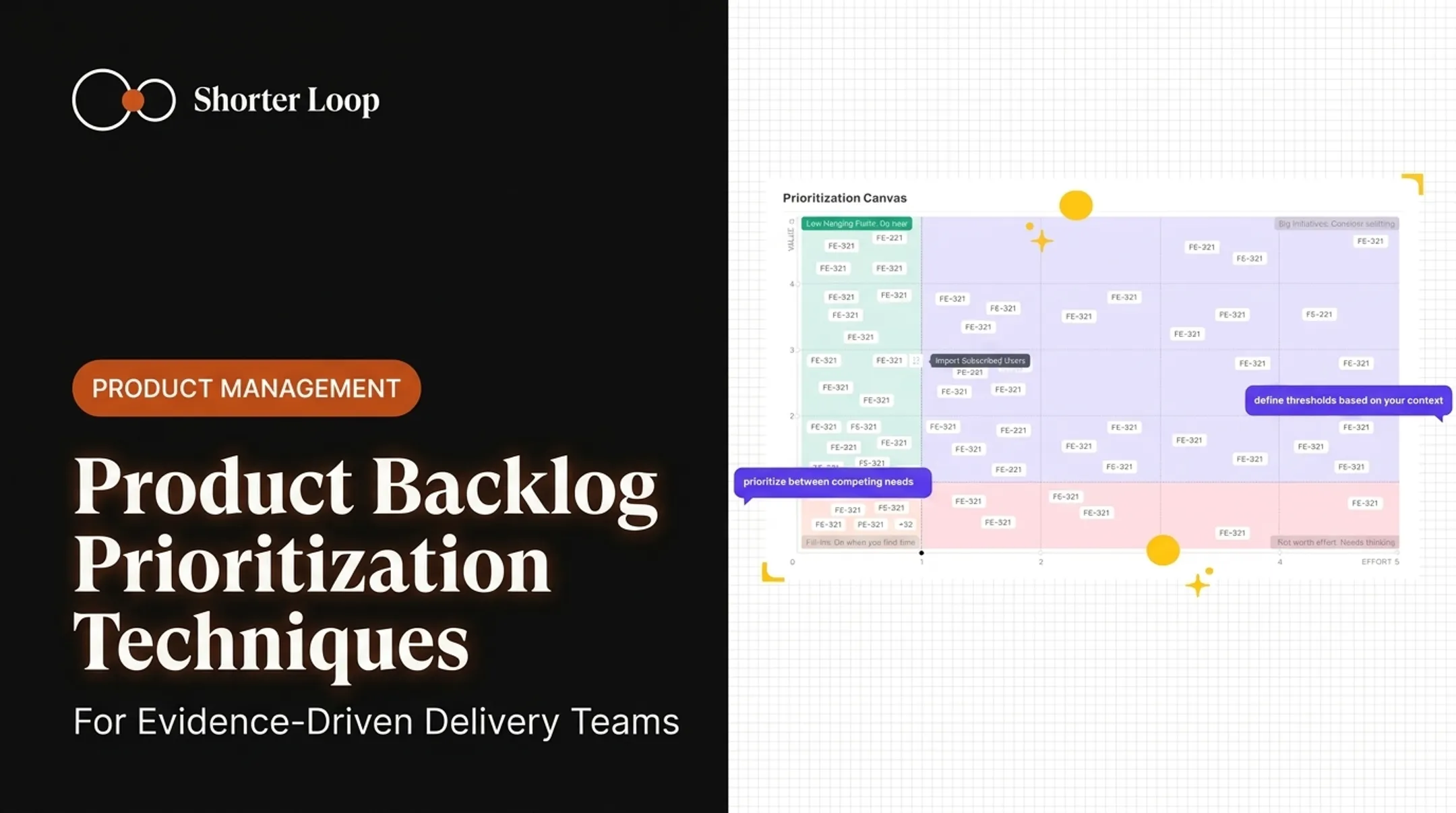
Backlog Prioritization places epics and features on a value-versus-effort chart with movable cut lines; the score is value divided by effort. It does not read your evidence. What it does give you is the claims behind each item on its Evidence tab, so you can open a placement and see whether the reasoning under it is backed, untested, or something the evidence disagrees with. The grid is a decision aid; the checking is still yours to do.
Revisit placements after discovery or delivery; a placement can change the moment new evidence lands.
Avoid Common Risk-Based Prioritization Mistakes
Mistaking request volume for priority. A high vote count says people are aware of a problem. It doesn't say how severe it is, who's affected, or whether it fits your strategy. Combine counts with customer context and outcome evidence before you commit to anything.
Recency and stakeholder bias. Overreacting to the latest executive request or loudest customer complaint is called HiPPO-ism for a reason. "An executive asked for it" or "we discussed this last quarter" is not a rationale for a high-stakes decision.
Effort or severity alone standing in for risk. An easy-to-build item doesn't automatically address your most consequential uncertainty. In the same demo workspace, an epic called Import wizard v2 ranks at the top of the backlog with a credible effort estimate, yet its value score rests entirely on an untested explanation for churn.
Stale reasoning. A decision built on sound evidence six months ago can be a bad decision today. Evidence and assumptions need to travel with the decision, not get left behind once the sprint ships.
Confusing uncertainty with low importance. A high-impact, poorly understood problem usually deserves focused discovery, not immediate roadmap commitment and not dismissal either.
Conclusion
Risk-based prioritization won't eliminate hard trade-offs, but it makes them easier to explain. Connecting impact, uncertainty, evidence, urgency, strategic fit, and capacity gives teams a defensible answer when someone asks "why this, and why now."
The operating model is straightforward even if execution takes discipline:
- Define criteria
- Tie decisions to evidence
- Say which claims are still untested
- Pick the smallest responsible next step
- Assign an owner
- Revisit as outcomes arrive
A small experiment for this week: take the top five items on your backlog and write next to each one the claim it depends on and the state of that claim. Any top-five item resting on a claim that is still untested needs a cheap check before it needs a sprint. Ask what the cheapest check would be, such as five customer interviews or a look at the usage data, and run it before committing capacity.
If you want to run that check with claims and evidence linked to your backlog, Shorter Loop offers a 14-day trial, no credit card required, or you can book a walkthrough.
Frequently Asked Questions
What are the 5 levels of priority?
There's no single universal scale, but a common product-oriented progression is critical, high, medium, low, and monitor or accept. Definitions should tie to impact, urgency, and expected response time rather than gut feel.
How much of our roadmap rests on claims nobody has checked?
Take the top ten items and open the claim behind each one. Count how many are backed by linked evidence and how many are still untested. Most teams running this for the first time find the proportion higher than expected, and that number is more useful than any risk score, because it tells you where a cheap check would change the plan.
What do we do when a high-risk bet has no evidence behind it?
Don't rank it and don't drop it. Treat the missing evidence as the first piece of work: name the claim it rests on, pick the cheapest check that could kill it, and set a date for the answer. A bet with an untested claim and a check scheduled is in better shape than one with a confident score and nothing underneath.
What is the best prioritization method?
No single method wins universally. The strongest approach is transparent and repeatable: combine impact, likelihood, evidence strength, urgency, strategic fit, and dependencies, then revisit it as new evidence arrives.