
Introduction
Your roadmap looks clean. Color-coded swim lanes, quarterly themes, a tidy "Now/Next/Later" view. But ask why Feature X sits above Feature Y, and the answer is often a shrug, a sales deal, or whoever shouted loudest in last week's planning meeting.
That's the real problem roadmap prioritization tools solve. They force teams to compare opportunities on customer value, business impact, confidence, effort, risk, and strategic fit, not on recency or volume.
This guide compares the tools product teams actually use to make those calls. It covers prioritization depth, how each handles customer evidence, roadmap communication, integrations, scalability, and AI capabilities. It also asks whether you can trace a decision back to its reasoning six months later.
Key Takeaways
- The right tool depends on your biggest gap: customer evidence, scoring rigor, strategic alignment, engineering sync, or outcome tracking
- Judge a tool on its criteria, trade-off visibility and decision rationale, which are what make a roadmap view mean something
- Covered categories include feedback-led platforms, full product management suites, engineering-native tools, and flexible scoring platforms
- Weigh evidence quality, integrations, and total cost at scale, not just interface polish
Compare the Tools at a Glance
| Tool | Best fit | Prioritization | Customer evidence | Pricing model |
|---|---|---|---|---|
| Productboard | Feedback-led teams linking insights to features | Custom scoring, drivers | Feedback inbox, insight-to-feature links | Per maker; quote-based above entry |
| Aha! Roadmaps | Strategy-heavy orgs with portfolio planning | Scorecards, custom equations | Ideas portal | Per user, tiered |
| Jira Product Discovery | Teams already delivering in Jira | Custom fields, matrices | Ideas with linked insights | Per creator; viewers free |
| airfocus | Teams wanting modular, configurable scoring | Weighted scoring, custom frameworks | Feedback module (add-on) | Modular, per component |
| Canny | Public feedback boards and changelogs | Demand or revenue vs. effort | Public/private voting portal | Per tracked user |
| ProdPad | Teams wanting an idea backlog with coaching | Impact/effort, custom | Ideas and feedback capture | Per editor, tiered |
| Linear | Engineering-led teams | Project priorities, initiatives | Not a feedback suite | Per user |
| Shorter Loop | Teams needing a roadmap item traced to its evidence | Value-vs-effort cut lines; RICE on solutions; Opportunity score set by hand | Feedback portal, clusters, Evidence tab | One plan per product, unlimited users |
One row is worth reading twice. Shorter Loop does not rank bets by how much evidence sits behind them, and gives no evidence-derived score. It shows which claims are backed, which the evidence disagrees with and which are untested, and the team decides. If you want the tool to produce the ranking, that is a reason to pick a different one.
Vendor pricing moves and tiers get renamed. Every figure below is taken from the vendor's own pricing page, linked and dated where it appears, and all of them were checked in October 2026. Re-check them there before you budget; treat the numbers as a starting point rather than a quote.
Overview of Product Roadmap Prioritization Tools
Product roadmap prioritization tools help teams do four things: collect opportunities, evaluate them against each other, decide what to pursue, and communicate those decisions on a roadmap.
That sounds like one job. It's actually five distinct stages, and most platforms only cover a few of them well:
- Product discovery – learning whether a problem and proposed solution are worth pursuing
- Prioritization – scoring or ranking competing opportunities against shared criteria
- Roadmap visualization – presenting the resulting plan to stakeholders
- Project tracking – managing the tasks required to build it
- Delivery management – shipping and monitoring the committed work
SVPG's discovery research draws a hard line between learning whether a solution works and the separate discipline of producing reliable software at scale. Conflating the two is exactly how teams end up with roadmaps that look organized but rest on stale assumptions.

Why This Matters for Growing SaaS Teams
For scaling B2B SaaS product orgs, evidence piles up fast: support tickets, sales call notes, interview transcripts, analytics dashboards, and feedback portals. Meanwhile, three or four teams compete for the same two engineering squads.
A strong tool supports a clear workflow:
- Capture evidence and group related problems
- Define criteria, then score or debate opportunities
- Connect priorities to strategy
- Hand selected work to delivery
- Review what actually shipped
The tools below are compared by the problem each one solves best. None of them is a universal winner.
Best Product Roadmap Prioritization Tools
Each tool below is evaluated on the same criteria: prioritization quality, evidence handling, strategic alignment, delivery connectivity, usability, scalability, and how transparently it shows trade-offs.
Productboard
Productboard is a customer-driven product management platform built around an insights repository. Feedback from support tools, sales calls, and surveys gets tagged, linked to features, and weighted using custom scoring that blends strategic drivers with effort.
It suits teams whose feedback is scattered across many channels and who want a structured line from customer evidence to roadmap decisions to delivery. Setup takes real effort, though.
Productboard's plan structure has shifted from a four-tier model (Starter, Essentials, Pro, Enterprise) to a simpler Business and Enterprise split with quote-based pricing, so always confirm current terms before budgeting.
One limitation worth flagging: Productboard links feedback to features well, but it doesn't natively trace whether a shipped feature actually delivered the outcome it promised.
| Dimension | Details |
|---|---|
| Prioritization | Custom weighted scoring, strategic driver inputs |
| Evidence | Multi-source feedback repository, AI-linked insights |
| Roadmap | Audience-specific, interactive roadmaps |
| Delivery | Jira sync |
| AI | Auto-links related insights, AI summaries |
| Pricing | Quote-based (Business/Enterprise); see Productboard pricing, checked October 2026 |
| Best fit | Feedback-heavy teams needing structured evidence-to-roadmap flow |
Aha! Roadmaps
Aha! is a broad strategy and roadmapping suite spanning goals, initiatives, ideas, releases, and dependencies, sold as separate but connected products (Roadmaps, Discovery, Ideas, Whiteboards, Develop).
It fits established or multi-product organizations that need portfolio-level planning and strategy-to-execution visibility across several product lines. The trade-off is complexity: scorecards, custom fields, and modular add-ons give you flexibility, but that same configurability tends to sprawl by the second or third year of use.
Pricing is per-user and tiered: Premium, Enterprise, and Enterprise+ plans, with Ideas Advanced and Discovery Advanced sold as separate add-ons. Automated scorecard metrics require the top-tier plan, so check exactly what's included before committing budget. Figures from Aha! pricing, checked October 2026.
| Dimension | Details |
|---|---|
| Prioritization | Custom scorecards (value, effort, confidence) |
| Evidence | Ideas portals, support-linked feedback |
| Roadmap | Cross-product portfolio roadmaps |
| Delivery | Native releases, dependency tracking |
| AI | Automated scorecard metrics (top tier only) |
| Pricing | Per-user, tiered, modular add-ons |
| Best fit | Multi-product orgs needing portfolio strategy depth |
Jira Product Discovery
Built for teams already living in Jira, Jira Product Discovery captures, scores, and ranks ideas before converting selected ones into delivery tickets, in the same system engineers already use.
Custom fields and formulas can replicate RICE-style scoring, and the connection between a discovery idea and the resulting epic is genuinely tight. That's the strength: one identity provider, one bill, one administration surface.
The gap is customer-facing feedback. Externally published views are read-only, not a full voting portal, and non-Atlassian integrations are thinner than dedicated feedback or portfolio tools.
Pricing runs per creator (contributors are free), with the dedicated Roadmaps feature and roadmap permissions reserved for Premium plans. Figures from Jira Product Discovery pricing, checked October 2026.
| Dimension | Details |
|---|---|
| Prioritization | Custom fields/formulas, matrix views |
| Evidence | Linked support tickets, quotes; read-only external views |
| Roadmap | Premium-only dedicated Roadmaps feature |
| Delivery | Native Jira ticket linking |
| AI | Not a core focus |
| Pricing | Per creator; Free/Standard/Premium |
| Best fit | Jira-native engineering teams |
airfocus
airfocus is a flexible platform built around swappable scoring frameworks (RICE, weighted scoring, MoSCoW, or fully custom models), combined with a priority matrix and configurable fields.
It suits teams that already have a prioritization philosophy and want software molded around it rather than forcing their process into someone else's template. That flexibility comes with setup cost: configuring models, fields, and hierarchy takes time upfront.

Feedback and advanced prioritization live in the Professional plan; portfolio dashboards and capacity planning require Enterprise. Both paid tiers list "request pricing" rather than published rates, and there's no free trial. Figures from airfocus pricing, checked October 2026.
| Dimension | Details |
|---|---|
| Prioritization | RICE, weighted scoring, MoSCoW, custom models |
| Evidence | Feedback/Insights (Professional+) |
| Roadmap | Matrix and roadmap views |
| Delivery | Jira, Azure DevOps, Linear |
| AI | Not prominently documented |
| Pricing | Quote-based; no free trial |
| Best fit | Teams with an existing framework to configure |
Canny
Canny centers on a public or private customer portal: users submit ideas, vote, and watch status move through a changelog. Prioritization scores weigh demand or revenue against effort.
It's a strong fit for teams that want visible customer demand feeding directly into roadmap decisions and public accountability through changelogs. Worth saying plainly: a vote count measures who was willing to ask, not what is worth building, so treat the ranking as a prompt to investigate rather than a decision. What it lacks is strategic planning depth, portfolio controls, and delivery management for larger multi-team orgs. Those pieces live elsewhere.
Pricing scales by tracked users: a free tier caps at 25 tracked users, Pro starts around $79/month for 100+, and Business requires a custom quote at 5,000+. Attribute-based segmentation requires Pro or above. Each additional product workspace is billed as a separate instance. Figures from Canny pricing, checked October 2026.
| Dimension | Details |
|---|---|
| Prioritization | Demand/revenue vs. effort scoring |
| Evidence | Public voting portal, segmentation (Pro+) |
| Roadmap | Public roadmap, changelog |
| Delivery | Jira, Linear |
| AI | Not a core focus |
| Pricing | Per tracked user, tiered |
| Best fit | Feedback-led teams wanting public demand signals |
ProdPad
ProdPad takes an outcomes-first approach: Now-Next-Later roadmaps tied to objectives and key results, plus portfolio views across multiple products and product lines.
It fits teams who've decided fixed-date feature promises create more problems than they solve, and who'd rather commit to outcomes and let the "how" stay flexible. Feedback flows in from email, Slack, and customer portals, then links to ideas and objectives.
Pricing is modular: you select components rather than buying a flat tier, which makes apples-to-apples comparison harder. Confirm exactly which modules and portfolio features are included in any quoted package. Figures from ProdPad pricing, checked October 2026.
| Dimension | Details |
|---|---|
| Prioritization | OKR-linked opportunity scoring |
| Evidence | Multi-channel feedback, linked to objectives |
| Roadmap | Now-Next-Later, portfolio views |
| Delivery | Jira integration |
| AI | Not a core focus |
| Pricing | Modular, select-your-components |
| Best fit | Outcome-oriented teams avoiding fixed-date roadmaps |
Linear
Linear is an engineering-led issue and project tool, not a customer-feedback suite. Initiatives group projects by company objective; cycles drive sprint-level execution; native Customer Requests attach feedback (including account revenue and size) directly to projects.
It works well for technically oriented teams prioritizing speed and tight coupling to development work. What's missing: formal scoring frameworks, public-facing roadmaps, and the kind of stakeholder-facing prioritization non-engineering teams often need.
Pricing is per user: a free tier caps at two teams and 250 issues, Basic and Business plans add unlimited teams and reporting, and Enterprise is custom. Initiative views require Enterprise. Figures from Linear pricing, checked October 2026.
| Dimension | Details |
|---|---|
| Prioritization | Manual, project-level priority tagging |
| Evidence | Native Customer Requests (linked, not public voting) |
| Roadmap | Initiatives, projects, milestones |
| Delivery | Native (it's built for delivery) |
| AI | Not a core focus |
| Pricing | Per user; Free/Basic/Business/Enterprise |
| Best fit | Engineering-first teams wanting tight dev integration |
How We Chose the Best Product Roadmap Prioritization Tools
We compared decision-making workflows, not roadmap aesthetics, against current official documentation and pricing pages.
Prioritization depth. Can the team run RICE, weighted scoring, value-versus-effort, opportunity scoring, cost of delay, or custom formulas, and will stakeholders actually understand the output? Intercom's RICE framework is explicit that scores guide judgment; they don't override it when dependencies or hard requirements intervene.
Evidence and customer context. We checked whether tools link feedback to ideas, segment by account value, import support or research data, and prevent one loud customer from outweighing fifty quiet ones.
Strategy, delivery, and outcome traceability. Do roadmap items connect to objectives, dependencies, release status, and what happened after launch? A roadmap that only shows "what's planned" without why is a presentation layer, not a decision system, something ProductPlan's roadmap guide also distinguishes clearly.
Collaboration, usability, governance. We looked at permissions, approval flows, decision history, onboarding effort, and whether AI outputs are traceable to source data or just confident-sounding guesses.
Pricing and scalability. We researched:
- Creator, editor, and contributor limits
- Add-on and integration costs
- How total spend changes as the org grows from one product team to several
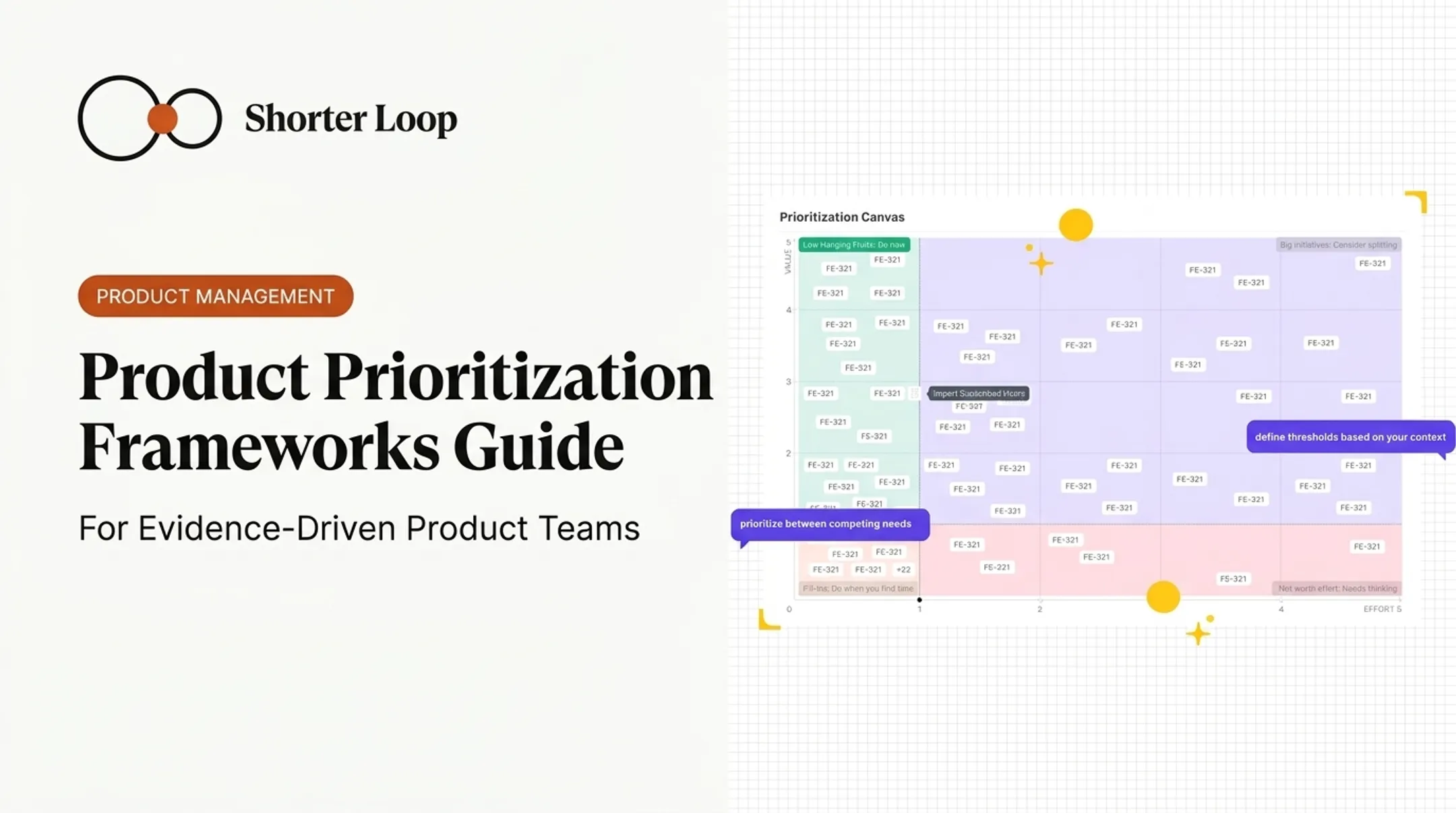
Those same criteria shape how Shorter Loop is built. Rather than treating prioritization as a standalone scoring exercise, Backlog Prioritization plots epics and features on a value-versus-effort chart with movable cut lines. RICE Score sits on solutions in Strategy Builder, and opportunities carry an Opportunity score (Spread, Intensity, Value) the team sets by hand, with an Evidence tab alongside.
Value and effort are set by where you drop an item on the chart, and Spread, Intensity and Value by clicking a level in each row of the Opportunity score panel; none of these scores is calculated from the evidence, which stays linked beside them. Sage, the built-in AI assistant, answers from your product's own documents, feedback and strategy and shows the evidence behind each answer; when it can't verify a point, it says so. Separately, when Sage drafts opportunities or solution ideas from weak evidence, it says so, and any claim without enough support stays marked Untested.
Pricing is $500 per product per month billed annually, or $600 billed monthly, with unlimited seats and no per-seat fees when you add engineers or designers to the conversation.
If you want to run that end-to-end test on your own backlog, you can start a 14-day trial (no credit card) or book a walkthrough.
Conclusion
The best roadmap prioritization tool is whichever one improves the quality and continuity of your product decisions. Judge it on that, ahead of the number of roadmap views it offers or how polished the onboarding feels.
Before committing, test a full workflow end to end:
- Raw customer evidence
- Prioritization decision
- Roadmap communication
- Delivery handoff
- Outcome review
Most demos skip straight to the roadmap view because that's the easy part to show.
If decisions outlive the reasoning and evidence behind them, or nobody can explain why a feature shipped six months after a planning meeting, a conventional roadmap tool won't fix it.
That's the gap Shorter Loop was built to close. It keeps evidence, strategy, delivery, and outcomes on the same records, so a roadmap item can still be traced back to the feedback and the decision that put it there months later. You can judge that claim yourself in a 14-day trial.
Before your next planning cycle, ask honestly: does your current toolset help you build the right thing every time, or does it just document decisions after they've already been made?
Frequently Asked Questions
What is the best roadmap prioritization tool?
There isn't a single best option. Match the platform to your primary need, whether that's managing customer feedback volume, strategic portfolio planning, Jira-native delivery, flexible scoring, or outcome-based roadmapping.
What does a roadmap prioritization tool do?
It captures ideas, organizes supporting evidence, applies prioritization criteria, enables scoring or team discussion, communicates the resulting roadmap, and connects selected work to delivery tracking.
How is a roadmap prioritization tool different from roadmap software?
Prioritization tools help decide what belongs on the roadmap, using criteria, scoring, and evidence. Roadmap software mainly visualizes and shares a plan that's already been decided.
Which features should product teams look for in a prioritization tool?
Look for evidence traceability, customizable scoring criteria, strategy alignment, delivery integrations, stakeholder permissions, outcome tracking, and transparent, scalable pricing.
Do product prioritization tools replace frameworks such as RICE or MoSCoW?
No. These tools operationalize frameworks like RICE or MoSCoW; they don't replace product judgment. Teams still need clear criteria definitions, reliable inputs, and regular review.
Is AI necessary in a product roadmap prioritization tool?
Not strictly necessary, but useful for synthesizing feedback and spotting patterns across large volumes of evidence. It should support human review with clear source traceability, not replace the decision itself.