
Introduction
A roadmap can look polished and still say nothing about why an item is on it. In ProductPlan's 2024 State of Product Management survey of over 1,440 respondents, 41% named building out product strategy and roadmap as the hardest activity to track and measure, according to the 2024 State of Product Management report. That's a minority of respondents, but a sizable one, and it points at the strategic part of roadmapping rather than the scheduling part.
This guide is written for the person who has just taken over a roadmap: a new product owner, or a head of product at a company that has grown past the point where one person holds all the context. It assumes you have a team, existing commitments you did not make, and stakeholders who expect dates.
A product roadmap turns product direction into a shared view of the customer problems, outcomes, and strategic bets your team plans to pursue. Done well, it tells everyone why an initiative exists, not just what's shipping next.
A roadmap can be a simple timeline or a list of initiatives. How useful it is depends on the evidence behind it, the prioritization logic, who it's built for, how much detail it carries, and how often it gets reviewed.
This article covers the preparation, a practical creation process, the variables that affect quality, common failure modes, and what to use instead when a roadmap isn't the right tool.
Key Takeaways
- Tie every roadmap item to why it matters, the outcome it supports, and the evidence behind it.
- Build from vision and strategy first; features and dates come later.
- Set time horizons and detail to confidence: firm near-term, flexible further out.
- Review against new evidence, shipped results, and capacity—not just calendar dates.
How to Create a Product Roadmap
Creating a roadmap means making five connected decisions, each building on the last.
Step 1: Define the Product Vision, Strategic Goals, and Target Outcomes
Start by naming who the product serves and which customer problem matters most right now. Connect that problem to your company's broader strategy, so it's clear the work isn't happening in isolation.
Translate the vision into a small set of measurable outcomes, not a features list. An outcome describes customer or business change; an activity just describes internal effort. "Reduce first-90-day churn from 22% to 12%" is an outcome. (It's the objective in FlowDesk, a fictional demo dataset Shorter Loop uses to show the product, which this article returns to below.) "Ship onboarding redesign" is an activity.
For each outcome, identify supporting evidence:
- Customer interviews and support themes
- Usage data and product analytics
- Sales insights from lost or at-risk deals
- Market research or earlier experiment results that still hold
If an outcome only has an opinion behind it, that's worth flagging before you build a plan around it.
Step 2: Gather and Frame Opportunities
Before deciding what belongs on the roadmap, pull together customer problems, technical constraints, risks, and stakeholder input in one place. This is discovery work, not roadmap work yet.
Rewrite feature requests as problem statements. "Add SSO" becomes "Enterprise buyers won't sign without SSO, and we're losing deals at the security review stage." That framing lets the team evaluate the underlying need instead of rubber-stamping a proposed solution.
Record what you don't know:
- Key assumptions behind each opportunity
- Confidence level (high, medium, low)
- Affected customer segments
- Open discovery questions still unresolved
The FlowDesk demo includes a version of this problem. Two teams' epics rest on the same claim about why accounts churn: that onboarding is the cause. No evidence has been linked to it, so it's still untested. Writing opportunities down as problems, with the claim each one depends on, is how that kind of overlap shows up before two teams commit capacity to it.
Step 3: Prioritize Initiatives Using Explicit Criteria
Pick criteria that fit your product's current stage: customer impact, strategic contribution, evidence strength, reach, urgency, effort, risk, dependencies. Then use one framework as a conversation aid rather than a verdict, and for each item write down the claim it rests on and the evidence behind that claim.
| Framework | Best for | Watch out for |
|---|---|---|
| RICE | Weighing reach, impact, confidence against effort | Confidence scores hide real uncertainty if not documented |
| MoSCoW | Negotiating scope for a defined release | Not designed to compare long-term strategic bets |
| Value vs. effort | Fast, visual comparison across many ideas | Doesn't explicitly model confidence or reach |
| Weighted scoring | Balancing several agreed strategic criteria | Choosing the weights still requires judgment |
Intercom, which popularized RICE, is explicit that a score isn't a verdict. Dependencies or essential work can justify choosing a lower-scoring item, according to Intercom's RICE framework guide. Treat any framework as a structured conversation starter, not a substitute for product judgment.
Involve product, design, engineering, and customer-facing teams in reviewing trade-offs. Document why high-value opportunities got deferred, not just why the winners were chosen.
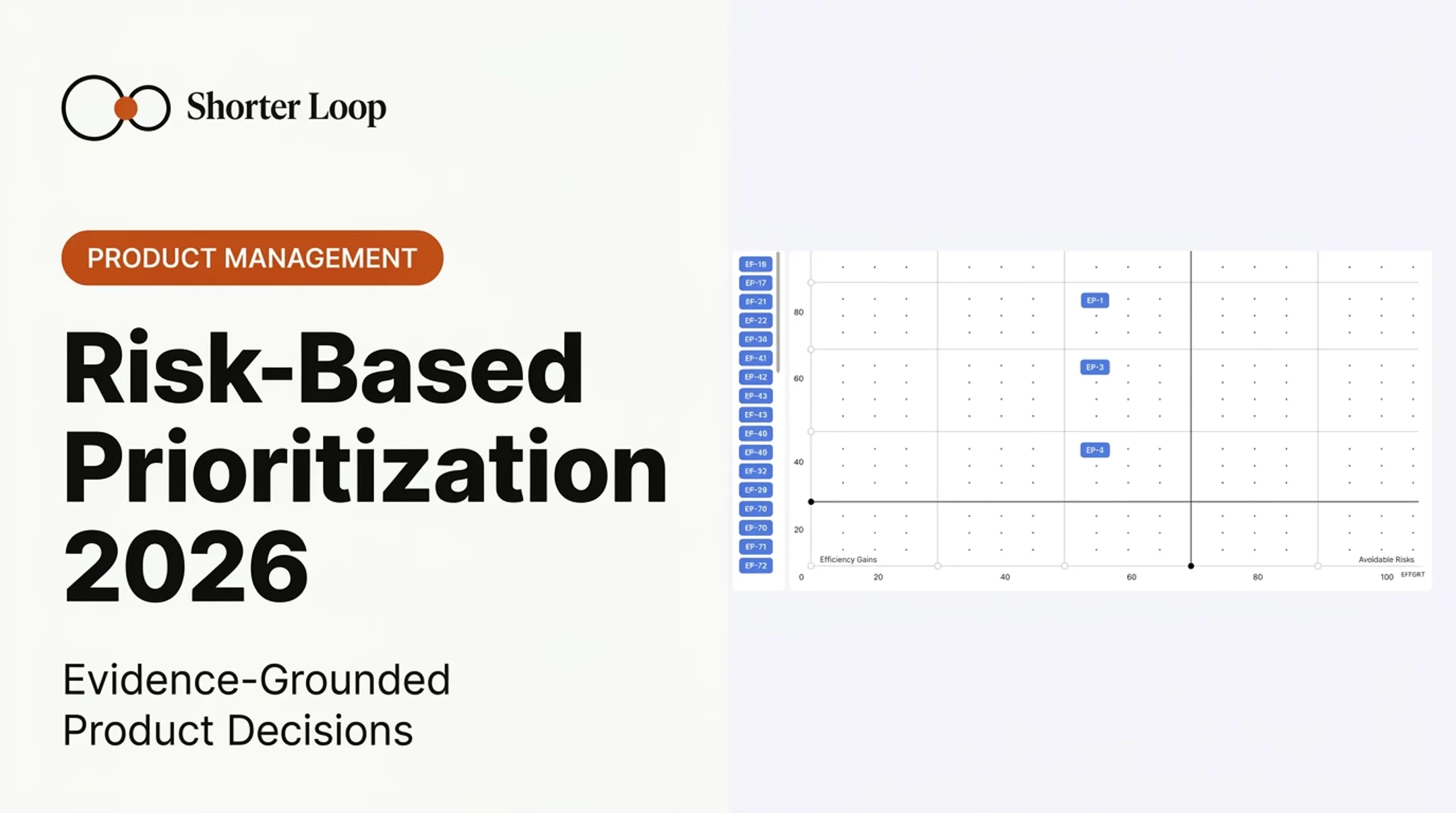
In the FlowDesk demo, candidate work is plotted by value and effort with a cut line; the cut line records what the team intends to fund with the capacity available for the quarter. Work below the line stays visible with its reasoning, so it can be revisited when capacity or evidence changes.
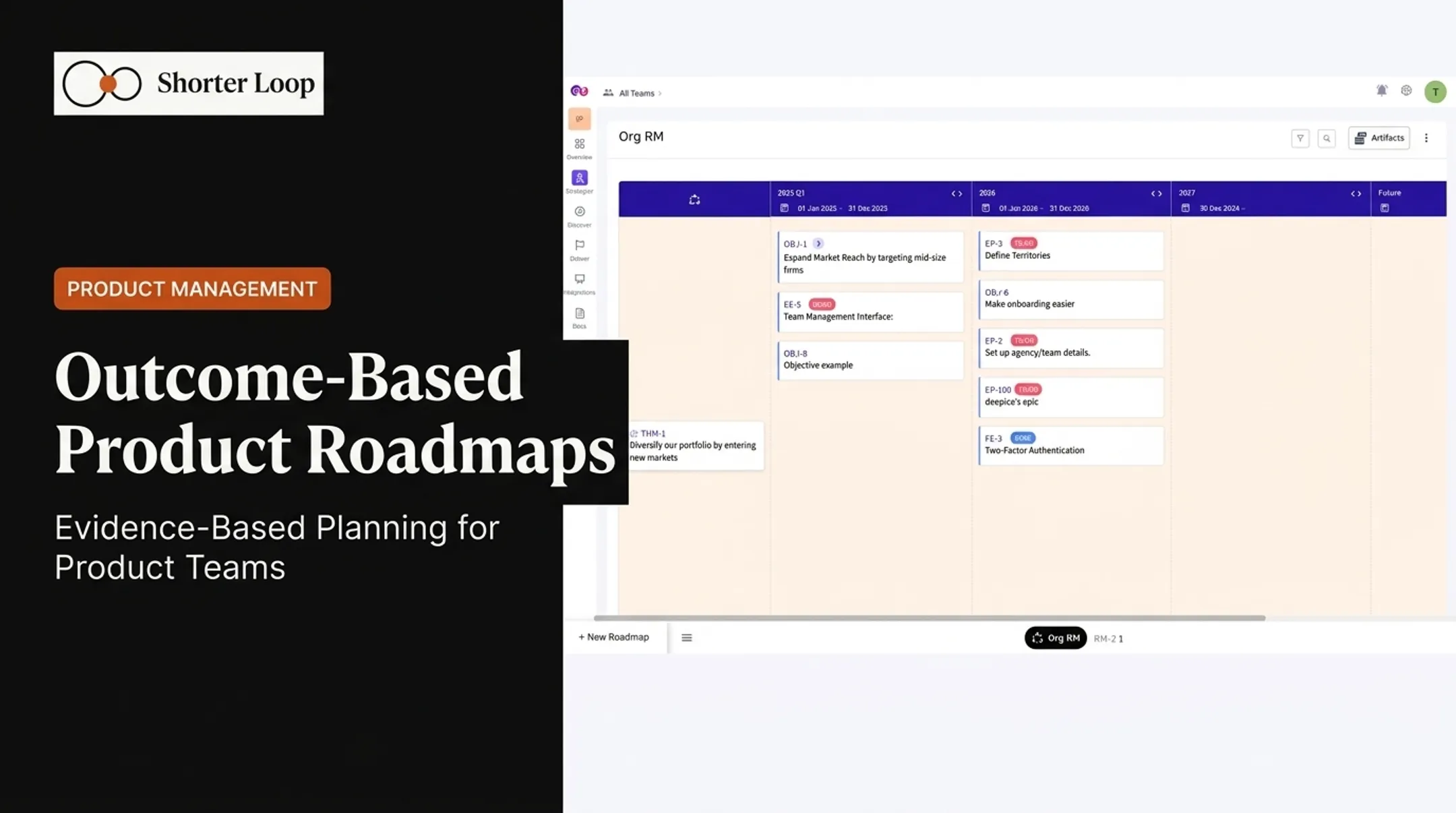
Step 4: Organize the Roadmap and Communicate It
Choose a format that matches the audience:
- Now/Next/Later for flexibility and honest uncertainty
- Themes and outcomes for executive or board conversations
- Initiatives and dependencies for cross-functional planning
Show enough detail for that audience, and no more. Sprint assignments and technical subtasks belong in a linked delivery plan, not the strategic roadmap itself.
Use confidence-based ranges instead of fixed dates for anything beyond the near term. A roadmap that only distinguishes "planned" from "done" turns dates into promises, whether you meant that or not.
Step 5: Connect the Roadmap to Execution and Outcomes
Link each initiative to its strategic objective, supporting evidence, an owner, the expected outcome, and any dependencies. Without that chain, nobody can explain why a bet exists six months later.
Define how you'll measure progress:
- Leading signals that show early learning (activation rate, time-to-value)
- Outcome measures that confirm the bet actually created value (retention, expansion revenue)
Schedule a review cadence, and stick to it. A common rule of thumb is to revisit the roadmap with stakeholders and engineers at least once a quarter, and sooner when the evidence shifts.
A mid-quarter review is where this chain gets used. If the evidence behind an epic has been contradicted since it was planned, the team can stop it before engineering starts rather than after it ships.

When Should You Create a Product Roadmap?
A roadmap is worth the effort when multiple teams or stakeholders need a shared view of direction, priorities, trade-offs, and expected outcomes. It's most useful for:
- Aligning a growing product organization around the same priorities
- Coordinating major cross-team initiatives
- Communicating strategy to leadership without drowning them in tasks
- Guiding discovery and delivery from the same evidence base
- Explaining clearly why some requests aren't being prioritized right now
For a single team, a simple objectives-on-a-timeline view works fine. Once several teams share the roadmap, grouping work into themes keeps the picture legible.
A roadmap becomes risky when it stops being strategic. Watch for these warning signs:
- Used as a detailed project schedule with sprint-level tasks
- Fixed dates promised 12+ months out
- Packed with every idea anyone has ever suggested
- Built before the team actually understands the customer problem
The right level of detail depends on organizational scale, decision complexity, audience, product uncertainty, and how many teams depend on each other's work. A five-person startup and a 200-person product org shouldn't use the same roadmap format, and forcing one to fit the other usually backfires.
What You Need Before Creating a Product Roadmap
Preparation decides whether your roadmap becomes a decision tool or a polished commitment list. Skip this step and you'll end up documenting opinions instead of strategy.
Vision, Strategy, and Outcome Requirements
Gather the current product vision, company objectives, strategic themes, target segments, and known constraints. Confirm each proposed initiative connects to a real customer problem or business objective.
Flag anything that only rests on opinion or urgency. "A senior stakeholder wants it" and "the enterprise team asked for it" aren't answers to why something belongs on the roadmap.
Evidence and Decision Context
Pull together customer interviews, support and sales themes, usage data, research findings, and results from prior shipped work.
The FlowDesk demo dataset shows why this matters. It holds 1,100 support conversations, 60 sales call notes, and 14 churn interviews, spread across different tools. Put side by side, the demo data shows 91% of accounts renewed when a second user logged in during week one, versus 32% of accounts that stayed single-user (a 68% churn rate). That's a correlation, not a cause: accounts that add a second user early may already be more committed. What it gives the roadmap is a hypothesis worth testing, which none of the sources showed on its own.

Preserve the reasoning behind past decisions too:
- Claims the decision rested on at the time
- Alternatives that were rejected
- Confidence level assigned
- What evidence would trigger a revisit
A decision made from solid evidence six months ago can be the wrong call today if conditions have shifted.
People, Tools, and Governance
Identify who needs to challenge assumptions and assess feasibility:
- Product, design, and engineering
- Research, marketing, and sales
- Customer success and relevant executives
When that evidence is scattered across spreadsheets, support tools, and old Slack threads, the reasoning behind a decision is usually the first thing lost.
Shorter Loop is a Product Integrity System that keeps the reasoning attached. Feedback from tools like Intercom or Zendesk, interview notes, and uploaded documents are linked to the claims and opportunities they support, and those link to the epics on the roadmap. Epics sync two-way with Jira, Azure DevOps, or GitHub, so a decision made in discovery still shows its evidence when it reaches engineering. Delivery status stays in the delivery tool: Shorter Loop doesn't replace Jira, so the integration has to be connected for the roadmap to show current progress.
Key Parameters That Affect Roadmap Quality
Roadmap quality has little to do with visual polish. It depends on how well the roadmap handles uncertainty, exposes trade-offs, and connects planned work to outcomes.
| Parameter | Why It Matters | What to Do |
|---|---|---|
| Evidence quality and confidence | Weak or stale evidence gets mistaken for a confirmed need | Label confidence explicitly; don't let low-confidence ideas masquerade as commitments |
| Strategic alignment | Unaligned initiatives consume capacity without moving the product forward | Test whether each item ladders up to a strategic objective, with a defined expected change |
| Prioritization criteria | Treating every request as equally urgent hides the real choices being made | Use consistent criteria so trade-offs and opportunity costs stay visible |
| Time horizon | Detailed long-range dates create false certainty | Add detail and confidence for near-term work; keep later horizons as themes, not dates |
| Traceability | Without links from evidence to outcome, teams can't explain a bet or learn from it | For each initiative, name the customer problem, the feedback or research behind it, the release that shipped it, and the KPI you checked afterward |
Traceability is also where evidence quality becomes visible. In Shorter Loop, each claim behind an initiative carries one of three states: Backed, Evidence disagrees, or Untested, linked to the evidence behind it. Sage, the AI inside Shorter Loop, says so when that evidence is thin instead of guessing. A two-year-old customer interview doesn't carry the same weight as this quarter's usage data, and a roadmap that can't show the difference will keep funding claims nobody has checked recently.

Common Mistakes, Troubleshooting, and Alternatives
In our reading, most roadmap problems trace back to unclear purpose, thin evidence, too much detail, or treating a living strategy as a fixed schedule. Use the checks below to spot the mistake, fix the symptom, and pick the right artifact for the job.
Common Mistakes
- Replace feature-only labels with the customer problem, intended outcome, evidence, and strategic theme behind each item.
- Involve delivery teams, customer-facing staff, and decision-makers before priorities lock—or expect rework later.
- Avoid premature dates; use confidence ranges or a Now/Next/Later view so teams do not ship the wrong thing fast.
- Apply explicit criteria and a documented "not now" list so politics and sprawl do not crowd out focus.
Troubleshooting Roadmap Problems
| Symptom | Likely Cause | Fix |
|---|---|---|
| Roadmap is stale | No owner, no review cadence | Assign an owner; review against new evidence |
| Stakeholders keep asking for status updates | Roadmap isn't accessible or current | Tailor views by audience; add a brief change log |
| Teams can't connect roadmap to delivery | Vague initiatives, missing links | Link epics and delivery plans without losing the strategic layer |
| Roadmap is full but nothing's prioritized | No real criteria applied | Revisit strategy; remove items without strong evidence |
Alternatives and Related Artifacts
A roadmap isn't the only tool you need, and using it for the wrong job creates friction:
- Use a product strategy document to define positioning and target customers, not to sequence initiatives.
- Use a project or delivery plan when you need tasks, dates, owners, and dependencies for a specific initiative.
- Use a backlog or opportunity solution tree to manage candidate work and preserve options before committing anything to the roadmap.
These artifacts work best as a set. Strategy sets direction; the roadmap communicates prioritized outcomes. Discovery tests assumptions, and delivery plans coordinate the work itself.

Conclusion
Here's a test you can run on your current roadmap this week. Pick the three items closest to delivery and, for each one, write down the outcome it supports and the most recent piece of evidence behind it, with its date.
If you can't name the evidence, or the newest piece is older than your last planning cycle, that item is resting on a claim nobody has rechecked. Move it back to discovery, or schedule the check before engineering starts. To run that check on your own top three items with the claims and evidence attached to each one, start a 14-day free trial of Shorter Loop; you won't need a credit card.
Frequently Asked Questions
Can you provide an example of a product roadmap?
A SaaS company might show Now: "Reduce onboarding friction for new accounts," Next: "Improve second-user activation," Later: "Explore team-based pricing tiers." Each column reflects a customer outcome, not a feature delivery date.
What is the difference between a product strategy and a product roadmap?
Strategy defines the choices and approach for achieving a product vision, such as which segment to serve and how to win. The roadmap communicates the prioritized outcomes and initiatives that express that strategy over time.
What is the difference between a product roadmap and a project plan?
The roadmap shows strategic direction and prioritization across multiple releases. A project plan handles detailed tasks, dates, owners, dependencies, and execution controls for one specific piece of work.
What is a product roadmap strategy?
It's the method for translating product vision, customer evidence, and business goals into a flexible roadmap that guides investment and communication. The focus is decision logic, not slide format.
What are the four types of product strategies?
There's no single universal four-item list. Porter's three generic strategies are cost leadership, differentiation, and focus, per Cambridge's Institute for Manufacturing. Ansoff's four growth options are market penetration, market development, product development, and diversification—name the framework you actually use.