
Introduction
A product manager at a growing B2B company usually has more ideas and requests than capacity, and the requests come from every part of the business:
- Sales wants the feature that almost closed last quarter's deal
- Support wants the bug fixed that's generating tickets
- Leadership wants the initiative tied to next year's strategy
None of these voices are wrong. But if the loudest one wins by default, the roadmap becomes a record of who spoke last, not of what matters most.
Prioritization frameworks give the people in that conversation a shared way to compare customer value, business impact, effort, confidence, and risk, so the decision depends less on who has the most political capital in the room.
This guide compares the frameworks product teams commonly use, explains when each one fits, and shows how to tie a prioritization call to the evidence and outcomes behind it.
Key Takeaways
- Frameworks make trade-offs visible; they don't hand you an automatic answer.
- Match the job: Value vs. Effort or MoSCoW for fast alignment, RICE or weighted scoring for ranked backlogs, Kano or opportunity scoring when evidence leads.
- Record the evidence, claims, and intended outcome behind every bet.
- Revisit priorities when evidence, goals, or constraints change.
What Product Prioritization Means
Product prioritization is the process of deciding which customer problems, opportunities, features, experiments, or technical improvements deserve attention first. ProductPlan describes it as ranking potential work items by importance, whether a roadmap theme, an initiative, or a single feature, in its prioritization glossary.
Feature prioritization ranks proposed solutions. Problem or outcome prioritization starts earlier: which customer problem or business result deserves investment before anyone sketches a solution.
Silicon Valley Product Group makes this point: a requested feature is a theory about how to hit an objective, not the objective itself. Score the feature and you've committed to someone's guess. Score the underlying problem and you keep your options open.
The cost of scoring guesses can show up in usage data. Pendo's 2019 Feature Adoption Report, an analysis of 615 customer subscriptions, found that 80% of features were rarely or never used. The figure doesn't show that weak prioritization caused that, and there are other explanations, such as poor discoverability or onboarding. It is consistent with features being built for problems nobody checked first.
What weak prioritization costs a growing B2B SaaS team:
- Fragmented roadmaps where each team optimizes locally
- Overloaded backlogs where everything is "important"
- Duplicated work across teams solving the same problem differently
- Decisions nobody can explain six months later, because the reasoning behind them never got written down
That last point matters more as an organization grows. A two-person startup can hold context in someone's head. A thirty-person product org can't.
Why Your Framework Gets Overridden, and What to Record When It Does
Inflated categories and false precision. Watch for:
- Too many items marked "Must-Have" (if everything's critical, nothing is)
- Scoring definitions that shift between sessions or scorers
- Confidence levels nobody can justify with evidence
- Formulas that look rigorous but hide subjective inputs
The fix is a shared scoring rubric and a rule: every score needs a linked piece of evidence, not just a gut feeling written as a number.
Process failures that undercut the whole exercise:
- Ignoring dependencies and real team capacity
- Mixing discovery work and delivery work without acknowledging they carry different levels of uncertainty
- Letting scored items go stale without revisiting them as evidence changes
- Allowing executive escalation to bypass the agreed process entirely
The last one is widespread. According to ProductPlan's 2026 State of Product Management survey, 60.2% of product professionals pointed to leadership escalations or new directives as a factor that overrides their prioritization process.

Escalations happen. The failure is skipping documentation when they do, so the exception becomes the new unwritten rule.
A framework's job is to make trade-offs visible, not to end discussion. If the process is set aside every time someone senior disagrees, record each override and its reason. That record shows how decisions are really being made, which is the first thing to fix.
Product Prioritization Frameworks at a Glance
No framework is best for every decision. Each one answers a different question, and using the wrong one for the decision is its own kind of mistake. Here's how the main options compare.
Value vs. Effort / Impact vs. Effort
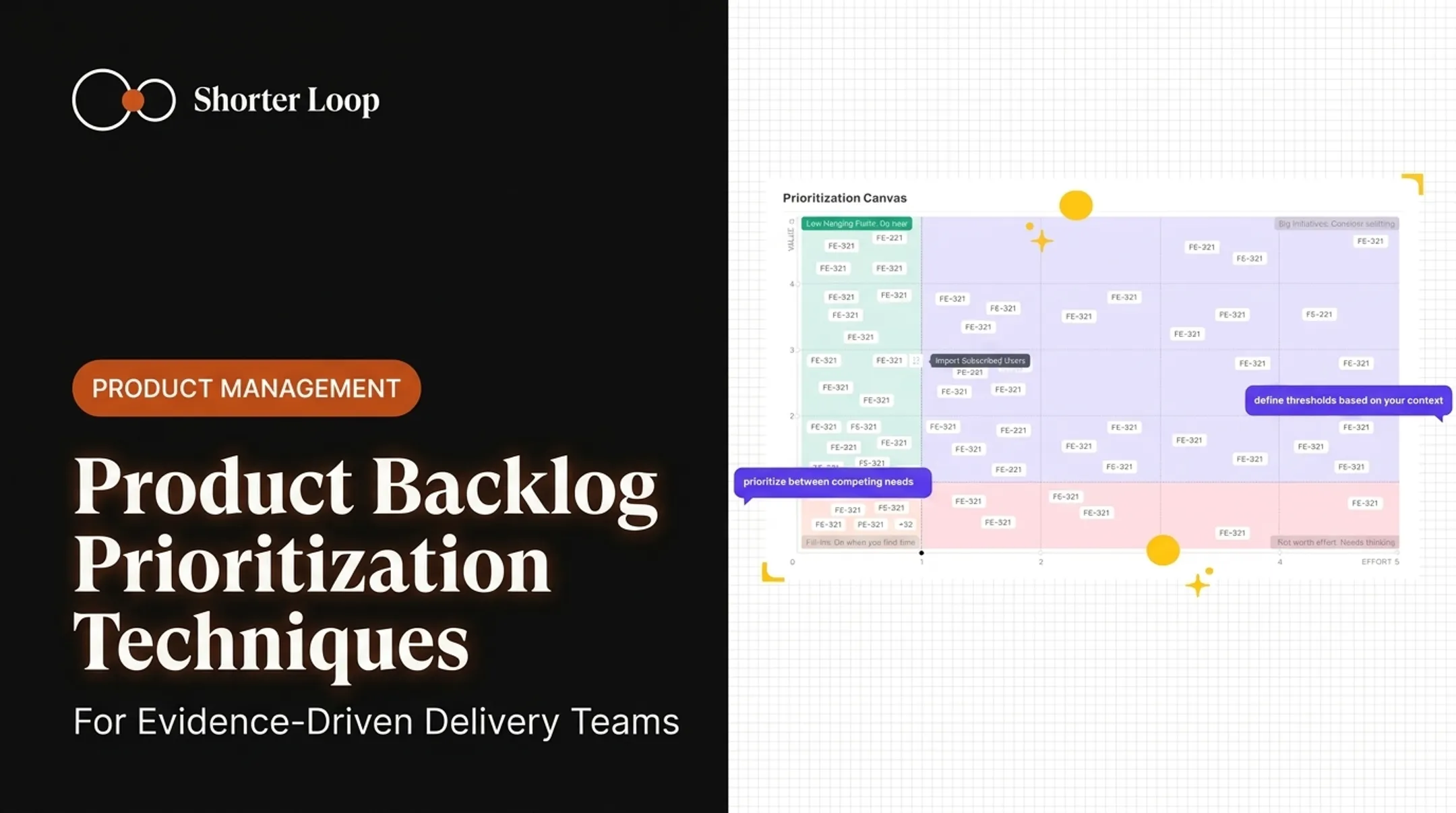
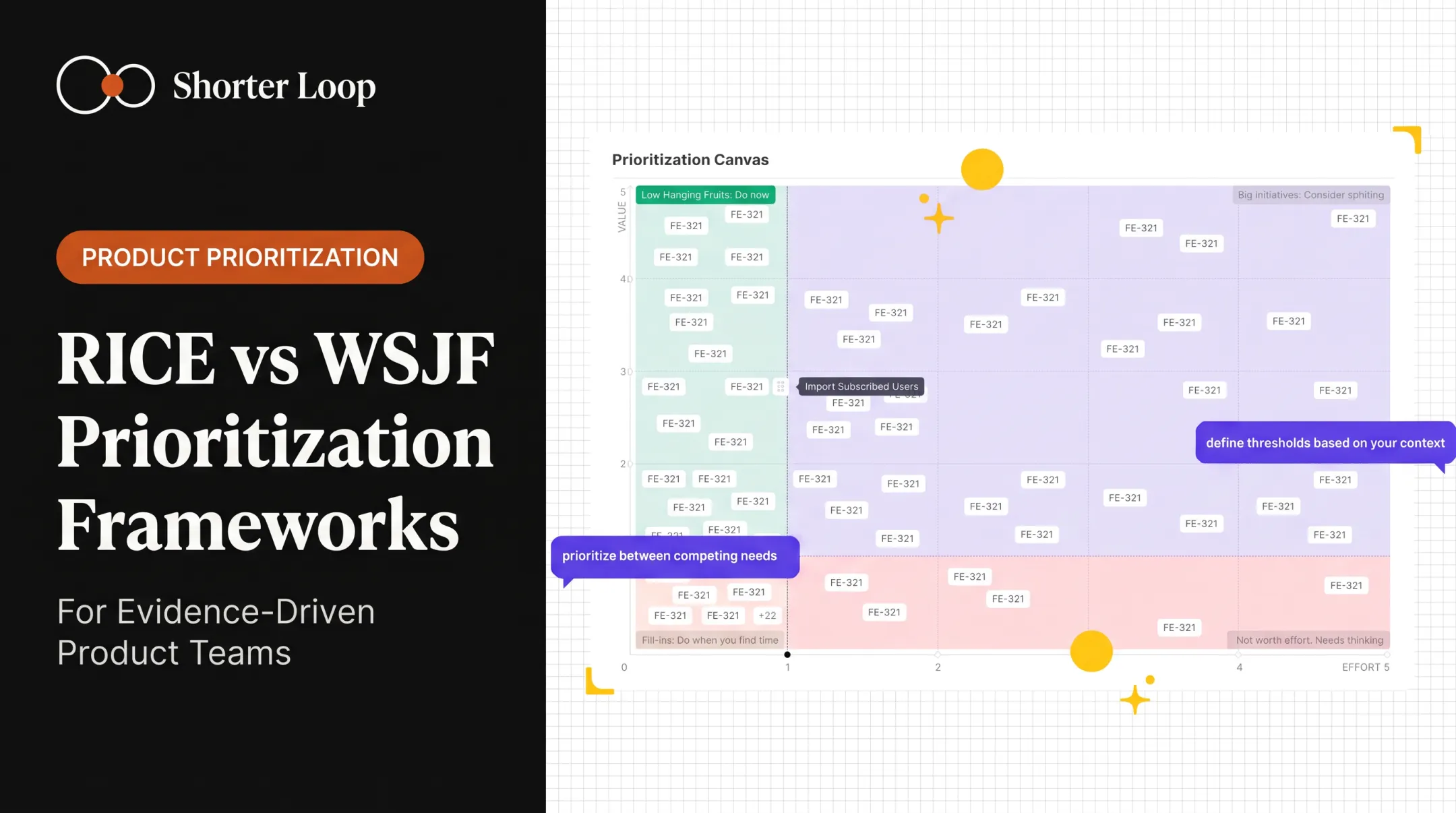
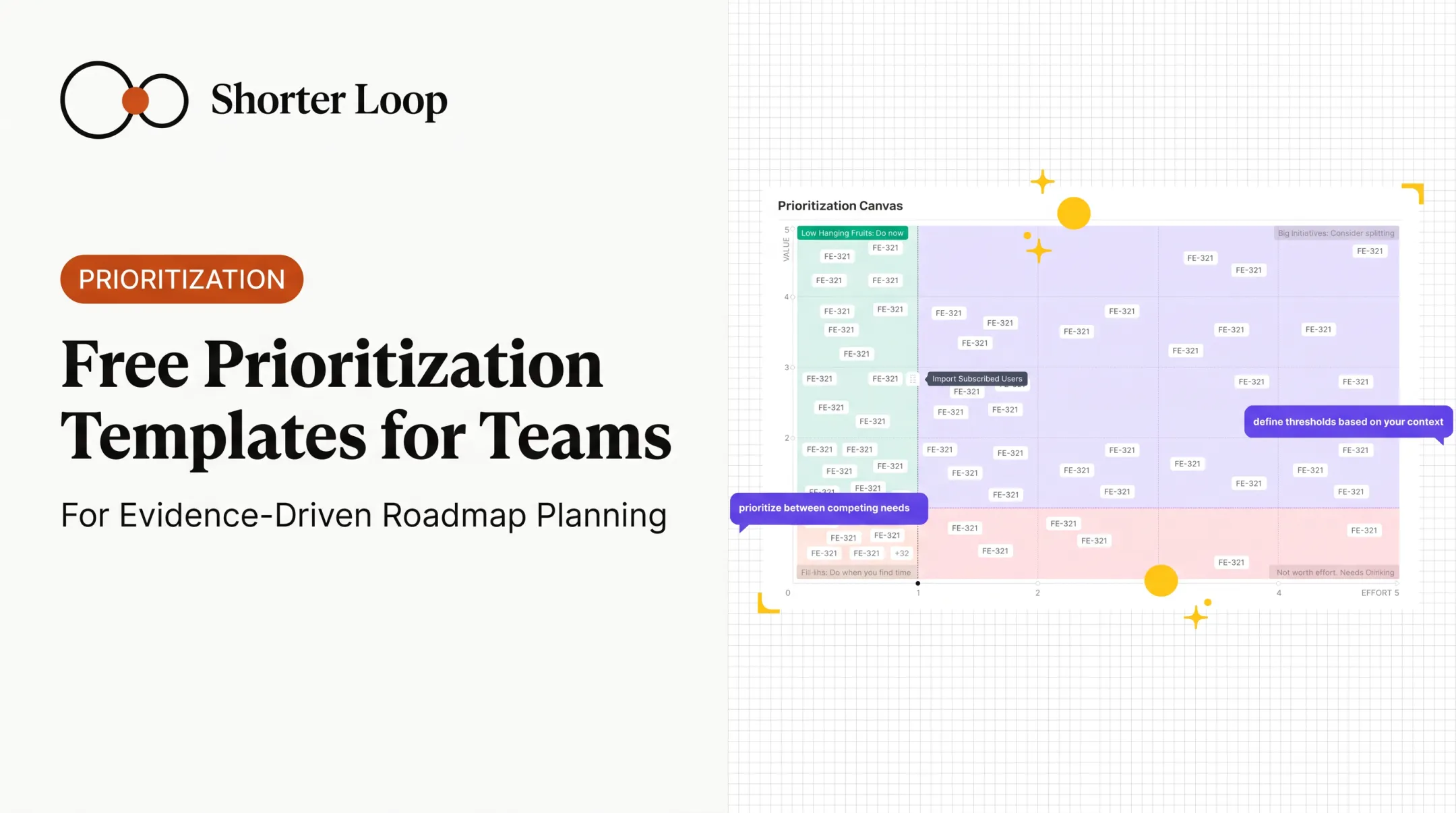
This is the fastest visual triage method. Plot candidates on two axes: value (or impact) and effort.
| Impact | Effort | Common Label | What to Do |
|---|---|---|---|
| High | Low | Quick wins | Ship these first |
| High | High | Big bets | Evaluate capacity before committing |
| Low | Low | Fill-ins | Do selectively |
| Low | High | Time sinks | Decline or rethink |
Product School notes in its impact/effort matrix guide that placement gets subjective fast if the team hasn't agreed on what "high impact" means. It's a discussion starter, not a ranked output.
Shorter Loop supports value/effort prioritization, and the scores sit next to the evidence linked to each item, so a "high value" placement can be checked against what supports it.
Here's an illustration from Shorter Loop's demo data. FlowDesk, a fictional demo dataset Shorter Loop uses to show the product, is set up as a shift-scheduling company. In the demo workspace, six epics are plotted on the matrix: three quick wins, one strategic bet, one low-priority item, and one that's hard to justify at all. A visible cutline for the quarter shows what's in and what's out, with custom shift templates below the line.
RICE
RICE scores initiatives on four factors: Reach (how many customers it touches), Impact (how much it changes the outcome you care about), Confidence (how sure you are), and Effort (person-months required).
RICE = (Reach × Impact × Confidence) ÷ Effort
As outlined in Intercom's RICE framework, Intercom grades impact on a relative scale and uses confidence explicitly to reflect uncertainty in the other three numbers. Sean McBride, the framework's author, has been clear that the resulting score is a way to compare estimates and support judgment.
RICE works best once you have more than one candidate solution for the same problem. In Shorter Loop, solutions sit under opportunities on the Tree view in Product Strategy, and RICE scoring can be used to compare them, with the team setting each input itself and checking the claims behind them on the evidence state, so you're ranking real alternatives instead of weighing one idea against nothing.
Weighted Scoring
Weighted scoring lets you pick your own criteria (customer value, strategic fit, revenue potential, risk reduction, effort) and assign each one a weight before scoring candidates against it.
It's more flexible than RICE, which is both its strength and its risk. Product School warns in its weighted scoring model guide that assigning weights is subjective. A polished spreadsheet with a clear numerical winner can still hide contested assumptions behind a false sense of objectivity.
Kano and Opportunity Scoring
These two methods share a starting point: direct customer input, not internal opinion.
Kano classifies features into three types:
- Basic needs: expected; punished if missing
- Performance needs: more is better
- Delighters: unexpected; disproportionately valued
It works by asking customers how they'd feel with a feature and without it, then interpreting the paired responses.
Opportunity scoring, built on Anthony Ulwick's Outcome-Driven Innovation approach, asks customers how important a desired outcome is and how satisfied they currently are with achieving it. The gap between those two numbers points to underserved opportunities. Strategyn's opportunity algorithm weights that gap by importance, so attention goes to outcomes that matter but still aren't being met.
Use Kano when you're testing reactions to a specific feature idea. Use opportunity scoring when you're still exploring what the underlying job or outcome is.
MoSCoW, Cost of Delay, and Collaborative Methods
MoSCoW sorts candidates into Must Have, Should Have, Could Have, and Won't Have (this time). It fixes time, cost, and quality while negotiating scope, which makes it well suited to release planning and MVP boundaries.
Cost of Delay asks a different question: what does waiting cost you? It's about timing and sequence, not implementation effort.
Collaborative methods like Story Mapping, Product Tree, and Buy a Feature bring customers and stakeholders into the conversation to surface priorities together rather than scoring them in isolation. Shorter Loop includes story maps: each solution has its own map, where goals run across the top, features sit under each goal and user stories under each feature.

None of these replace judgment. They structure the conversation so judgment has something concrete to work from.
How to Choose and Apply the Right Framework
Start with the decision you're making, not the framework you like best.
Are you:
- Defining MVP scope? → MoSCoW
- Ranking a large backlog? → RICE or weighted scoring
- Testing whether customers even want this? → Kano or opportunity scoring
- Facing a hard deadline with fixed capacity? → Value vs. Effort with a cutline
- Deciding whether timing changes the value of an initiative? → Cost of Delay
Once you know the decision, gather your evidence before anyone scores anything:
- Customer research and usage data
- Support and sales signals
- Strategic goals
- Technical constraints and dependencies
- How recent each input is
The FlowDesk demo data includes a case of skipping this step. The top-ranked backlog item, an import wizard rebuild, has a credible effort estimate but a value score that rests entirely on an untested explanation for churn. In Shorter Loop, that explanation shows up as a claim that is still untested, with no evidence linked to it. The score looks rigorous; the evidence underneath it isn't there.
A Practical Workflow
- Clarify the outcome you're trying to move, not just the feature you're considering
- Collect and link evidence from research, usage data, and support signals
- Define scoring guidance so "high confidence" means the same thing to every scorer
- Involve product, design, engineering, and relevant stakeholders before scores are final
- Score or map the candidates using the framework that fits the decision
- Discuss disagreements openly rather than letting the highest score settle it without discussion
- Record the decision and rationale somewhere the team can find it later

Frameworks also combine well. Use Value vs. Effort for a quick first pass, then apply RICE or weighted scoring to the smaller set that remains. Use MoSCoW afterward to draw the release boundary.
The FlowDesk demo workspace follows roughly this sequence: score value and effort, plot into quadrants, draw a cutline, then break the top epic into stories ready for a sprint.
The step most often skipped is the one after delivery. Document the hypothesis, the intended outcome, the owner, and the success measure, then check what happened.
In Shorter Loop, that step has a place to live: a solution's Delivery tab shows the versions and backlog items that deliver it, and its epics go to delivery through the Jira, Azure DevOps, or GitHub sync. Each version carries a hypothesis and, once assessed, a verdict of Validated, Inconclusive or Invalidated, with outcome evidence linked to back it. Shorter Loop doesn't replace the delivery tool, and it doesn't assign people or track hours. It does let the team draw a visible cutline on the value/effort view, recording what it intends to fund with the capacity available for the period; staffing and scheduling stay in your delivery or resourcing tool.
The Mistake Underneath the Others: Scoring Requests Instead of Problems
Most of the failures above start in the same place. If your backlog captures every raw request instead of the problem underneath it, the scores end up ranking noise, however careful the rubric. A sales rep will naturally push hardest for the feature that lost the last deal, which isn't necessarily what would win the next hundred. Before anything is scored, group requests by the problem they describe and score that.
Conclusion: Keep the Reasoning With the Ranking
The right framework is the one that fits your decision, your evidence, and your team's maturity, not the most complex model available. A five-person startup doesn't need weighted scoring across nine criteria. A hundred-person product org can't run on gut feel alone.
Whichever framework you use, run this diagnostic on your current top three priorities. For each one, can you trace it backward through:
- The customer evidence and claims that justified it
- The decision itself
- The delivery work that followed
- The outcome that happened, or the date you'll be able to measure it
If any priority breaks the chain at the first step, re-score it once the evidence is linked, or move it below the cutline. If you'd like to see how Shorter Loop links evidence, scores, and delivery work, you can start a 14-day trial (no credit card) or book a walkthrough.
Frequently Asked Questions
What is the best product prioritization framework?
There's no universal best framework. Choose based on the decision at hand: RICE works well for structured ranking of a large backlog, while Value vs. Effort suits fast, visual triage.
What is feature prioritization in product management?
Feature prioritization means deciding which potential product improvements to address first, based on customer value, business goals, confidence, effort, urgency, and feasibility. It differs from problem prioritization, which starts a step earlier.
What is a good prioritization matrix for product managers?
The Value vs. Effort (or Impact vs. Effort) matrix is a solid default. It sorts candidates into four quadrants: quick wins, big bets, fill-ins, and time sinks, but only works if the team agrees on what "value" and "effort" mean before scoring.
How often should we re-score the backlog?
Re-score when the evidence changes, not on a calendar. A quarterly pass over the top of the list catches most drift; scores further down go stale harmlessly. What matters more than the cadence is that a claim that is untested, or that the evidence disagrees with, triggers a re-look at anything resting on it.
What do we do when leadership overrides the ranking?
Record the override and the reason beside the item, then carry on. Escalations are normal; the damage comes from not writing them down, because the exception quietly becomes the unwritten rule and the framework stops being trusted. A log of overrides and their reasons also shows, after a quarter or two, how decisions are really being made.
How do we score work that is mostly discovery?
Score it on what you expect to learn rather than what you expect to ship. A two-week test that could kill a quarter of planned work has a different value profile from a feature, and forcing it through the same impact scale usually ranks it last. Give discovery its own slice of capacity instead of making it compete.