
Nearly half of surveyed product professionals point to visibility gaps and data silos as a reason they're consolidating tools, according to ProductPlan's 2024 report. That's not an isolated frustration. It's what happens when planning information lives in too many places at once.
A quarterly roadmap closes that gap. It is a concise planning view that ties this quarter's priorities to customer problems, business goals, and the evidence behind each bet, and it earns its place when several teams plan against the same goals. This article covers what a quarterly roadmap actually is, what belongs in one, which format fits your audience, and how to keep it current as things change.
Key Takeaways
- A quarterly roadmap turns strategic goals into a focused set of initiatives for a three-month window
- A roadmap that holds up explains the reasoning behind each priority, alongside the features and dates
- Pick the roadmap view based on the audience: executives want outcomes, delivery teams want dependencies
- Update the roadmap whenever the evidence behind an item changes
What Is a Quarterly Roadmap?
A quarterly roadmap is a high-level plan showing the objectives, focus areas, initiatives, and expected outcomes a team is pursuing over one quarter. It sits between long-range strategy and day-to-day execution, giving teams enough specificity to act on without pretending to know more than they do.
It's easy to confuse a quarterly roadmap with neighboring planning artifacts. Each one answers a different question:
| Artifact | What it answers | Time horizon |
|---|---|---|
| Annual strategy | Where is the product headed overall? | 12 months |
| Quarterly roadmap | What are we prioritizing right now, and why? | 3 months |
| Delivery plan | How will this get built? | Weeks to a quarter |
| Sprint backlog | What's being worked on this cycle? | 1-2 weeks |
According to Scrum.org, a roadmap explains the strategic "why" behind development, while a release plan handles the "what" and "when" of actual delivery. A quarterly roadmap should never try to double as a release schedule.
Why Three Months Works
A quarter is long enough to pursue a meaningful objective and short enough to adjust when customer needs, market conditions, or capacity shift. Commit to a year and you're locked into assumptions that may not survive contact with real users. Plan week by week and you lose sight of the bigger bet you're making.
Who uses it:
- Product leadership setting direction and checking resourcing
- Product managers translating strategy into initiatives
- Engineering and design leads assessing feasibility
- Go-to-market teams preparing for what's coming
- Executives tracking investment against outcomes
Each group needs a different slice of detail from the same underlying plan, a point we'll come back to.
What to Include in a Quarterly Roadmap
A roadmap built around feature names and ship dates tells you what's happening, not why it matters. The stronger approach starts with context and works outward.
Strategic context first. State the objective, the customer problem being addressed, and why it matters this quarter specifically. Skipping this is how roadmaps turn into to-do lists.
Goals tied to measurable outcomes. Don't just list features. Explain how success will be evaluated, using metrics your organization already tracks where possible. According to ProductPlan's 2023 report, 54% of roadmaps were still built around outputs, while only 44% communicated outcomes. That gap is worth closing.

Initiatives grouped by theme. Organize by strategic bet, customer problem, or product area, not a flat feature list. In Shorter Loop, each roadmap is created from a Now / Next / Later or Timeline template, and objectives carry the key results that define them, so an initiative sits under the goal it serves rather than standing alone.
Evidence behind each bet. Every major initiative should trace back to something real: customer interviews, support themes, usage data, or a prior experiment. A SaaS team (FlowDesk, a fictional demo dataset Shorter Loop uses to show the product) built its Q3 "Fix Enterprise Retention" outcome on 41 pieces of feedback from support conversations, sales notes, and churn interviews, not a single loud customer request.
Confidence and timing, honestly labeled.
- Mark work as committed, planned, or exploratory
- Use quarter- or month-level timing only when confidence supports it
- Avoid exact launch dates for work that's still speculative
Execution context, kept lightweight. Note owners, major dependencies, and key risks. Link out to the detailed delivery plan for epics and stories rather than cramming task-level detail into the roadmap itself.
Copyable Quarterly Roadmap Template
Use one row per initiative. The example is fictional.
| Quarter | Objective | Customer problem | Evidence | Initiative | Owner | Success measure | Dependencies | Review date |
|---|---|---|---|---|---|---|---|---|
| [Quarter/year] | [Desired outcome] | [Problem and segment] | [Evidence links] | [Proposed bet] | [Owner] | [Baseline and target] | [Constraints] | [Date] |
| Example quarter | Improve first-week activation | New administrators struggle to invite colleagues | [Interview and activation evidence] | Test a clearer invitation flow | [Owner] | [Agreed activation measure] | [Dependency] | [Review date] |
Before approving an initiative, confirm its evidence, owner, success measure and review date. Update the row when new learning changes the decision.
Roadmap Formats and When to Use Them
There isn't one correct roadmap format. The right one depends on who's reading it and how much certainty you actually have.
Objective and Initiative
A simple table: objective, customer problem, initiative, expected outcome, owner, confidence, status. This works well for executive alignment and multi-team planning, where the audience wants strategic clarity, not task detail.
Outcome-Based
Structured around objectives, key results, supporting evidence, and the initiatives meant to move those results. This format keeps teams from mistaking shipping activity for actual success, since the measure of progress is the outcome, not the release.
Capacity and Dependencies
Adds team capacity, cross-team dependencies, risks, and sequencing, often with scenario options:
- A committed plan
- A constrained plan (if capacity drops)
- A stretch plan (if things go well)
This suits growing B2B SaaS organizations where engineering, design, and go-to-market teams are all competing for the same limited resources.
Now, Next, Later
Instead of fixed dates, work is grouped into broad horizons or confidence levels. It's a good fit when future priorities are still being discovered and a precise date would just create false certainty. Shorter Loop offers both kinds of roadmap, Now / Next / Later and Timeline, and you pick one when you create each roadmap, because a roadmap's kind can't be changed afterward.

Audience-Specific Views From One Source of Truth
The same underlying data can become different views for different people:
- Executives see themes, investment, and outcomes
- Delivery teams see dependencies and near-term detail
- Sales and customer teams see customer value and broad timing
The goal is one coherent source of reasoning, with the level of detail adjusted per audience, not separate roadmaps that quietly contradict each other.
How to Build and Run a Quarterly Roadmap
Building the roadmap is only half the job. Running it through the quarter is where most plans break down.
Review evidence and last quarter's learning. Pull together customer feedback, support and sales themes, usage signals, and experiment results. Separate corroborated problems from opinions and untested requests.
Set goals and prioritize initiatives. Translate current priorities into a small number of quarterly objectives. Evaluate candidates against customer value, strategic fit, effort, confidence, and dependencies. Frameworks like RICE or ICE support this conversation, but they inform judgment, they don't replace it.
Check feasibility before committing. Bring in engineering, design, data, marketing, and customer success leads to review capacity and constraints. Where uncertainty is high, compare realistic scenarios instead of forcing one number.
Align stakeholders around the "why." Present the roadmap as a set of choices and hypotheses. Explain what evidence supports each one, what's uncertain, and what you're deliberately not doing this quarter. Capture objections and decisions so the reasoning survives the meeting.
Connect the roadmap to execution. Link initiatives to delivery work without turning the roadmap into a task tracker. This is where a system like Shorter Loop can help: it connects customer evidence, strategy, roadmap bets, and delivery outcomes in one continuous loop, so a team can trace why a bet exists and what actually happened once it shipped. A walkthrough shows how that connection holds up across a full quarter.
Inspect and update throughout the quarter. Use recurring check-ins to review progress, new evidence, and whether the expected outcome still justifies the investment.

The FlowDesk example is instructive here. Its churn objective sat open at 15%, against a 12% target, well into the quarter. Rather than quietly letting the number ride, the team stopped two epics before writing a line of code and returned six weeks of engineering time to the roadmap. That kind of visible course correction only happens when the roadmap shows stopped work with a reason, not just a "done" column.
Common Quarterly Roadmap Mistakes and How to Avoid Them
Most roadmap failures start when teams treat the document as something it was never meant to be.
Treating it as a fixed contract. Specific deliverables with hard deadlines should be the exception, not the default, according to SVPG's research. Use confidence levels and explicit assumptions so the plan can flex without eroding trust.
Filling it with features instead of reasoning. Every major item should connect to a customer problem, a goal, supporting evidence, and an owner who can explain the bet.
Overcommitting without a feasibility check. Review capacity and dependencies across teams before locking in a priority. Document what gets delayed or descoped to make room.
Running separate roadmaps per stakeholder. Maintain one source of reasoning and evidence, then tailor the view, not the underlying commitments, for each audience.
Updating only at quarter boundaries. Schedule lightweight check-ins mid-quarter, plus an end-of-quarter review that records outcomes, misses, and what assumptions changed for next time.
What the Board Looks Like Across Several Teams
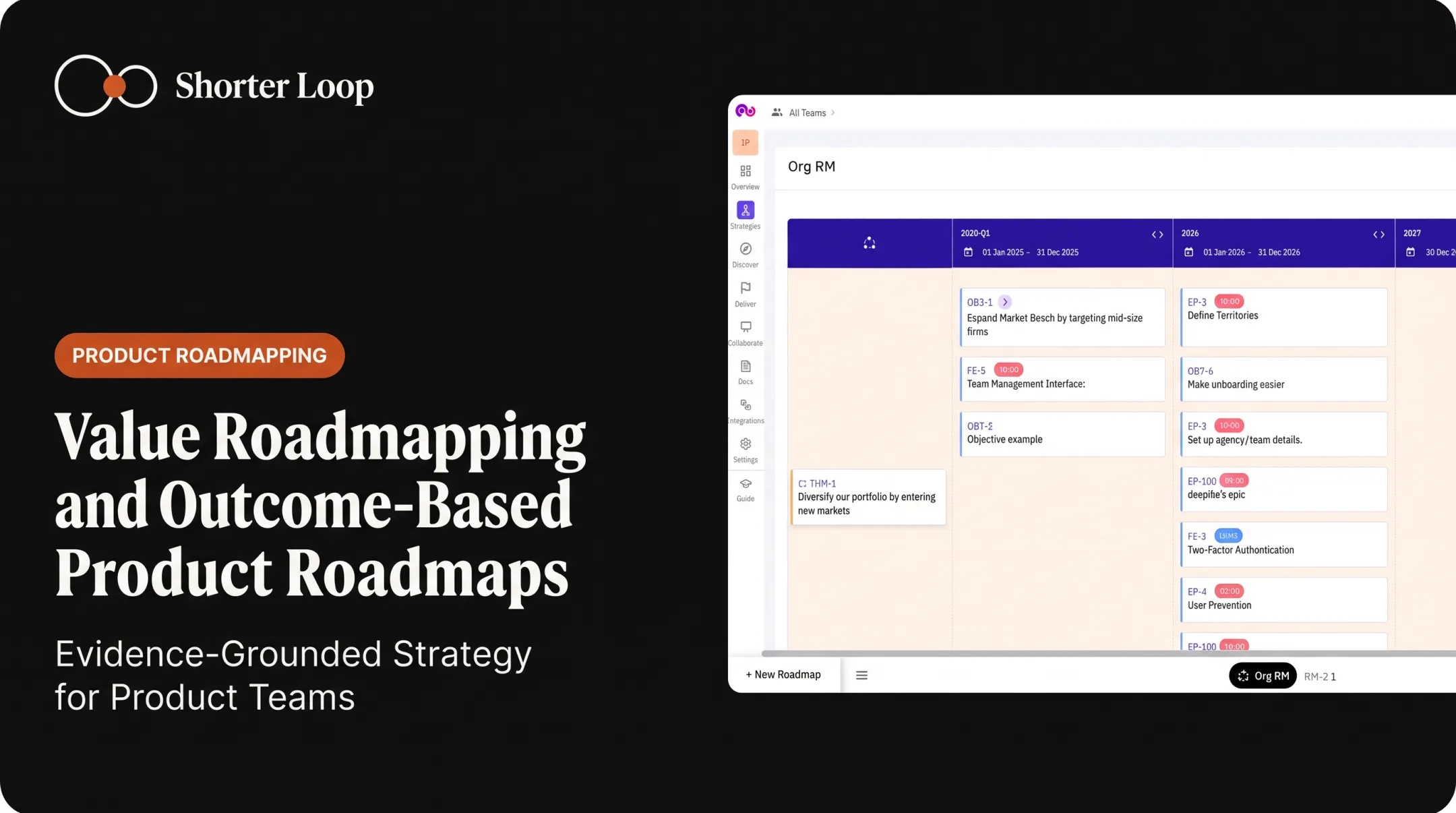
A worked example. The roadmap is created from a Timeline template, so the columns are the four quarters. The rows are themes: onboarding, data trust, reporting. Inside each theme sit objective lanes, one per objective, so the Integrations squad's objective and the Reporting squad's objective are visibly separate rows even where their work lands in the same quarter.
Cards are the opportunities, solutions, epics and features placed on it. Click a strategy card and it opens in the strategy side panel; epics and features open in the backlog quick view. On the full page of an opportunity or solution, the claims line under the title reads something like "4 claims · 2 backed · 1 evidence disagrees · 1 untested", and the Evidence tab shows the sources behind it.
For leaders running several products rather than several squads, Org Roadmap rolls those boards up into one cross-product view. It needs the Enterprise plan, or the organization roadmap turned on.
Frequently Asked Questions
How do you run quarterly planning?
Review evidence and last quarter's learning first. Set goals, prioritize initiatives, and check capacity and dependencies across teams. Align stakeholders on the reasoning, then document decisions before publishing the roadmap.
How often should quarterly planning meetings be held?
Hold the main planning session once per quarter, with shorter recurring reviews in between, often at the start and midpoint. The right cadence depends on how fast your market and evidence are changing.
What are good goals to include in a quarterly roadmap?
Customer, product, business, quality, or learning goals tied to measurable outcomes work best. Each goal should come with a clear explanation of why it matters this quarter, not just a target number.
What is a quarterly roadmap?
It's a high-level plan for a three-month period that connects objectives and customer problems to initiatives, expected outcomes, ownership, timing, and confidence level.
What does a quarterly roadmap look like?
Common layouts include quarter columns, objective-and-initiative tables, outcome-based boards, or Now-Next-Later views. The right layout shows only the detail the intended audience actually needs.