
This is the daily reality for most product teams: more plausible bets than capacity to pursue them. A scoring model only helps if the organization respects what it produces.
Good prioritization software should do more than sort a backlog by score. It should help you compare opportunities using real evidence, make trade-offs visible to stakeholders, and carry the reasoning behind a decision into delivery and outcomes.
This guide compares five prioritization tools for product teams, dedicated prioritization platforms and one broader work-management option, against evidence traceability, scoring flexibility, collaboration, roadmap visibility, integrations, and scalability.
Key Takeaways
- Prioritization software ranks ideas, requests, and initiatives against customer value, strategic fit, confidence, effort, and timing.
- Strong tools link customer evidence and decision rationale to roadmaps and delivery, not just another backlog.
- Shorter Loop fits growing product organizations that need to preserve reasoning behind bets from discovery through outcomes.
- Compare tools by workflow fit, evidence quality, framework flexibility, collaboration, and adoption effort, not feature count alone.
Overview of Prioritization Software for Product Teams
Product prioritization software helps teams collect opportunities, apply structured criteria, rank competing bets, communicate roadmap decisions, and revisit priorities as new evidence appears. That's a different job than managing tasks.
Prioritization Tools vs. Task Management Tools
Task-management software manages committed work: sprints, assignments, deadlines. Prioritization software helps decide what deserves that commitment in the first place.
The line between the two categories is worth drawing: product-management software covers the product lifecycle, ideas, feedback, and strategy, while project-management software covers plans, tasks, schedules, and resources. The two overlap on collaboration and tracking, and they solve different problems.
For scaling B2B SaaS teams, this distinction gets sharper every quarter. As organizations add product teams, feedback arrives from a dozen corners: support tickets, sales calls, win-loss interviews, and app reviews. It ends up scattered across inboxes and spreadsheets.
Strategy dilutes as it passes through more layers. Roadmaps disconnect from the evidence that justified them. And decisions tend to outlive the reasoning behind them.

What Good Prioritization Software Actually Does
A capable platform in this category should offer:
- Scoring frameworks such as RICE, weighted value models, or custom formulas
- Customer-feedback inputs tied to specific opportunities
- Custom fields for effort, confidence, and strategic alignment
- Roadmap and portfolio views that scale across teams or products
- Collaboration features for stakeholder input and debate
- Delivery-tool integrations so decisions flow into engineering work
- Decision history showing why a bet was made
- Outcome review that closes the loop after work ships
AI features deserve scrutiny here. A recommendation engine that can't show its source evidence is asking for blind trust, exactly the kind of assumption-driven decision-making prioritization is supposed to replace. Look for AI that cites what it's reading, not AI that just sounds confident.
Best Prioritization Software and Tools
This is a practical shortlist, not an absolute ranking for every team. Pricing, plan limits, and integrations change often, so verify current details directly with each vendor before you commit.
Shorter Loop
Shorter Loop is built as a product integrity system for teams making decisions under uncertainty. Rather than treating prioritization as a one-time scoring exercise, it connects customer evidence, strategy, decisions, delivery work, and outcomes in one traceable loop.
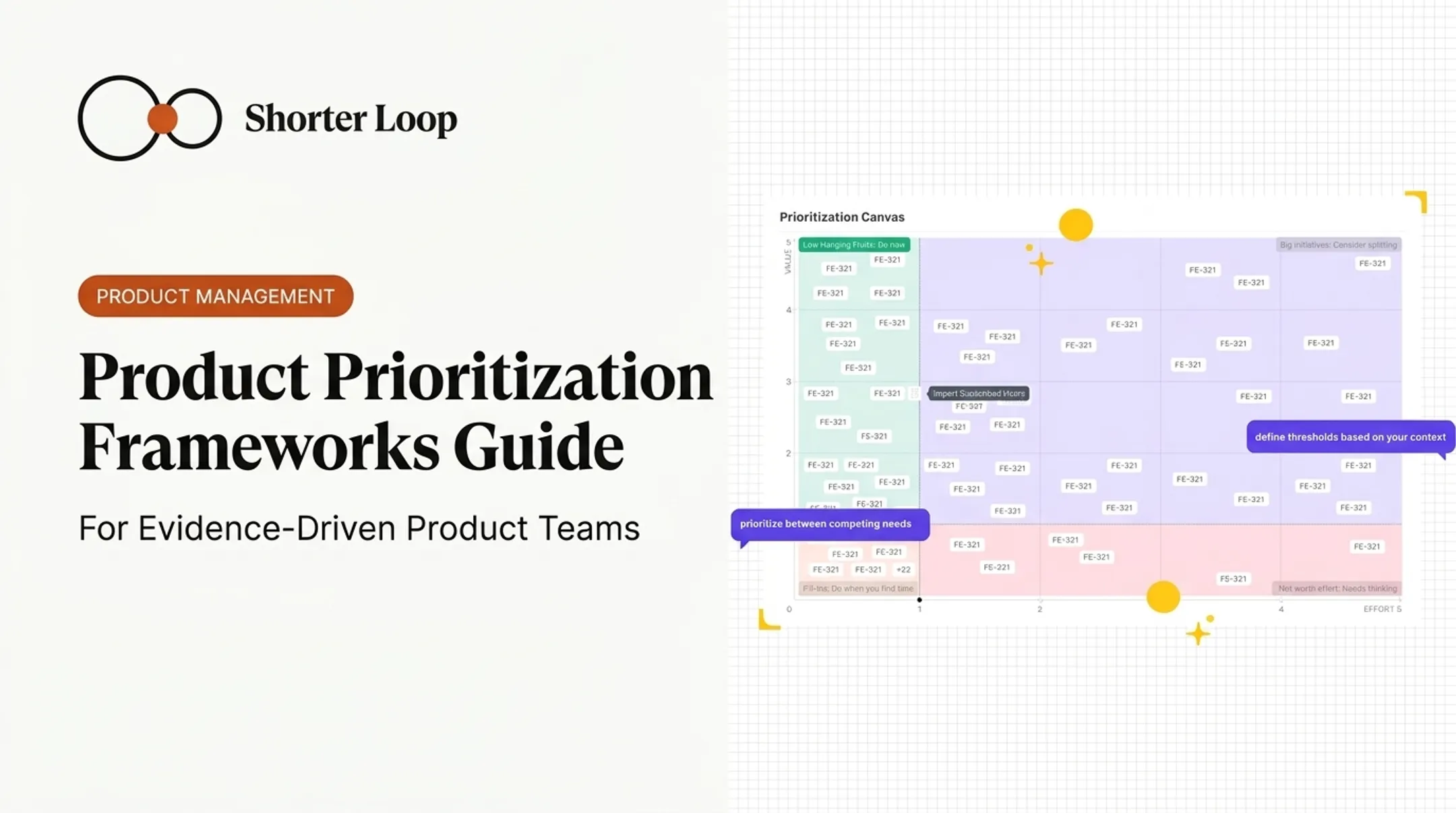
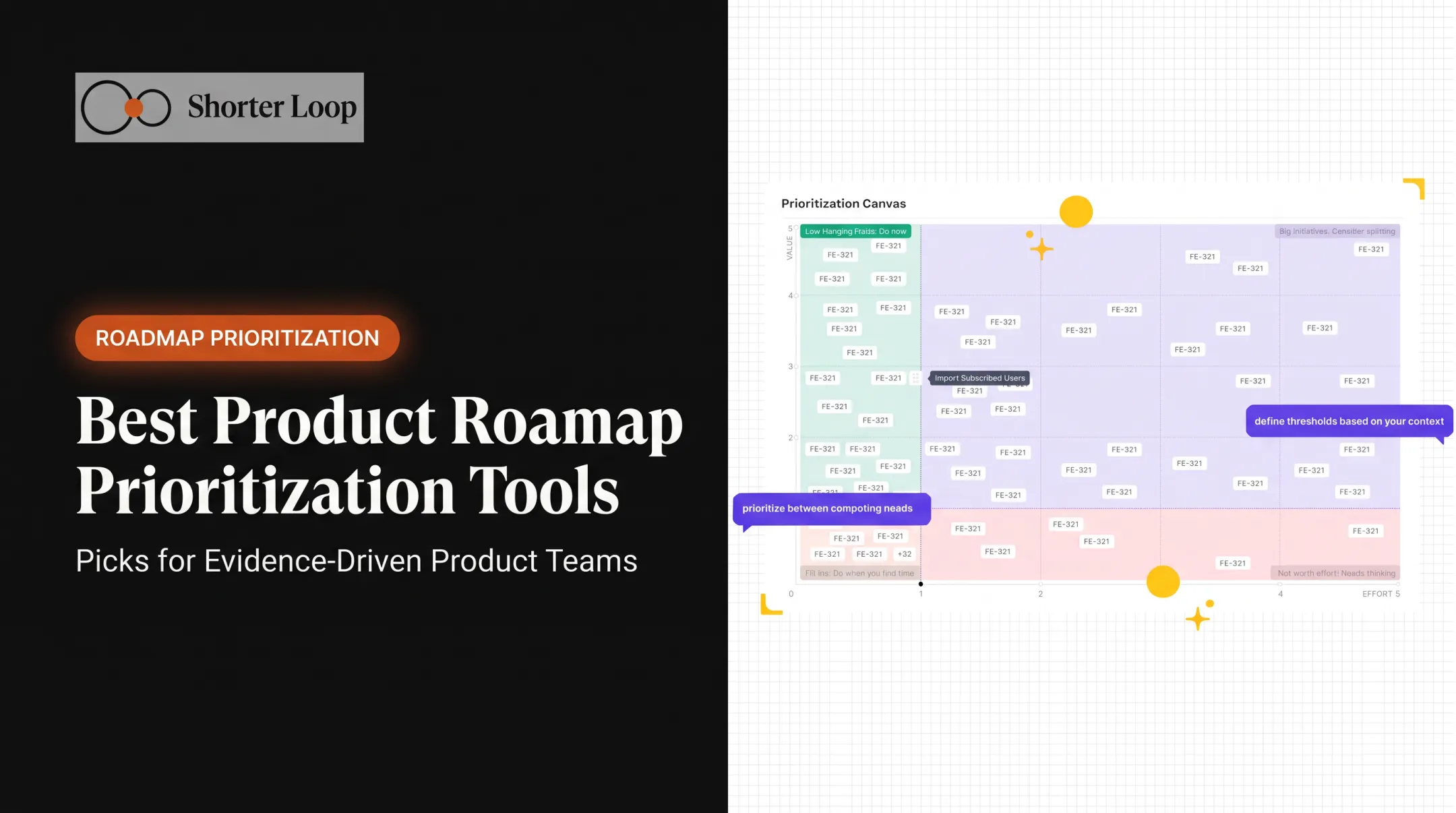
The platform's Backlog Prioritization plots epics and features on a value-versus-effort chart, scores each one as value divided by effort, and lets you drag the cut lines that separate what is in from what waits. A separate RICE Score sits on each solution in Strategy Builder for teams that want a numeric backstop earlier in discovery.
What sets it apart is continuity before and after scoring. A product opportunity can trace back to the support conversations, sales notes, and interviews that justified it, and forward to whether the shipped work moved the intended metric.
That continuity matters most for scaling B2B SaaS organizations where customer evidence, discovery, strategy, and delivery have splintered across teams and tools.
Sage, the built-in assistant, answers questions from your product's documents, feedback, strategy items and connected data sources, and lists the Supporting evidence under each answer so you can open what it relied on.

Comparison notes:
- Best for: Multi-team product organizations with fragmented evidence and strategy
- Core differentiator: Continuity from discovery through outcomes, not a one-time scoring snapshot
- Pricing: $500 per product per month billed annually, unlimited team members, no per-seat fees, plus a 14-day free trial
- Integrations: Jira, Azure DevOps, and Linear sync two-way; HubSpot is inbound only
- Trade-off to verify: Shorter Loop uses a fixed product hierarchy, so teams wanting to model an unconventional process exactly as imagined should confirm fit during the trial
Jira Product Discovery
Jira Product Discovery captures product ideas, applies prioritization criteria, and connects discovery decisions directly to Jira-based delivery work. If engineering already lives in Jira, this keeps everything in one ecosystem.
Ideas get scored using customizable fields for Effort, Impact, Goals, and Confidence, with formulas ranging from simple weighted scores to user-written arithmetic. Matrix views support two-axis comparisons like RICE, and prioritized ideas convert into Jira epics without a manual handoff.
At scale, the payoff is a shorter planning cycle: when strategic pillars are already linked to discovery work and delivery, a quarterly planning marathon can shrink to a short recurring steering session, because the ranking is maintained continuously rather than rebuilt from scratch.
Comparison notes:
- Best for: Jira-centered product and engineering teams
- Pricing: Free for up to 3 creators; Standard around $10.50/creator/month; Premium around $26.25/creator/month; viewers are free
- Strength: A low-friction path from prioritized opportunity to engineering ticket
- Trade-off to verify: Cloud-only, and evidence management is lighter than dedicated discovery platforms
Productboard
Productboard is a customer-feedback-led product management platform. It organizes insights from channels like Intercom and Zendesk, links them to specific features, and keeps scoring connected to the people who actually asked for something.
Every feature idea shows who requested it, their comments, and an auto-calculated score based on real feedback rather than a PM's gut feel. Spark, Productboard's built-in AI, synthesizes feedback and links its recommendations back to the source material that informed them.
A typical pattern: a search-improvement idea quietly collects customer notes through the feedback portal until the weight of them prompts the team to pull it forward into a dedicated improvement sprint.
Comparison notes:
- Best for: Organizations drowning in feedback from support, sales, and research
- Pricing: Not published; the pricing page lists Business and Enterprise plans behind Request demo and Contact sales, with a five-maker minimum (checked October 2026)
- Strength: Strong feedback-to-feature traceability
- Trade-off to verify: Tracing a feature back to the feedback behind it is solid; tracing forward to whether it worked is thinner
airfocus
airfocus is built for teams that want to configure their own prioritization process instead of adopting someone else's framework. It supports RICE, weighted scoring, MoSCoW, and fully custom models, with configurable fields and hierarchies that connect to OKRs, feedback, and delivery.
Its Priority Poker feature helps with stakeholder alignment: contributors submit independent scores against agreed criteria before the group discusses them, surfacing disagreement early instead of letting the loudest voice win by default.
Its Insights agent analyzes feedback and links findings back to their source, following the same disclosure principle worth demanding from any AI feature.
Comparison notes:
- Best for: Teams wanting flexibility to configure scoring around an existing process
- Pricing: Both Professional and Enterprise plans require a sales quote
- Integrations: Jira Cloud and Azure DevOps Cloud on Professional; Jira Server, Azure DevOps Server, and Salesforce added on Enterprise
- Trade-off to verify: No public pricing means budget comparison takes an extra step
Aha! Roadmaps
Aha! Roadmaps is a strategy-first planning platform. Workspaces hold strategy, releases, ideas, and features, and workspace lines roll individual products up into a company-level view so leadership can see how a roadmap item ladders up to a stated goal.
Its scoring model, the product value score, factors Population, Need, Strategy, Effort, and Confidence into a weighted equation rather than using RICE outright.
Comparison notes:
- Best for: Strategy-heavy organizations needing to connect roadmap items to vision and portfolio planning
- Pricing: Premium around $59/user/month annually; Enterprise around $99/user/month annually; Enterprise+ around $149/user/month, annual billing only
- Integrations: Jira, Azure DevOps, and GitHub
- Trade-off to verify: A discounted Startup Pack exists for very early companies; everyone else should model per-user costs as headcount grows
Asana (Generalist Alternative)
Asana isn't built as product-prioritization software, but plenty of teams use it that way. Custom priority fields, owners, dependencies, and Timeline views cover the basics of ranking and visualizing work.
Formula custom fields let you build weighted scoring with arithmetic operators, but that capability only unlocks on Advanced plans and above. Feedback intake happens through forms routed to a dedicated section, though Asana doesn't automatically synthesize that feedback into evidence tied to a specific opportunity the way dedicated product tools do.
Comparison notes:
- Best for: Teams needing task-priority fields and execution tracking rather than full product discovery
- Pricing: Custom fields and forms on Starter; formulas, portfolios, and goals require Advanced tier and above
- Trade-off to verify: Fewer tools to manage, but confirm it supports the customer-evidence aggregation your product team actually needs
How We Chose the Best Prioritization Software
We evaluated each tool against the complete decision lifecycle: collecting evidence, defining criteria, ranking opportunities, communicating trade-offs, handing work to delivery, and reviewing outcomes afterward.
Evidence and Decision Traceability
Can a user connect customer feedback, research, assumptions, goals, and confidence levels to one specific decision? We tested this against a realistic scenario: dozens of feedback items, support conversations, sales notes, and churn interviews, condensed into a single product opportunity.
Tools that kept every item linked in both directions scored higher than those that lost the connection once a feature shipped.
Framework and Scoring Flexibility
We checked support for RICE, MoSCoW, Kano, value-versus-effort, cost of delay, and custom weighted scoring. None of these is universally "correct"; they answer different questions. RICE suits reach-and-impact trade-offs, MoSCoW suits scope negotiations, and Kano suits satisfaction research. A tool that locks you into one model limits how you think.

Collaboration, Execution, and Scalability
We also assessed:
- Stakeholder alignment: shared views, comments, permissions, and whether debates get resolved or repeated
- Delivery continuity: how a decision reaches Jira, Azure DevOps or Linear, and whether changes made there come back
- Portfolio visibility: support for multiple teams, products, or business units
- Adoption effort: how much setup and training a rollout demands
Mistakes to avoid:
- Choosing a tool for its popularity instead of its fit with your decision process
- Treating any scoring model as objective instead of reviewing its underlying assumptions
- Ignoring the implementation and ongoing maintenance effort required
- Buying AI features that generate recommendations without showing their evidence or reasoning
Conclusion
The best prioritization tool is the one that fits your team's actual decision process, not the one with the longest feature list. It should keep customer evidence, strategic intent, delivery activity, and outcomes connected, so a priority call made in Q1 still makes sense when someone questions it in Q3.
Shortlist two or three tools. Test them with a real backlog and real customer evidence, not a demo dataset. Then ask a simple question: can your stakeholders understand the reasoning behind the resulting priorities, or are they just trusting a score?
If your team is growing past the point where evidence and strategy still fit in one person's head, try Shorter Loop to keep that reasoning connected from discovery through delivery and outcomes. A 14-day free trial is enough to test it against a real decision.
Frequently Asked Questions
What is the best app for prioritizing tasks?
It depends on what you're prioritizing. Personal task ranking needs a simple to-do app; project execution needs a work-management tool like Asana; evidence-based product decisions need dedicated prioritization software like Shorter Loop or Productboard.
What is the best prioritization framework?
No single framework works for every decision. RICE suits reach-and-impact trade-offs, MoSCoW suits scope negotiations, Kano suits satisfaction research, and cost of delay suits time-sensitive bets. Match the framework to your evidence and team maturity.
What is prioritization software used for?
It helps teams collect opportunities, apply consistent criteria, rank competing work, communicate trade-offs, connect decisions to delivery, and revisit priorities as new evidence arrives.
How is product prioritization software different from project management software?
Prioritization software helps decide what should get built. Project management software plans, assigns, and tracks work after that decision is already made. Some platforms blend both, but the core jobs differ.
What features should I look for in prioritization software?
Look for evidence traceability, customizable scoring, feedback aggregation, roadmap and portfolio views, collaboration tools, delivery integrations, permissions, outcome tracking, and a reasonable learning curve.
Can prioritization software improve stakeholder alignment?
Yes. Transparent criteria, shared evidence, and visible trade-offs reduce opinion-led debates. But software can't replace accountable product judgment. It just makes the reasoning easier to see and question.