
Introduction
Suppose a growing SaaS team's backlog holds six epics, roughly 200 smaller items, and no order to any of it. Customer requests sit next to defects, strategic bets sit next to technical debt, and nobody agrees on what ships first.
This gets harder as B2B SaaS companies scale. Customer evidence spreads across support tickets, sales calls, interviews, and survey tools. Different teams see different fragments of the same problem. Product decisions have to balance value, urgency, effort, risk, and how confident anyone is in the underlying evidence.
This article compares the major prioritization techniques and how to choose among them. It also shows how to tell which priorities rest on evidence and which rest on whoever argued loudest in the last planning meeting.
Key Takeaways
- Backlog prioritization directs limited capacity to the most valuable, timely outcomes.
- No single framework fits every backlog: stack ranking, MoSCoW, Kano, RICE, value/effort, and WSJF solve different problems.
- Scores work only when teams define criteria, document assumptions, and revisit rankings as evidence changes.
- Strong prioritization weighs value, alignment, effort, dependencies, risk, urgency, and evidence confidence together.
What Is Product Backlog Prioritization?
Product backlog prioritization is the deliberate process of ordering features, improvements, bug fixes, technical work, and research according to expected value and timing. It's different from just collecting requests in a spreadsheet. Prioritization forces trade-offs: something has to move up, something has to wait, and something might not happen at all.
The product backlog and the sprint backlog aren't the same thing. The product backlog is the full, evolving set of possible work. The sprint backlog is the smaller subset a team commits to for one delivery cycle. Scrum treats the Product Backlog as an ordered, emergent list, not a promise that every ranked item ships next.
A product manager or product owner usually facilitates prioritization, but they don't do it alone:
- Customer-facing teams surface complaints, requests, and churn signals
- Designers and engineers weigh in on feasibility and technical risk
- Analysts bring usage data
- Stakeholders add strategic context
Every priority needs a reason attached to it: a customer problem, a strategic objective, a regulatory requirement, a dependency, or a time-sensitive opportunity. Without that reason, a rank is just a number nobody can defend six weeks later.
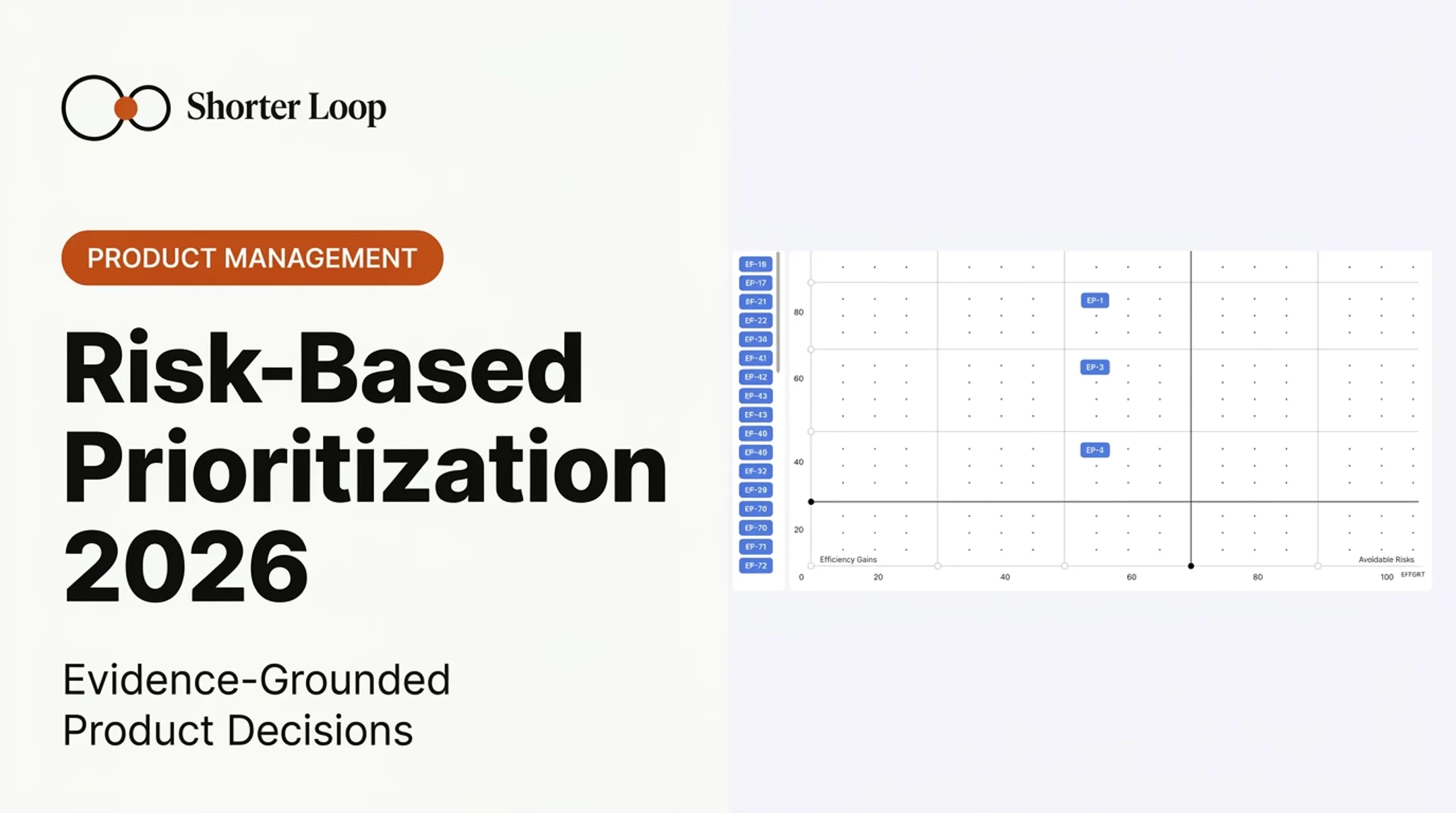
This is where evidence gaps show up fastest. Take FlowDesk, a fictional demo dataset Shorter Loop uses to show the product; it models a scheduling software company. In its backlog, "Import wizard v2" ranks first, with a value score of 80 and an effort score of 20 (a strong ROI on paper).
That value score, though, rests on an untested claim that setup difficulty is driving churn. The rank looks solid. The evidence behind it isn't.

Why Is Product Backlog Prioritization Important?
Prioritization exists to point limited engineering and product capacity at work that actually improves customer value, business performance, or product quality, not whatever got escalated most recently.
Without a shared approach, a few things tend to happen:
- Organizational influence can override the evidence unless the team makes its decision criteria explicit.
- Urgent-but-minor requests displace strategic work
- Technical debt stays invisible until it causes an outage
- Nobody remembers why a decision was made three sprints later
A common version of this: two people argue about the same epic without noticing that one is arguing about effort and the other about value. Scoring value and effort as separate numbers makes that kind of disagreement easier to see, because each person can point to the input they dispute.
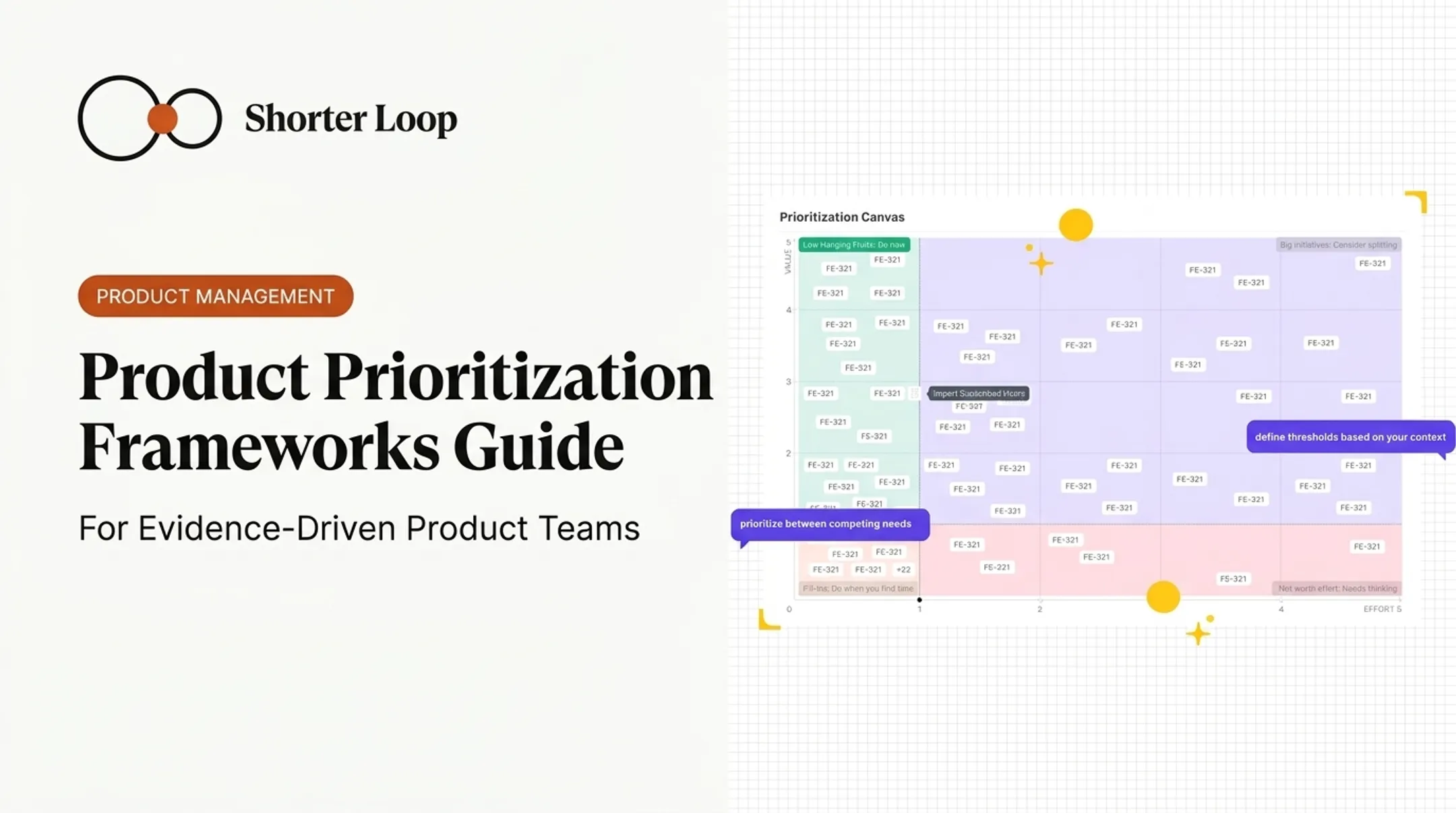
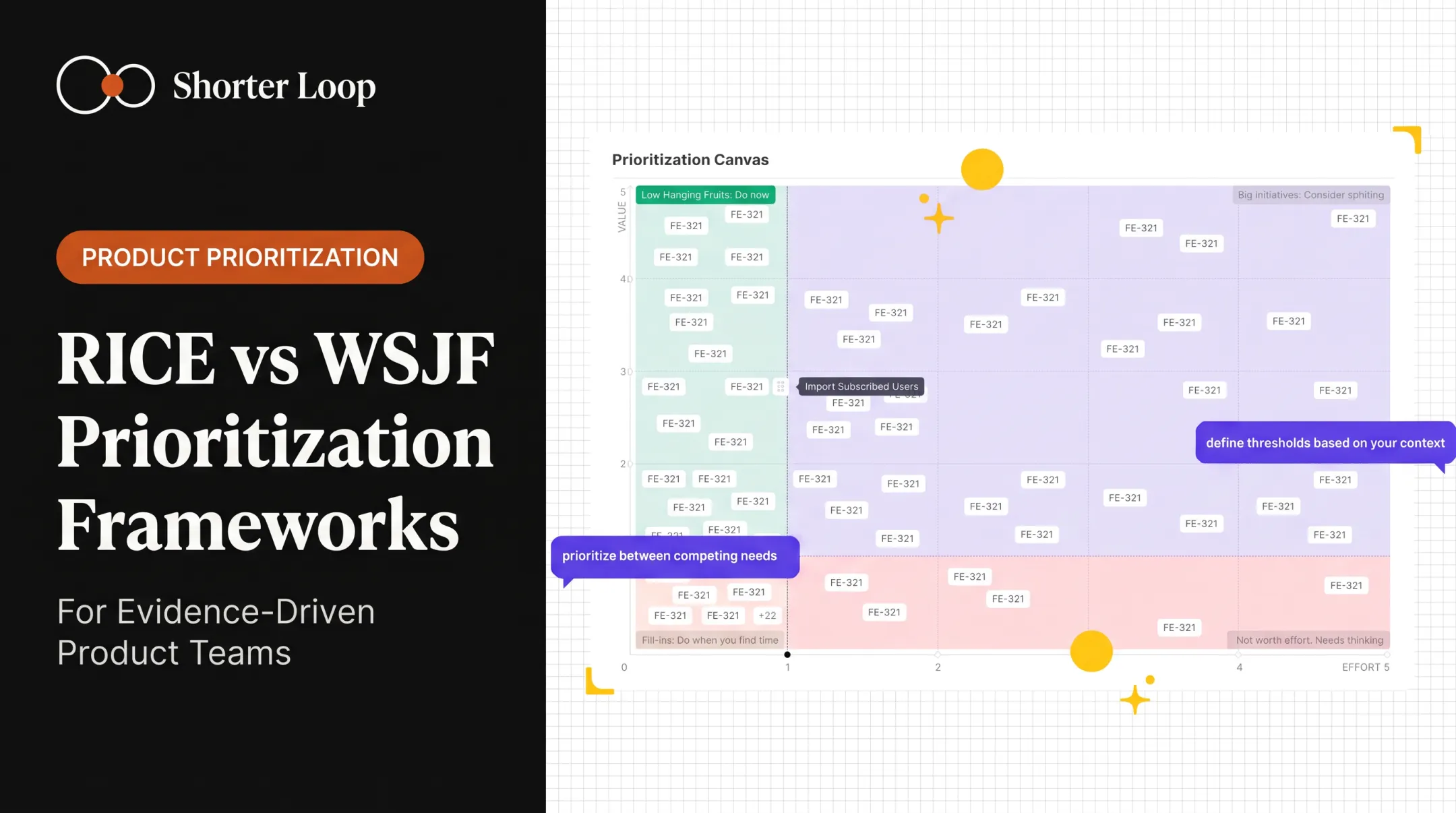
A shared priority order helps by giving everyone the same explanation for why item A sits ahead of item B. In the FlowDesk demo data, Shorter Loop's Backlog Prioritization chart makes this visible with cut lines that split the chart into areas such as "do now" and "do later", and items that land in the later area stay on the chart where everyone can see them.
Those cut lines only stay honest if the team revisits them. Prioritization isn't a one-time roadmap exercise. New customer evidence, shipped outcomes, and shifting market conditions change the relative value of backlog items constantly. A decision that made sense with the evidence available six months ago can be the wrong call today.
Types of Product Backlog Prioritization Techniques
These techniques are decision aids, not universal formulas. A common pattern is to combine a lightweight categorization method with a scoring or sequencing method. Categorize first, then rank within categories.
Stack Ranking
Stack ranking places every backlog item in a single relative order: one item per position, not a pile of items all marked "high priority." It answers a simple question: what comes right after this?
It works well for a small, focused list. It gets slow and subjective fast once the backlog grows past what one team can hold in their head. Backlog order should reflect factors like customer value, risk, ROI, and dependencies, not a vague "priority" label applied to everything at once.
MoSCoW Method
MoSCoW sorts items into four buckets:
- Must-have — required for a viable release
- Should-have — important work that can be deferred if necessary
- Could-have — desirable, lower impact
- Won’t-have — excluded from the current scope and eligible for later reconsideration
It's strong for release scope negotiations. The risk: stakeholders label everything "Must-have" without a capacity constraint to push back against. The DSDM handbook warns that Must-Have effort above roughly 60% of total capacity threatens delivery predictability. Enforce that threshold before the label loses meaning entirely.
Kano Model
Kano classifies features by customer reaction:
- Must-be — expected basics; their absence causes dissatisfaction
- One-dimensional — more is better, proportionally
- Attractive — delights customers, but they don't miss it if absent
- Indifferent — customers don't really care either way
- Reverse — some customers actively dislike having it
Kano is most useful when customer experience and perception matter most. It needs real customer research to work, and it says nothing about technical risk, dependencies, or strategic fit. Those need a separate check.
RICE and Value/Effort Scoring
RICE scores an idea using four inputs:
- Reach — people or events affected in a given period
- Impact — effect per person
- Confidence — how solid the estimates are
- Effort — person-months required
As Intercom's original RICE framework defines it, the formula is:
(Reach × Impact × Confidence) ÷ Effort
A simpler value/effort matrix skips the multi-factor math and just plots expected value against delivery effort, favoring high-value, low-effort work.
Both approaches make assumptions visible and comparable, which is useful. The warning: a precise-looking score built on weak reach or confidence estimates creates false confidence. In Shorter Loop's Backlog Prioritization chart, where you drop an epic or feature sets both its value and its effort, and the score is value divided by effort. Both axes stay on screen, so anyone can point at the input they dispute.
Cost of Delay and WSJF
Cost of Delay measures the economic value lost by waiting. As product-development economist Don Reinertsen put it, in guidance SAFe cites in its WSJF framework, "If you only quantify one thing, quantify the Cost of Delay."
WSJF (Weighted Shortest Job First) sequences work by dividing relative Cost of Delay by relative job size, factoring in:
- Time criticality
- User or business value
- Risk reduction or opportunity enablement
- Dependencies and fixed-date commitments
These methods earn their complexity only when delay genuinely changes value or risk. Forcing WSJF math onto a small item whose economic impact can't be meaningfully estimated just adds noise.
Story Mapping as a Contextual Technique
Story mapping arranges backlog items along the user's journey instead of a flat list. It surfaces the minimum usable experience, exposes dependencies, and shows release slices that isolated backlog items hide entirely.
Story mapping is context for ranking, not a competing method. Map the journey first, then apply MoSCoW, Kano, RICE, or stack ranking to what the map reveals.

Before You Score, Check the Claim Behind the Score
Most scoring arguments are really arguments about an unexamined claim. Go back to the FlowDesk backlog above, where "Import wizard v2" sits at the top with a value score of 80 against an effort score of 20.
The effort estimate is credible; that team has rebuilt an importer before. The value score of 80 rests on a line written into the item months ago: setup difficulty is what drives churn in the first 90 days.
Open the claim underneath it and the picture changes. "Setup difficulty drives early churn" traces back to one comment from a sales engineer in a meeting. No interviews, no usage data, no churn analysis is linked to it. In Shorter Loop's terms the claim's state is untested, and the Evidence tab on the item shows exactly that: the claims behind it, the sources grouped as feedback, documents, analytics, and related work, and the overall verdict.
Nothing about the score was calculated wrongly. An 80 resting on an untested claim is still an 80. It is just an 80 that means something different from an 80 resting on forty pieces of linked evidence, and a scoring spreadsheet cannot tell you which one you are looking at.
The practical habit is cheap: before the ranking meeting, take the top three items and ask what evidence supports the value score of each. Where the answer is "someone said so," that is not a reason to drop the item. It is a reason to spend a week checking before spending a quarter building.
How to Choose the Right Type of Product Backlog Prioritization
The right technique depends on the decision you're making, the quality of your evidence, backlog size, and how much alignment you need, not which framework is trending on LinkedIn.
Factors to weigh:
- Purpose and goals — Use Kano when customer satisfaction is the open question, MoSCoW when negotiating release scope, WSJF when delay and job size matter most.
- Evidence quality — Make confidence explicit when data is thin, and prioritize discovery work that can test a claim before betting engineering time on the feature.
- Scale and backlog size — Stack rank a short list of options; use categories or scores once the backlog spans multiple teams.
- Complexity, dependencies, and risk — Bring engineering into the room. Technical debt, security work, and dependencies deserve a seat next to customer-facing features, not a separate, ignored list.
- Effort and capacity — Use relative estimates to compare investment. Don't treat story points as a performance metric for individuals.
- Keeping the reason — Pick a process that lets priorities change while the evidence and the reason behind each change stay written down.
A scoring sheet won't keep that reason for you. As the Import wizard v2 example shows, nothing in the scoring process forces the claim behind a value score into view before the ranking is agreed.
In Shorter Loop, prioritization runs on items already linked to the claims and evidence behind them: opportunities score on Spread, Intensity and Value, solutions with RICE, and features on a value/effort view. Each claim carries one of three states (Backed, Evidence disagrees, or Untested), so a churn explanation that is still untested shows up next to the high value score resting on it instead of hiding inside it. Shorter Loop doesn't make the ranking call for you; the product manager still decides, and delivery status stays in Jira or whichever delivery tool syncs with it.
What to Check Before Finalizing a Type of Product Backlog Prioritization
Before locking in a method, run these checks.
Don't over-engineer the decision. A simple category or direct comparison often produces a clear call faster than an elaborate scoring model. Match the method's complexity to the size and stakes of the decision, not to how sophisticated it looks in a slide deck.
Check for false precision. Document the assumptions behind every score. A plain value ÷ effort ratio is a reasonable default: elaborate formulas add little when nobody can explain or challenge the inputs behind them. When a low-confidence input drives a high rank, flag it before committing capacity.
Check for missing work. Technical debt, defects, research spikes, dependencies, and operational commitments belong on the same list as customer-facing features, not a separate backlog nobody reviews.
Check whether priorities are defensible. Record why an item moved. A single decision trail (what supports the bet, what changed, and what downstream work depends on it) means a new team member isn't reconstructing reasoning from six-month-old Slack threads.
Set a review trigger, not a constant reshuffle. Revisit priorities when there's new customer evidence, a shipped outcome, a strategic shift, or an approaching deadline. In the FlowDesk demo data, custom shift templates sit below the cut line. That's the right result while nothing new has arrived to justify reopening the decision.
Conclusion
Pick a technique based on the decision in front of you, not habit. Then run this check on your current backlog: take the top three items and, for each, write one sentence naming the evidence behind its value score and how confident you are in it.
If any of those sentences comes out as "someone asked for it" or "we've always thought so," that item needs a discovery task before it needs a sprint. Put the test on the backlog first and let the result move the rank.
If you want to run that check with each item's claims and evidence linked in one place, you can start a 14-day trial of Shorter Loop (no credit card) or book a walkthrough.
Frequently Asked Questions
What are the different prioritization techniques?
The major ones are stack ranking, MoSCoW, Kano, RICE, value/effort scoring, Cost of Delay, WSJF, and story mapping. The right choice depends on whether you're negotiating scope, sequencing by economic impact, or checking customer perception.
Several teams share one backlog. How do we rank across them?
Rank by the outcome each item serves, so ownership stops being the deciding factor, and agree one cut line that every team can see. A value-versus-effort view helps here because both inputs stay visible: a team can argue that an effort estimate is wrong without reopening someone else's value score. Keep sequencing inside a team as a separate conversation from the shared order.
How do I explain a rank to a stakeholder three months later?
Write the reason down at the moment you rank, not when someone asks. One sentence naming the customer problem, the objective it serves and the evidence behind the value score is usually enough. When a stakeholder asks why their request sits below the line, you can show what it was weighed against and what would change the answer, which is a far shorter conversation than piecing the reasoning back together from memory.
When should we re-rank the backlog?
Re-rank when something changes the inputs: new customer evidence, a result from work you shipped, a strategic shift, or a date that has moved. Re-ranking on a fixed weekly rhythm with no new information mostly produces churn and makes the order harder to trust. Agree the triggers with your team up front and leave the order alone between them.