
Introduction
Every bet you fund commits engineering time, budget, and your own credibility to two assumptions: that a customer has a problem worth solving, and that they will choose your solution over doing nothing. When you run several teams, you are making that commitment three or four times a quarter, and the cost of being wrong is paid by whichever team you pointed at the work.
The hard part is testing whether the bet holds up before anyone writes production code.
CB Insights' analysis of 431 failed startups found poor product-market fit cited in 43% of them, second only to running out of capital. Pendo's 2019 Feature Adoption Report, drawn from usage across 615 subscriptions, found 80% of features in the average product are rarely or never used.
Gut feel, confident stakeholders, and a polished business case don't change those odds. An idea can still fail on desirability, feasibility, viability, usability, strategic fit, or execution, even when everyone in the room loves it.
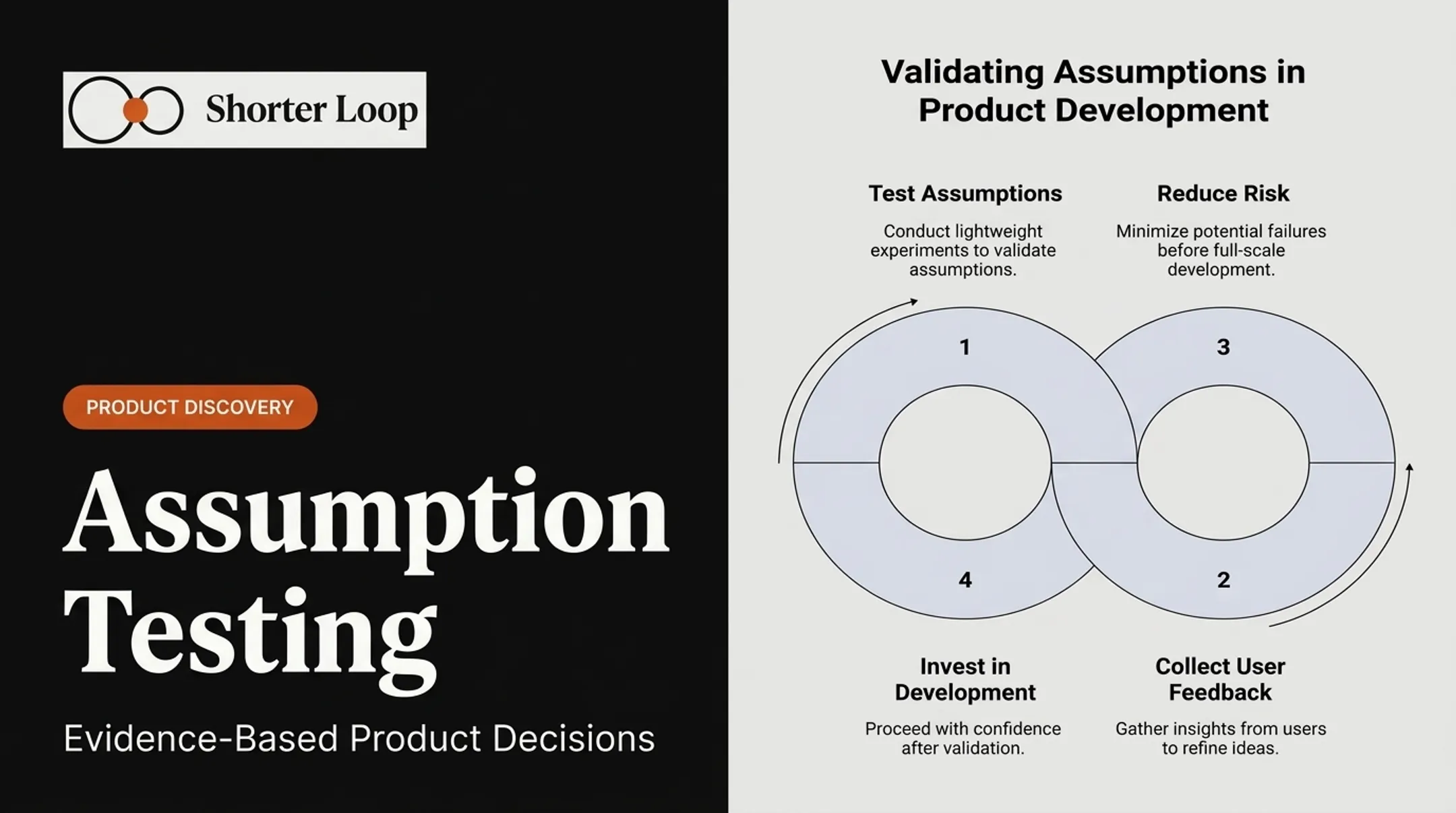
This article covers how to find the riskiest assumption behind a bet, pick the lightest credible test, define success and failure before looking at results, and turn every outcome into a real decision: proceed, pivot, pause, or stop. It also covers how to keep those decisions comparable when more than one team is testing at the same time.
Key Takeaways
- Test the assumption most likely to invalidate the idea, not the one that's easiest to prove right
- Match method to question: interviews for problems, prototypes for solutions, spikes for feasibility, experiments for demand
- Set observable pass/fail criteria before the test begins.
- Write the decision and the evidence behind it on the item itself, so the team that inherits the work can see why it was made
- Don't mistake sign-ups, clicks, or enthusiasm for proof of real adoption
How to Test a Product Bet
Step 1: Frame the Idea as a Testable Opportunity
Before testing anything, rewrite the idea so it can actually be proven wrong. A vague pitch like "we should add shift-swap automation" can't be tested. Reframe it as a problem statement, naming the customer, the context, the unmet need, and the expected outcome, without assuming the solution is already right.
State the hypothesis in falsifiable terms. "Mid-sized logistics managers will adopt automated shift-swapping if it cuts manual rescheduling time by more than 30%" is testable. "Users want automation" is not.
Separate what you actually know from what you're assuming. Take FlowDesk, a fictional demo dataset Shorter Loop uses to show the product, a shift-scheduling platform serving roughly 400 logistics customers across the Benelux region. Its team once explained high first-90-day churn with "onboarding is too hard."
When they checked, that explanation traced back to one sales engineer's comment in a March meeting. Zero customer evidence backed it up, yet it had been repeated so often it felt like fact.
A simple breakdown helps before testing begins:
| Category | FlowDesk Example |
|---|---|
| Fact | First-90-day churn sits at 22% |
| Assumption | Onboarding complexity is driving churn |
| Opinion | "Customers just don't read the setup guide" |
| Open question | Which specific step causes drop-off? |
Step 2: Map and Rank the Risks
Not every assumption deserves a test. Evaluate the idea against the risk lenses that actually matter: desirability, usability, feasibility, viability, strategic fit, operational scalability, and, where relevant, security, privacy, accessibility, or regulatory exposure.
Teresa Torres's assumption-testing framework ranks beliefs by two factors: how important they are to the idea's success, and how much evidence already supports them. A critical belief with almost no evidence behind it is the one to test first, even when it's the uncomfortable choice.
FlowDesk learned this the hard way. Two separate engineering squads spent six weeks building different fixes for the same unproven churn explanation before anyone tested whether onboarding was actually the problem.
A risk map should answer three questions for each assumption:
- Who owns this question, and who can act on the answer?
- What evidence already exists, direct or indirect?
- What's still missing before investment increases?
Rank assumptions by impact and uncertainty, then pick the riskiest one. Resist the pull to test the easiest question first just because it's comfortable.
Step 3: Choose the Smallest Credible Test
Choose a testing method that directly examines the assumption:
- Problem reality – customer interviews, support ticket review, or direct observation
- Desirability – concept tests, fake-door pages, or low-fidelity prototypes
- Usability – task-based testing with real users attempting real workflows
- Feasibility – a focused technical spike, scoped to one engineering question
- Demand and viability – landing pages, pre-orders, pilots, or pricing experiments
Stated intent and observed behavior aren't the same thing, and confusing them is one of the easiest ways teams fool themselves. When Buffer's founder tested an idea for a scheduling tool, he built a two-page flow: one page collected emails, the next showed pricing and tracked who clicked a paid plan. Those clicks signaled interest, not revenue.
Buffer's early test only confirmed actual payment once a working product shipped.
A qualitative signal is often enough for an early decision, such as five customer conversations surfacing the same unmet need repeatedly. A controlled or quantitative test becomes necessary once you're estimating conversion rates, pricing sensitivity, or anything you plan to scale a commitment on.
Step 4: Define the Experiment Before Running It
Write down the experiment design before collecting a single data point:
- Participants – who qualifies, and how will you recruit without bias?
- Setup and duration – what will people do, and for how long?
- Comparison point – is there a control group or baseline?
- Primary metric – the one number that answers your hypothesis
- Supporting observations – secondary signals worth capturing but not deciding on
- Data handling – how will you store and protect what you collect?
Decide what counts as a pass, a fail, or an inconclusive result before you look at the evidence.
FlowDesk tested whether a referral-style "shared link" feature would drive account growth. The design was simple: 30 new accounts over two weeks, with a threshold set in advance. If fewer than half shared the link within the first week, the assumption would be rejected.
In practice, 22 of 30 accounts shared the link, and 14 gained a second user without any prompting. The result cleared the bar decisively.

Before trusting any result, check for biased recruitment, leading questions, broken prototypes, tracking errors, and anything else that could contaminate what you're measuring.
Step 5: Review Evidence and Make the Next Decision
Compare what you observed against the original hypothesis, not against what you hoped to see. Document what you learned, what's still uncertain, and whether the test genuinely addressed the riskiest assumption, or just a convenient one.
Then make an actual decision:
- Proceed to the next test or to delivery
- Pivot the problem or the proposed solution
- Pause while gathering missing evidence
- Stop the idea entirely
Specify which evidence is missing, how the team will collect it and what decision it will support.
FlowDesk's shared-link result was strong enough to justify building the feature. It shipped on November 14. The release bundled four delivery items for the original opportunity, and the experiment stayed under the solution it tested, with the opportunity's 41 pieces of supporting evidence still on its Evidence tab.
Churn, the objective the whole bet was meant to serve, remained under assessment for weeks afterward. By the January board review, the VP of Product could walk through the entire chain: assumption, evidence, experiment, shipped work, and actual churn movement. Nothing had to be reconstructed from memory.
When Should You Run the Test?
Start testing the moment an idea contains a meaningful assumption, before strategy decks, roadmaps, or internal politics make it expensive to change course. The earlier you test, the cheaper it is to be wrong.
Good moments to test include:
- Customer evidence about a problem is fragmented across support tickets, sales calls, and interviews
- A new opportunity is competing with existing roadmap commitments for the same resources
- A team is proposing a meaningful change to customer behavior or workflow
- Leadership is weighing a significant investment based on limited evidence
Testing can also be premature. If the problem itself is still vague, the target customer isn't defined, the idea clearly fails a strategic-fit check, or the team hasn't agreed on what evidence would change its mind, running a test wastes effort on the wrong question. Clarify the problem first; the test gets more useful once there's something specific to challenge.

What You Need in Place Before You Test
Problem and Evidence Readiness
Gather these before you run a test:
- A specific customer segment
- A written opportunity statement
- Existing evidence and the assumptions in question
- An honest list of what is still unknown
Direct customer evidence from interviews, usage data, and support conversations carries far more weight than internal anecdotes repeated in meetings.
Team, System, and Governance Readiness
Pull in the people the risk actually requires:
- Product, design, and engineering for feasibility questions
- Sales and support for demand signals
- Legal, security, or finance when the idea touches compliance or revenue
Confirm access to participants, instrumentation, prototype environments, and any approvals needed upfront.
Decision Readiness
Agree in advance:
- Who makes the call
- How evidence gets recorded
- Which outcomes trigger a proceed, pivot, pause, or stop
Decide how the result will connect back to strategy, delivery planning, and the outcome you will check after launch.
What Shapes the Result You Get
Test quality depends less on which tool you use and more on whether the question, the evidence, and the decision actually fit together.
The Assumption and Risk Being Tested
A test can generate plenty of data while still missing the assumption that could sink the idea. Testing a minor feature preference before confirming problem severity, real demand, or technical feasibility creates false confidence, not real validation.
Evidence Strength and Participant Quality
Feedback from the right customers, in the right context, beats a large pile of vague or biased responses. Recruitment criteria and sample relevance matter more than headcount.
Around five participants can reveal real usability problems in a qualitative study, but a reliable quantitative benchmark, like a conversion rate, needs a much larger sample, as Nielsen Norman Group's research explains. Five interviews can confirm a problem is real; they can't tell you how many customers will pay for the fix.

Success Criteria and Metric Choice
A single primary metric turns an abstract goal into a decision signal. Separate leading signals from harder commercial evidence:
- Leading signals: comprehension and engagement
- Harder evidence: activation, retention, qualified demand, or revenue
Which metric matters most depends on how early you run the test.
Test Fidelity and Timing
A sketch, a clickable prototype, a concierge service, and a live product answer different questions. Don't treat evidence from a rough concept as proof of production-grade usability or commercial viability. Raise fidelity as commitment and risk increase, not before.
Traceability From Evidence to Outcome
Teams need a clear line of sight on:
- Why the bet exists
- What evidence supported it
- What got delivered
- Whether the expected outcome showed up
This is where most testing efforts break down. Findings end up in a doc nobody connects back to the roadmap item it justified. In Shorter Loop an experiment sits under the solution it tests in Product Strategy, and closing it as Invalidated, Inconclusive or Abandoned asks for a reason, which stays on the item with the date and who decided.
Common Mistakes and Troubleshooting
Mistakes That Undermine Evidence
Testing to confirm an idea, rather than to challenge its riskiest assumption, is the most common failure mode. Reduce it by precommitting decision criteria before the test runs, and bringing in reviewers who weren't involved in writing the original proposal.
Other recurring mistakes:
- Choosing vanity metrics, like page views or sign-ups, instead of the metric that answers the actual question
- Rushing execution or picking a tool because it's available, not because it fits the question
- Treating interview enthusiasm, prototype clicks, or sign-ups as proof of sustained demand, rather than early interest
Desirability signals and willingness to adopt, pay, or change behavior are different things. A customer saying "I'd use that" in an interview is not the same as a customer changing their workflow.

Quick Troubleshooting Guide
| Symptom | Likely Cause | What to Check |
|---|---|---|
| Results look positive, but the decision stays unclear | No metric or threshold was defined before testing | Revisit the original hypothesis; separate the primary metric from supporting observations |
| Feedback contradicts itself | Participants represent different segments or contexts | Segment the evidence; review recruitment and question wording |
| The team can't reuse what it learned | Findings live in disconnected docs with no link to the decision | Build a decision record: evidence source, assumption, result, owner, later outcome |
Alternatives to a Single Experiment
No single method validates every risk. Combine or sequence approaches based on how mature the idea is and which decision you're making.
| Approach | When It's Better | Trade-off |
|---|---|---|
| Customer discovery and continuous evidence gathering | The problem, segment, or job-to-be-done is still unclear | Builds depth and context but doesn't predict behavior, willingness to pay, or feasibility alone |
| Prototype, pilot, or concierge validation | You need to test an end-to-end experience before building production capability | Reveals usability and operational learning fast, but can hide automation, cost, or scale constraints |
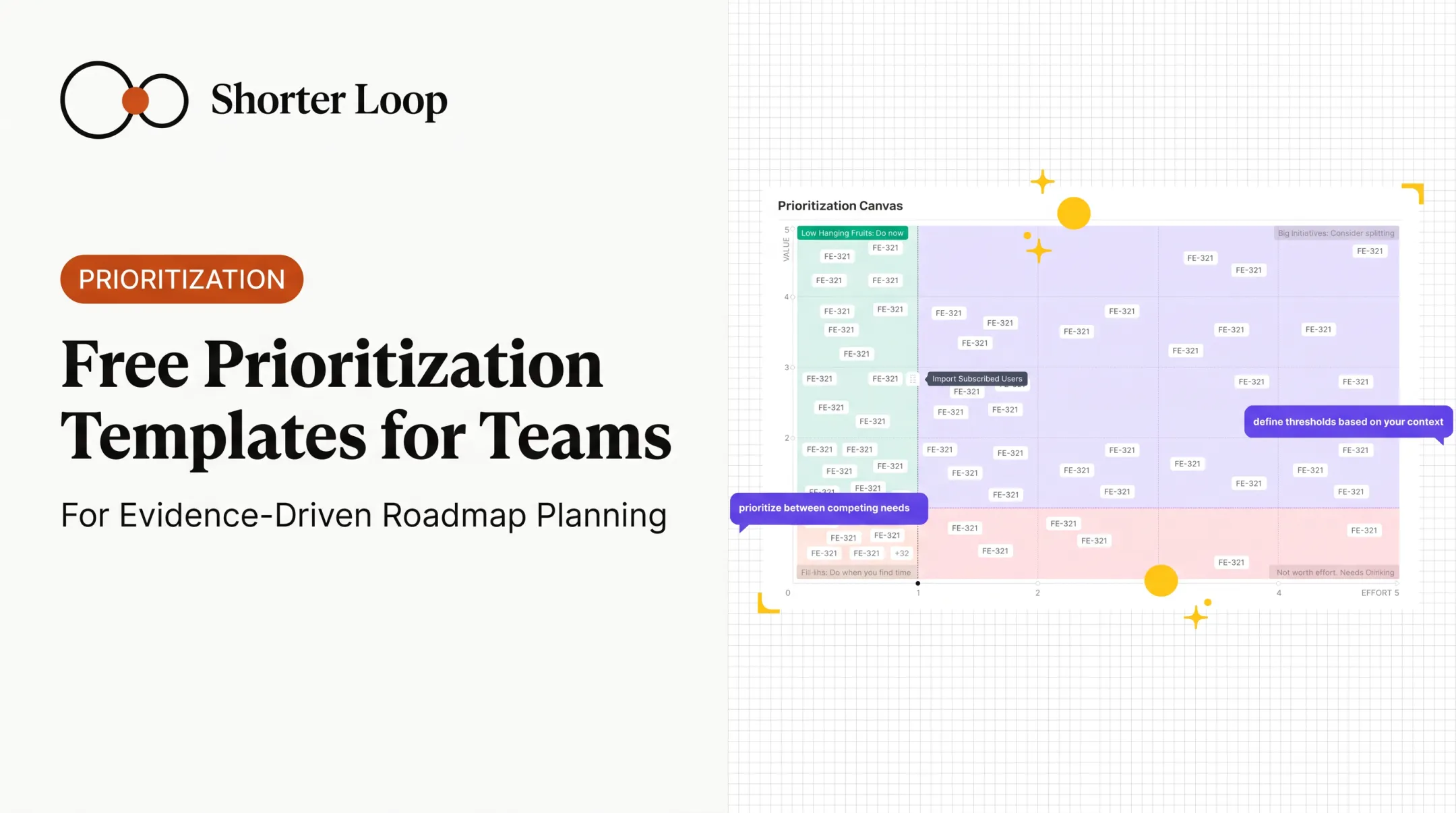
| A shared scoring pass across teams | Several bets compete for the same engineers and you need to compare them on the same terms | Makes the comparison visible, but turns into opinion unless the criteria and the evidence behind each score are written down |
Shorter Loop's Product Strategy, with opportunities and solutions together in the Tree view, supports this kind of sequencing directly. Teams can score opportunities on spread, intensity, and value, then attach lightweight experiments to specific assumptions before committing engineering time.
Conclusion
Testing a bet means reducing the uncertainty that matters most, early enough that changing your mind still costs you little.
A strong test connects four things:
- A clear hypothesis
- Evidence that actually matches the question
- A threshold set before you look at results
- A decision you're willing to act on: proceed, pivot, pause, or stop
Growing product organizations lose this thread constantly. An assumption gets tested in one tool, the decision gets made in a meeting, and the outcome shows up in a dashboard nobody connects back to the original bet.
In Shorter Loop that thread stays on the items themselves: the line under a solution's title shows how many of its claims are backed, and the reason an experiment was stopped is still there next quarter. If you'd rather not rebuild that reasoning each quarter, start a 14-day trial.
Frequently Asked Questions
How many customer interviews is enough for one test?
Fewer than people expect, if the sessions are with the right accounts. Six to eight conversations with customers who have the problem acutely will usually surface the pattern; twenty with a mixed group often will not. Stop when new conversations stop producing different problems, not when you hit a number.
Who signs off on a pass or fail?
Name the decision owner before the test runs, and write the criteria down with them. The common failure is a result everyone interprets to suit the position they already held, which happens whenever the bar was set afterwards.
Where should the result be stored?
With the thing it tested, where the next person to question the bet will look. In Shorter Loop the experiment sits under its solution in Product Strategy, with its own claims and Evidence tab. Its sample-size criteria and variants lock the first time it runs, and if it ends Invalidated, Inconclusive or Abandoned, the item page shows that outcome with the date, who decided and the reason.
How do you test whether a bet is worth pursuing?
Check strategic fit first, then test the riskiest assumption, whether that's problem evidence, feasibility, usability, or willingness to pay. End with a clear proceed, pivot, pause, or stop decision rather than open-ended data collection.
What is the best test to run?
It depends on the uncertainty: interviews for problem reality, prototypes for desirability and usability, technical spikes for feasibility, and pilots or pricing experiments for demand and viability. Match the method to the question, not the other way around.
How do you know when to stop testing?
Stop when evidence consistently fails a critical assumption, the opportunity no longer fits strategy, or the expected outcome isn't worth the trade-off. If another round of testing won't change the decision, it's time to decide, not test again.