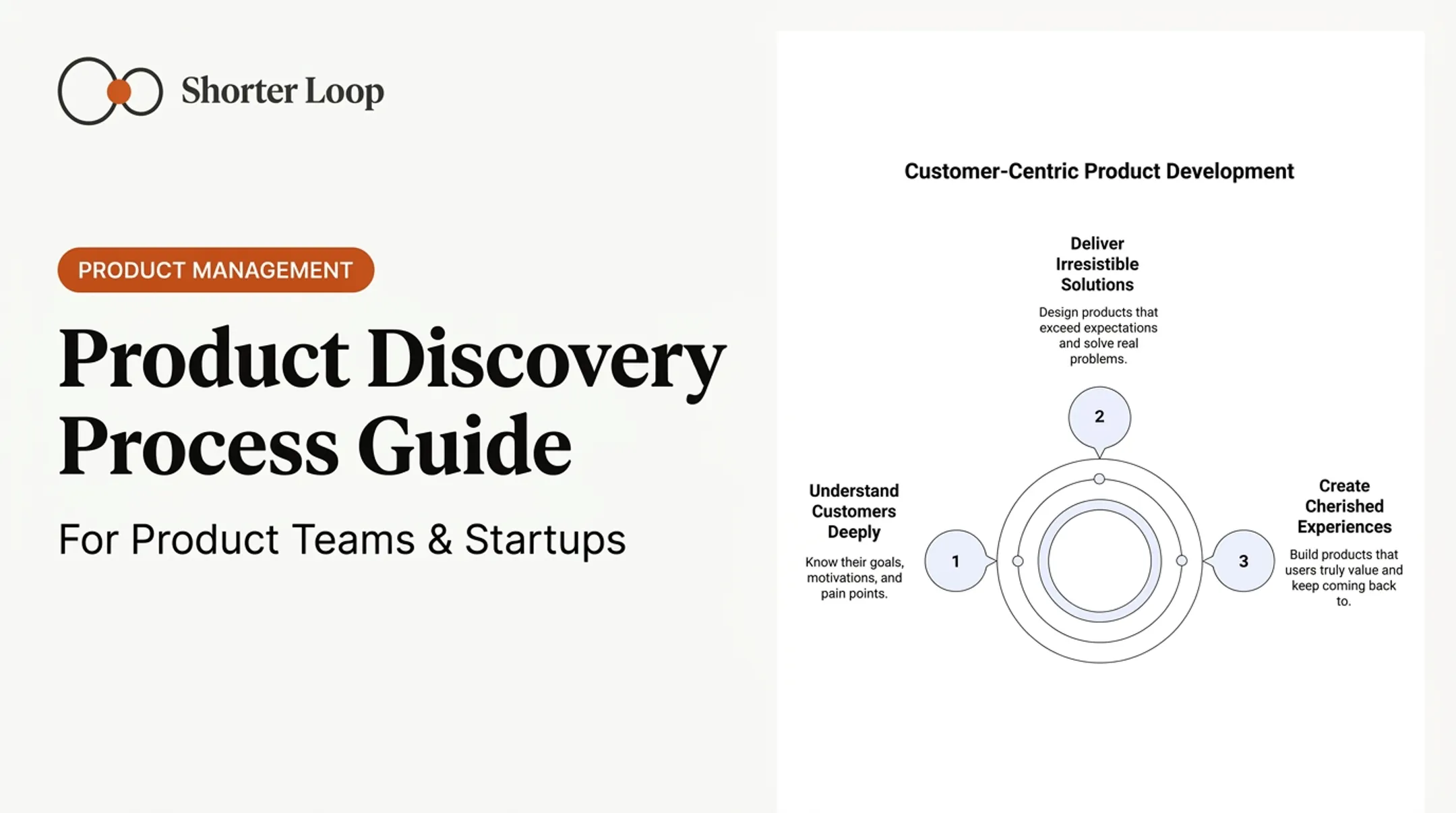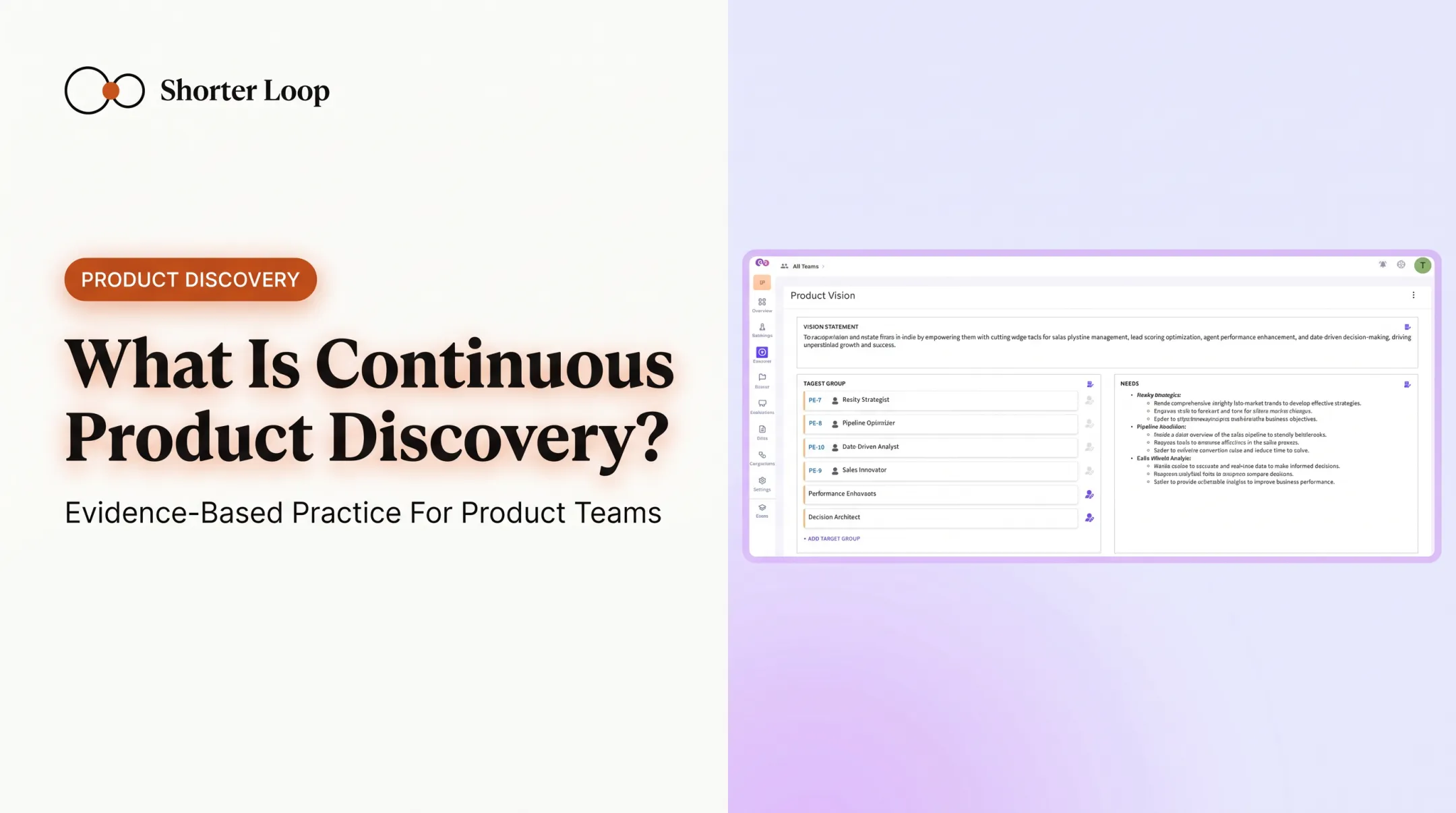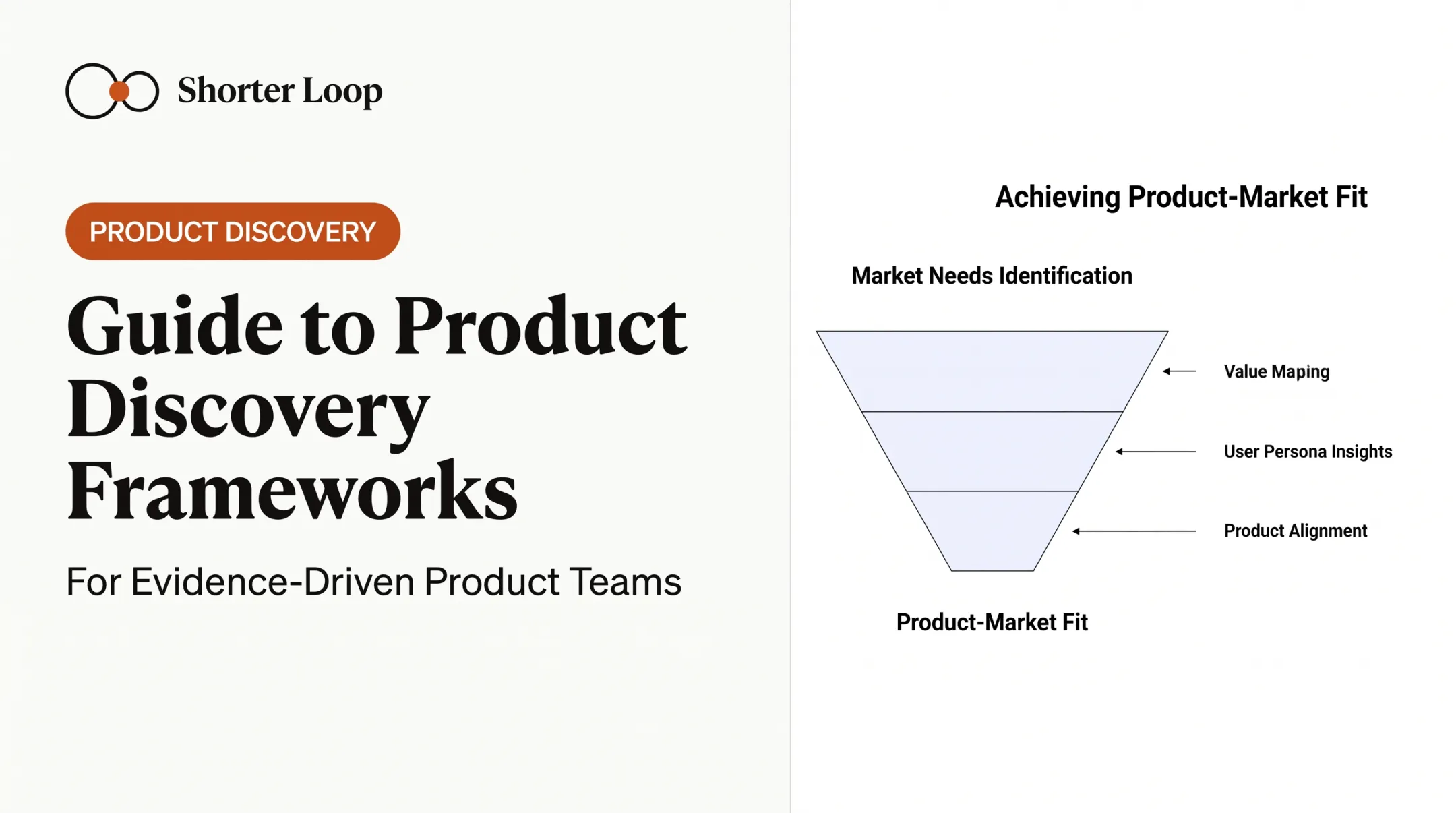

Product discovery is the process for preventing this. It's the ongoing work of understanding customer problems, testing assumptions, and building enough confidence to decide what is worth building. It helps teams reduce risk before committing significant resources to delivery. This article breaks down the product discovery process, covering practical techniques, tools, and common misconceptions for product managers, founders, designers, and engineers.
Key Takeaways
- Product discovery uses customer and business evidence to determine which problems deserve investment.
- Strong teams continue discovery alongside delivery and use new evidence to revisit product decisions.
- Common techniques include interviews, surveys, observation, analytics, and prototyping.
- Tools should help teams capture evidence, test assumptions, collaborate, and connect decisions to delivery.
- The quality of discovery depends on the questions asked, and tool count matters far less.
What Is Product Discovery?
Product discovery is the structured, collaborative effort to understand customer needs, identify meaningful opportunities, explore potential solutions, and validate assumptions before increasing investment. The goal is a clear problem definition, a strong understanding of the target customer, and tested solution options that justify what to do next.
This process focuses on investigating four key areas of uncertainty, a framework popularized by Marty Cagan of SVPG:
- Value risk: Will customers value it enough to buy or use it?
- Usability risk: Can users figure out how to use it?
- Feasibility risk: Can our team build it with the available time, skills, and technology?
- Business viability risk: Does this solution work for our business (strategy, financials, legal, etc.)?
Discovery differs from product delivery. Discovery is about learning and deciding what to build; delivery is about building, releasing, and operating the chosen solution.
Discovery also goes beyond customer research. It bridges evidence from research to concrete product decisions, and works as a continuous learning loop rather than a rigid approval gate.
Why Product Discovery Is Used in Product Management
The primary purpose of product discovery is to reduce the risk of building the wrong thing. The cost of failure is high. A 2019 Pendo report found that 80% of features in the average software product are rarely or never used. Discovery helps teams avoid adding to that statistic.
By grounding decisions in evidence, product discovery leads to better prioritization. Teams can compare opportunities based on customer pain, strategic fit, expected value, and effort. This clarity is especially critical for scaling B2B SaaS teams, where feedback floods in from sales, support, and account conversations. Without a deliberate link, that feedback tends to stay in support and sales tools while the backlog gets shaped somewhere else.

That gap has real costs. Skipping discovery often leads to:
- Wasted engineering capacity on unused features
- Unclear product direction and strategic drift
- Late-stage rework and missed deadlines
- Stakeholder disagreements that lack a shared evidence base
- Low customer adoption and churn
Effective discovery improves cross-functional alignment. When product, design, engineering, and commercial teams all work from the same evidence, everyone understands why a bet exists.
Platforms like Shorter Loop create this shared context by connecting scattered evidence from interviews and support tickets to the opportunities and decisions they inform.
How the Product Discovery Process Works
Think of product discovery as an iterative loop rather than a linear checklist: frame an outcome, understand the problem, explore solutions, test your assumptions, and decide what to do next. The rigor of the process should match the risk of the decision. A small UI change might need a quick A/B test, while a major new product line requires much deeper validation.
The core of the process is transforming scattered inputs (customer conversations, analytics data, sales feedback, and strategic goals) into corroborated insights and traceable product decisions.
Step 1: Frame the outcome and the decision
Start with the customer or business outcome you want to influence, and leave the feature you want to build for later. For example, instead of "build a new dashboard," the goal might be "reduce the time it takes for new users to complete their first key task."
Clearly define the decision the discovery work needs to support. Write down your initial assumptions: Who has this problem? How significant is it? What are they doing to solve it today? What do we believe might be a better solution? This initial framing sets the direction for your investigation.
Step 2: Understand and define the problem
Next, examine the customer's world to validate or invalidate your initial problem framing. This involves a mix of qualitative and quantitative research methods.
- Qualitative Techniques: Use customer interviews, contextual inquiry (observing users in their environment), and reviews of support calls to understand user behavior and context.
- Quantitative Techniques: Use product analytics, funnel analysis, surveys, and usage data to assess the frequency and scale of the problem.
Synthesize your findings into artifacts like customer journey maps, opportunity statements, and a concise problem definition. Separate observed evidence from your own interpretations. A research repository or an evidence-management tool can help keep this organized. For example, in Shorter Loop, Generate Clusters groups scattered support tickets and sales notes, and a cluster can be saved as a single opportunity with every item still linked to the conversation it came from. FlowDesk, the fictional demo dataset Shorter Loop uses to show the product, works this way on 1,100 support conversations, 60 sales notes and 14 churn interviews.
Step 3: Explore and test possible solutions
With a well-defined problem, you can start exploring solutions. Resist the urge to commit to the first idea. Instead, generate multiple options through collaborative ideation sessions like story mapping or design studios. An Opportunity Solution Tree is a great visual tool for this, mapping multiple solutions back to a single opportunity.
Then, choose the lightest possible experiment to test your riskiest assumption. This could be:
- A simple sketch or paper prototype
- A clickable prototype (such as Figma or InVision)
- A "fake door" test (a button for a feature that doesn't exist yet)
- A concierge test where you manually provide the service
The goal is to test whether the idea solves the problem in a way people will adopt, which is a higher bar than whether they like it. A positive reaction to a concept is not proof of future behavior. After each test, capture what you learned and which assumptions changed. This evidence will support your final decision to proceed, pivot, or pause.
Step 4: Decide, deliver, and continue learning
Based on the evidence you've gathered, make an explicit decision: proceed with development, revise the solution, run another test, or kill the idea. Involve the entire product trio (product, design, engineering) to ensure value, usability, and feasibility are considered together.
Once an opportunity is validated, the work moves to delivery. A key challenge here is losing context. A product integrity system like Shorter Loop helps preserve the "why" by linking the final delivery work back to the original problem, evidence, and assumptions. After release, the cycle continues. Product analytics, customer feedback, and outcome metrics become new evidence for the next round of discovery.

Where Product Discovery Is Applied
Product discovery applies well beyond new products. It's a versatile process used across the entire product lifecycle to answer critical questions.
Common use cases include:
- New product ideas: Validating product-market fit before a major investment.
- Major features: De-risking large engineering commitments.
- Pricing and packaging: Understanding customer value and willingness to pay.
- Onboarding and retention: Identifying and fixing points of friction in the user journey.
- Workflow improvements: Observing how users actually work to find optimization opportunities.
Discovery work happens continuously, but certain techniques are better suited for specific questions:
- Context and needs: Interviews, observation, and journey mapping
- Patterns and scale: Surveys, analytics, and competitive research
- Solution assumptions: Prototypes, usability tests, and experiments
- Preserving context: Research repositories, decision logs, and integrated platforms
For multi-team B2B organizations, establishing shared evidence practices is vital. Without a connected system, each product area can develop its own disconnected customer narrative, leading to strategic misalignment and duplicated effort.

Key Factors That Affect Product Discovery
The effectiveness of your discovery efforts depends on several factors. Critical thinking about your process matters more than following any framework by rote.
- Evidence quality: Is your evidence from relevant customers? Does it represent actual behavior or just stated preferences? Tools that preserve the source and context of each insight are invaluable.
- Question and hypothesis quality: Are you genuinely trying to learn, or just seeking confirmation for a solution you've already chosen? A good hypothesis is specific and falsifiable.
- Customer and market context: Are you considering the different needs of users, buyers, and administrators? What are the switching costs and existing alternatives?
- Cross-functional involvement: Have you involved engineering early enough to assess feasibility? Does your sales team understand the "why" behind the roadmap?
- Tool and information architecture: Do your tools make evidence searchable and connect insights to decisions? A platform like Shorter Loop is designed to maintain this context, while standalone whiteboards or documents can quickly become outdated.
- Measurement and learning cadence: How will you measure success? Are you distinguishing between leading indicators (such as engagement with a prototype) and lagging outcomes (such as reduced churn)?
- AI use and governance: AI can be a powerful assistant for summarizing large evidence sets, but humans must verify important conclusions. An AI advisor like Shorter Loop's Sage works well when its answers can be traced directly back to the underlying customer evidence in your system.
Common Issues and Misconceptions
Many teams struggle with discovery because of a few persistent myths.
- One-time phase before development: Discovery is continuous, and a pre-build gate is only part of it. Initial discovery de-risks a big bet; continuous discovery runs in parallel with delivery so teams can refine understanding as new evidence appears.
- Asking customers what features they want: Real discovery observes problems and context. Customers are experts in their problems, and solution design is a different skill. In the FlowDesk example (a fictional demo dataset Shorter Loop uses to show the product), churn interviews showed dispatchers were the real daily users, while the team had built for operations managers.
- Large volumes of feedback as proof: Biased samples, loud stakeholders, and unverified opinions can still distort prioritization. Volume is a weaker signal than reliable evidence.
- More frameworks or tools: Frameworks should clarify thinking, and tools should reduce friction. Question quality and decision quality matter more than how many tools sit in your stack.
A common failure pattern is creating "unsupported" artifacts. A persona might have a 95% completeness score in a tool, but if it's not based on actual customer interviews, it's just a work of fiction.
When Product Discovery May Not Be Appropriate
A full discovery cycle isn't always necessary. It can be overkill for low-risk, easily reversible changes that already have strong evidence behind them.
Skip or shrink discovery when:
- Changes are low-risk and easy to reverse
- Existing evidence already supports the decision
- Security, compliance, or reliability fixes cannot wait
Urgent issues still need focused validation, but a full discovery cycle should not hold them up.
Watch for "discovery theater," where research happens but decisions never change. No clear owner, no next step, or questions already answered usually means the process is inefficient. A technical spike, an incident analysis, or shipping a change and measuring the outcome is often the better path.
Conclusion
Product discovery is a continuous, evidence-based discipline for reducing risk and making better investment decisions. The goal is to build enough confidence for the next responsible product decision, then learn from the outcome.
The best teams choose techniques and tools that fit their context, customer, and the stakes of the decision, rather than adopting frameworks wholesale. As product organizations scale, the biggest challenge becomes keeping customer evidence, assumptions, decisions, and delivery work connected.
A product integrity system like Shorter Loop is built to solve this, ensuring the "why" behind every product bet is never lost. You can try that on a live bet with a 14-day trial.
Frequently Asked Questions
What does "product discovery" mean?
Product discovery is the process of learning about customer problems and testing assumptions about potential solutions. It helps teams decide what is valuable, usable, feasible, and viable to build before committing to development.
What is the product discovery process?
It's an iterative loop that involves framing an outcome, understanding the customer's problem, exploring solutions, testing assumptions, and making a decision. The results and learnings from one cycle feed directly into the next.
How do you keep product discovery evidence connected to decisions?
Link each opportunity and decision back to the customer evidence and assumptions behind it, so the "why" survives handoff to delivery. A research repository, decision log, or evidence-management platform can all serve this purpose, as long as sources stay traceable.