
This matters most for product managers, product leaders, and cross-functional teams at B2B SaaS companies introducing AI into discovery, planning, delivery, or product operations. A General Assembly 2025 survey of 117 product managers found that 98% use AI at work, yet 66% also use unapproved tools their companies haven't vetted. Speed without grounding just means you're wrong faster.
This article breaks down the stages of a reliable AI product management workflow, where AI genuinely helps, the controls that keep it honest, and the situations where AI shouldn't make the call at all.
Key Takeaways
- An AI product management workflow is a repeatable system where AI supports research, synthesis, and drafting while humans keep final judgment.
- The strongest version is a continuous loop: evidence feeds decisions, decisions drive delivery, outcomes become the next round of evidence.
- AI outputs need grounding in current internal sources and human review before they touch strategy or customers.
- Automate repeatable tasks with clear success criteria; keep trade-offs, prioritization, and risk calls with people.
- Workflow quality depends on relevant context, clear ownership and consistent review.
What Is the AI Product Management Workflow?
An AI product management workflow is the repeatable operating system a product team uses to turn customer and business inputs into decisions backed by evidence, delivery work, launches, and measurable outcomes, with AI assisting at defined points.
The goal is simple to state, harder to execute: help teams learn faster, make better product bets, cut avoidable rework, and preserve why each important decision was made. That last part gets lost constantly. A team ships a feature, moves on, and six months later nobody can explain the original reasoning.
This is not the same thing as "AI product management" in the sense of managing a product that has AI features baked in. The workflow is about how a team uses AI to do product work. Building an AI-powered product is a separate discipline that happens to share a name.
A Workflow Is More Than a Stack of Prompts
A handful of saved prompts or a general-purpose chatbot isn't a workflow. A real workflow defines:
- Inputs: what evidence feeds each stage
- Owners: who is accountable for each decision
- Decision points: where human approval is required
- Review criteria: what "good enough to act on" looks like
- Outputs: what gets produced and where it lives
- Feedback loops: how outcomes get traced back to the original bet
AI can draft, summarize, compare options, and flag patterns. It should not own final product judgment. That distinction, drafting versus deciding, is the line between assistance and autonomy, and it's the one most teams blur without noticing.
Picture an evidence-to-outcome chain: customer evidence informs assumptions, assumptions inform strategy, strategy informs roadmap choices, and roadmap choices become delivery work. Delivery then produces outcomes that either confirm or challenge the original evidence.
When any link in that chain breaks, usually because evidence lives in one tool and decisions live in another, teams lose the ability to explain their own product.
How the AI Product Management Workflow Works (Conceptual Flow)
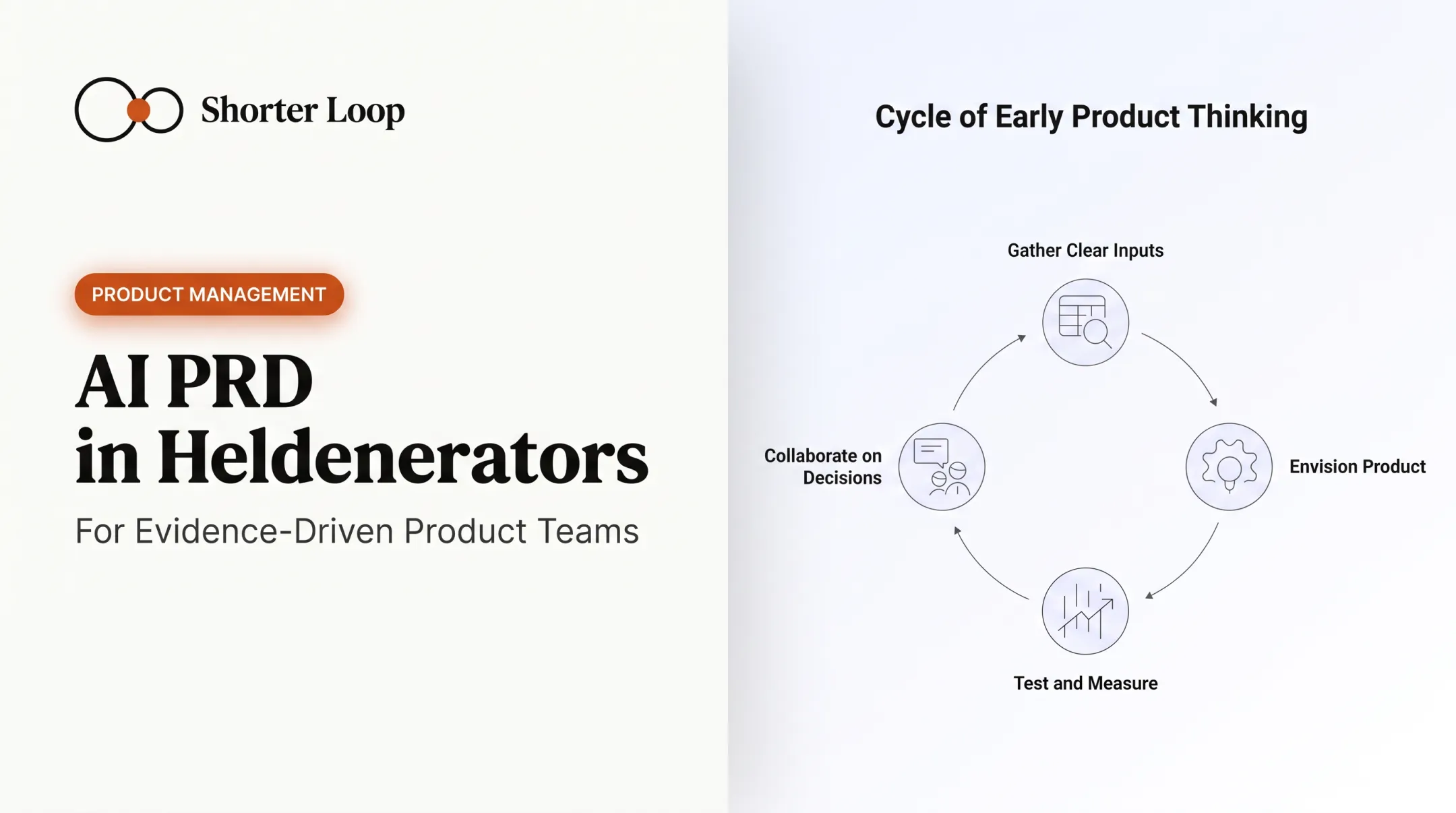
The end-to-end flow looks like this: collect evidence, frame the problem, check assumptions against evidence, prioritize the opportunity, define the bet, coordinate delivery, launch, measure outcomes, and feed the learning back into discovery. It's a loop, not a line.

Typical inputs include:
- Customer interviews and surveys
- Support tickets and sales conversations
- Product analytics and usage data
- Market research and competitive signals
- Strategic objectives and technical constraints
- Prior decision records
AI can retrieve and synthesize these inputs, cluster recurring needs, surface contradictions, draft research summaries, and propose questions worth human investigation.
In McKinsey's product management study, 40 PMs used AI across discovery, viability, and build work, producing deliverables like market-research documents and PRDs faster. Junior PMs gained speed but sometimes lost quality, while experienced PMs held the line. Speed alone isn't the win condition.
The core transformation the workflow performs: raw, scattered information becomes a clearly framed customer problem, an explicit set of assumptions, a decision, and a measurable product bet. Controls, source citations, permissions, structured templates, evaluation criteria, and human approvals keep that transformation honest and traceable.
Step 1: Discover and Frame the Problem
Gather evidence from interviews, tickets, calls, and surveys, then let AI organize it. But frequency isn't proof. A theme mentioned 40 times isn't automatically more important than one mentioned five times by your highest-value accounts.
If AI clusters feedback into a theme, a PM still checks the original verbatims, the customer segments involved, and any contradictory signals buried underneath. Before anyone discusses solutions, the team records:
- The problem statement
- Affected users or segments
- Supporting evidence
- Confidence level
- Unresolved questions
Shorter Loop handles this by linking feedback as evidence to the claims on an opportunity, rather than leaving it as a free-floating summary. In FlowDesk, a fictional demo dataset Shorter Loop uses to show the product, 41 pieces of feedback scattered across three systems get grouped into themes, with the largest cluster connected directly to a specific product opportunity, not just a tag in a spreadsheet.
Step 2: Check the Evidence, Prioritize, and Define the Bet
AI can support market research, assumption mapping, opportunity comparison, and impact-versus-effort analysis. It can even help design an experiment. What it shouldn't do is make the prioritization call alone. That's a trade-off decision, and trade-offs require context AI doesn't fully have.
Once an opportunity is selected, connect it to:
- A strategic objective
- A measurable success metric
- A scope boundary
- Explicit, named risks
AI can draft a product brief or PRD from approved evidence. The PM and relevant partners (design, engineering, sometimes legal) still verify requirements, feasibility, customer value, and acceptance criteria before anything moves forward. Shorter Loop builds the same check into its AI drafting. When Sage drafts opportunities or solution ideas and the evidence behind them is weak, it says so, and any claim without enough support stays marked Untested, so whoever reads it next can see which parts were never checked. Sage, the assistant, shows the supporting evidence under each answer and says so when it cannot verify a point.
Step 3: Deliver, Launch, and Learn
During delivery, AI helps with backlog preparation and drafting, while the delivery tool keeps the work item's status. These are bounded, repeatable tasks with clear definitions of done: exactly where automation earns its keep.
After launch, monitor:
- Adoption and usage behavior
- Qualitative feedback
- Operational signals (support volume, error rates)
- The specific outcome the bet was meant to produce
Adoption isn't the same as impact. People finding a feature doesn't mean it changed their behavior or your metrics. Post-launch results should update the original decision record: what was learned, which assumptions held or broke, and what happens next.
The FlowDesk demo dataset tracks a "Guided Integration Setup" bet. Integration completion rose by 18 percent, while the retention metric the team was aiming at barely moved. The setup change did what it was meant to do; the claim that setup friction was driving churn came out unsupported.
Where AI Fits in the Workflow
AI use cases map cleanly onto the product lifecycle:
| Lifecycle Stage | AI's Role |
|---|---|
| Discovery | Research synthesis, feedback clustering |
| Prioritization | Scenario comparison, impact/effort modeling |
| Planning | Draft generation (briefs, PRDs) |
| Delivery | Drafting status updates, summarizing open questions |
| Post-launch | Signal analysis, outcome tracking |
There are three levels of AI involvement worth distinguishing:
- Simplification of repetitive work (formatting, transcribing)
- Augmentation of human analysis (surfacing patterns a person might miss)
- Automation of bounded tasks with a clear definition of done (reformatting a batch of raw notes into one summary)
Confusing these levels is how teams end up automating something that actually needed human judgment.
Consider a B2B SaaS team where support and sales feedback arrives daily across different tools. AI groups that feedback, retrieves related past research, drafts opportunity themes, and prepares a review brief for a product council to discuss.
The council still decides. AI just made sure the discussion starts from organized evidence instead of someone's memory of a recent customer call.
Persistent, shared context beats isolated chats. A one-off conversation with a general AI tool forgets everything the moment it closes. Context that includes product strategy, customer segments, constraints, terminology, current metrics, and prior decisions needs to persist somewhere the whole team can draw from.

This is the specific gap Shorter Loop is built to close. Rather than treating AI assistance as disconnected documents and chat threads, it connects evidence, decisions, strategy, delivery, and outcomes in one system, so AI-assisted work operates from actual product context instead of starting from zero every time.
Where AI Workflows Go Wrong
Four things decide whether an AI-assisted workflow helps a team or quietly misleads it.
- Thin or skewed evidence. If the feedback behind a theme is stale, duplicated or drawn from one segment, the AI summary inherits the skew. Check the original verbatims and who they came from before acting on a theme.
- Answers without sources. Fluent summaries can still contain unsupported or inconsistent claims. A NIST generative AI profile recommends verifying generated sources before trusting consequential outputs, so treat any output you cannot trace as a draft.
- No named owner. Decide in advance which outputs AI may draft and which decisions need sign-off from product, design, engineering, security or legal.
- Loose data handling. Customer confidentiality, personal data and model-provider retention policies all matter. GDPR and UK GDPR set rules on how customer data is processed and kept, so ask each vendor whether your data is used to train models and get the answer in writing.
Volume is the trap that runs through all four. A request from 40 free-tier users can matter less than a quieter signal from three enterprise accounts about to churn, and a pile of extra PRDs or roadmap drafts says nothing about whether the team is deciding better.
When the AI Product Management Workflow May Not Be Appropriate
AI shouldn't be the primary decision-maker for:
- Final prioritization calls involving real trade-offs
- Sensitive personnel or customer judgment calls
- Unsupported market claims presented as fact
- Safety-critical decisions
- Commitments requiring legal or contractual interpretation
Several conditions reduce effectiveness even when AI isn't making the final call:
- Poor source data
- No clear product strategy
- Rapidly shifting requirements
- Weak access controls
- Unavailable subject-matter experts
- No practical way to evaluate output quality
Sometimes a manual process is simply better. A small, low-risk decision with limited evidence rarely justifies the setup and review overhead an AI workflow requires.
Watch for these signs that AI adoption needs clearer ownership and planning:
- Teams can't explain where an output came from
- Reviewers rubber-stamp drafts without checking them
- Duplicate work is increasing.
- Recommendations can't be connected to any actual product outcome
If you recognize any of these, don't try to fix everything at once. Start with one bounded use case, establish evidence and review standards for it, measure quality honestly, and expand only once that first workflow has proven itself useful.

A Scale-Up Scenario: Three Squads, One Roadmap
A 120-person SaaS company runs three product squads against a single roadmap: Onboarding, Reporting and Integrations. In a quarterly review, a sales director asks why the Onboarding squad's bulk-import rebuild is scheduled ahead of a reporting feature two large accounts have asked for by name. Nobody in the room can answer, and the meeting turns into a negotiation about who shouted loudest.
Here is the same question run through the three steps above.
- Discover and frame the problem. The Onboarding squad's import work traces to more than thirty support tickets, a run of sales notes and two churn interviews, all describing setup that stalls in the first week. The Reporting squad's request traces to two accounts, both named, both large. Both count as evidence, of different kinds: one is a pattern across many accounts, the other a strong signal from two.
- Check the evidence, prioritize, and define the bet. Each squad writes down the claim its item rests on. Onboarding's claim, that setup friction drives early churn, has tickets and interviews linked to it. Reporting's claim, that the two accounts will not renew without the feature, rests on the account team's word with no renewal data attached, so it is still untested. The Integrations squad, whose next release depends on the new import, confirms the order. The import work stays first, with a success metric for first-week setup completion.
- Deliver, launch, and learn. The reporting request gets a decision of its own: test the renewal risk with the two accounts this month before committing a quarter to it. Both decisions are written down with their reasons, and after launch the import bet is checked against its metric.
When the sales director, or the next person, asks why the import work is first, the answer is already on the record: the claim, the evidence behind it, and what the team agreed to check next.
Conclusion
An AI product management workflow is a loop you keep going round: discovery feeds decisions, decisions drive delivery, delivery produces outcomes, and those outcomes are the evidence for the next call. Break the loop at any point and the team is guessing with extra steps.
AI earns its place by reducing repetitive work and sharpening analysis. People still carry the responsibility for context, trade-offs, empathy, and accountability: the parts of product work that don't compress into a prompt.
The habit underneath all of it is small: write down why you made each call, and go back and check what happened after it shipped. Shorter Loop is built around that habit, and it fits the workflow you already run. Jira, or whichever delivery tool your team uses, keeps the work item's status; what gets added is the evidence and the decision sitting next to it. You can start a 14-day trial and run one bet through it.
Frequently Asked Questions
What are the main stages and frameworks of product management?
The core stages are discovery, evidence checks, prioritization, planning, delivery, launch, measurement, and iteration. Frameworks like Agile or stage-gate should support decisions at each stage, not replace the judgment behind them.
What are the typical steps in a product management workflow?
Teams gather customer evidence, frame the problem, check assumptions against evidence, prioritize opportunities, deliver and launch the work, then measure outcomes and feed learning back into discovery. It's a loop, not a one-way path.
What are the main types of product management workflows?
Common types include continuous discovery and delivery, stage-gate, Agile/iterative, experiment-led, and AI-assisted workflows. Stage-gate suits regulated or high-investment decisions, while continuous discovery and experiment-led approaches fit fast-moving SaaS teams better.
Can you give an example of a product management workflow?
A B2B SaaS team clusters support and sales feedback with AI, checks the top theme against customer context, prioritizes it against strategic goals, and documents a specific product bet. The team delivers and launches the fix, then measures whether the intended outcome, not just adoption, actually happened.
How should product teams evaluate AI outputs in a product management workflow?
Verify sources and citations behind any AI-generated claim, test recurring workflows against known examples, and track edits or overrides reviewers make. Evaluate success based on outcomes, not just how polished the draft looked.
Does AI replace product managers?
No. AI can automate research, synthesis, drafting, and bounded coordination tasks effectively. Product managers remain responsible for judgment, customer understanding, prioritization trade-offs, and accountability for what ships.