
A backlog is rarely short of good ideas. The hard part is picking the one that deserves engineering time this quarter, and standing behind that choice when someone disagrees with it.
The stakes show up in the data. A 2019 study of 615 Pendo customer subscriptions found that 80% of tagged software features were rarely or never used over a three-month window. Somewhere between the idea and the release, a lot of engineering capacity goes toward things customers don't use.
This article walks through a practical process: define the decision, gather real evidence, compare it against alternatives, score it honestly, and revisit it after launch. No framework replaces judgment, but a clear process makes that judgment easier to trust, and easier to correct.
Key Takeaways
- Prioritize one feature as your strongest current bet—not a permanent rank over everything else.
- Define the customer problem and measurable outcome before comparing feature options.
- Score options on pre-agreed criteria: value, strategic fit, reach, confidence, effort, risk, and urgency.
- Record the evidence and assumptions behind the call, then revisit when new data arrives.
How to Prioritize One Feature of a Software Product
Here's a five-step process for turning "we think this matters" into a decision you can defend and, later, learn from.
Step 1: Define the Decision and the Outcome
Start by writing the decision in one sentence: which feature should the team build next, for which customer segment, to move which objective. If you can't state it that plainly, you're not ready to prioritize yet.
Then describe the problem itself:
- Who is affected, and roughly how many of them are there?
- What do they do today instead (the current workaround)?
- How often does it show up, and how painful is it when it does?
Don't treat the feature idea as proof the problem exists. A workaround that annoys ten people once a quarter is a different problem than one that blocks a renewal every month.
Finally, decide how you'll know it worked. Useful measures include activation, feature adoption, retention, or revenue. FlowDesk, a fictional demo dataset Shorter Loop uses to show the product, models a scheduling company with an outcome that's specific: cut first-90-day churn from 22% to 12%, not a vague "improve retention."
Step 2: Gather and Assess the Evidence
Pull together everything you already have: support conversations, sales feedback, usage data, churn reasons, past experiments, interviews, market analysis. There's often more evidence sitting in disconnected tools than anyone has counted.
Two things matter more than volume:
- Separate the problem from the solution. A request for "a button that does X" is usually a workaround, not the best fix. Confirm the underlying problem is real and recurring first.
- Check who's actually represented. Evidence from your biggest account isn't the same as evidence from your target segment. One loud stakeholder can look like ten quiet customers if nobody checks.
Also flag evidence quality honestly: how recent is it, how big was the sample, and does anything contradict it? In Shorter Loop, each claim carries one of three states (Backed, Evidence disagrees, or Untested), linked to the evidence behind it, so a claim resting on a single interview quote doesn't get treated as settled fact six months later. Whatever tool you use, know the difference between confidence and certainty before you score anything.
When Two Features Score the Same
This is worth settling before any scoring starts, because scores tie more often than people expect, and the tie is where the evidence earns its keep.
Two items both come out at 7.5. The first, a bulk import rebuild, has 41 pieces of linked feedback behind it across support tickets, sales notes and two churn interviews. The second, a reporting export, rests on one claim from a single sales call, recorded six months ago and never checked.
The scores are identical. The confidence behind them is not, and nothing in the number shows that. What shows it is the claim state sitting beside each: backed on the first, untested on the second.
Shorter Loop will not break that tie for you. It keeps both items, each with its own claim state and linked evidence, and it does not rank one above the other on the strength of that evidence. The call stays with the team; what the product guarantees is that the team can see what each option rests on while making it.
That is why the reporting export might still be the right choice, if the account behind it is about to renew. But the conversation changes from "which one is the 7.5" to "are we comfortable spending a quarter on something nobody has checked", which is the question actually in front of the team.
Step 3: Compare the Feature With Realistic Alternatives
A feature only looks like the obvious choice when it's compared to nothing. Build a short list instead:
- The proposed feature
- A competing feature solving a different problem
- A smaller version of the same feature
- A non-product fix (documentation, support process, pricing change)
- Doing nothing this cycle
Ask whether the feature addresses the highest-value problem you know about, or just the most visible one currently sitting in the backlog. A well-organized request tracker can make a minor irritation look urgent simply because it's been logged in twelve different wordings.
Then check what could change the priority:
- Dependencies on other teams or systems
- Sequencing constraints: does something else need to ship first?
- Technical enablers that make more than one feature possible
- Compliance, security, or legal review timelines
A feature that scores well in isolation can slip several sprints once these constraints surface. Better to find that out now than after the sprint starts.
Step 4: Weigh the Evidence, Then Score
By this point you should know what each option rests on. The score is a way of summarizing that for a conversation, so read the evidence first and let the framework put numbers on it afterward. Pick one that matches the evidence you have, rather than the fanciest available:
- Value versus effort for a fast, low-stakes call
- RICE (reach, impact, confidence, effort) when comparing several features at different scales of impact
- Weighted scoring when multiple criteria matter and you want customizable weights
- Opportunity scoring when customer satisfaction data is central
Intercom's original RICE framework article is explicit that a high score isn't a commitment: dependencies and "table stakes" work can, and should, override the math.
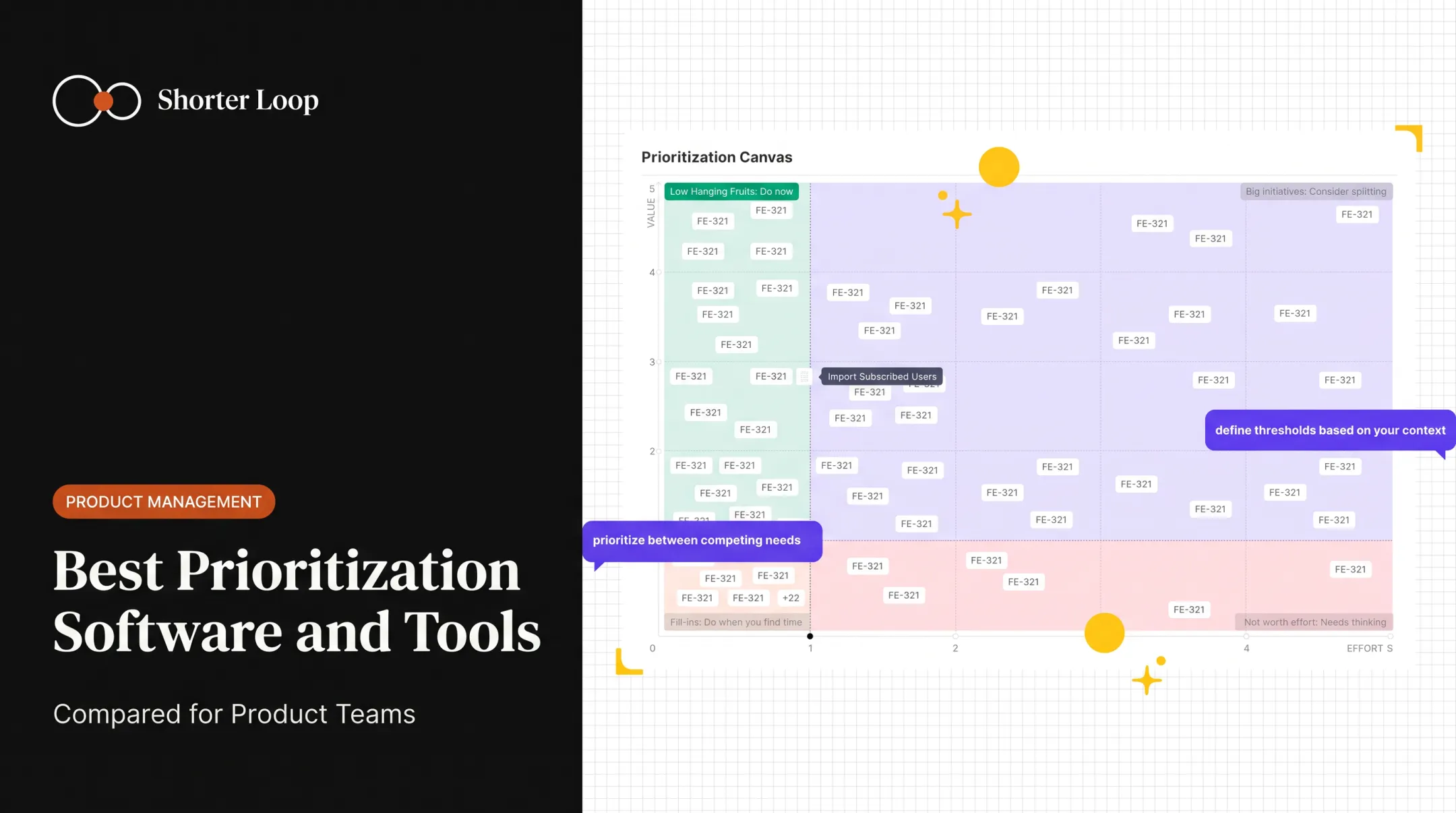
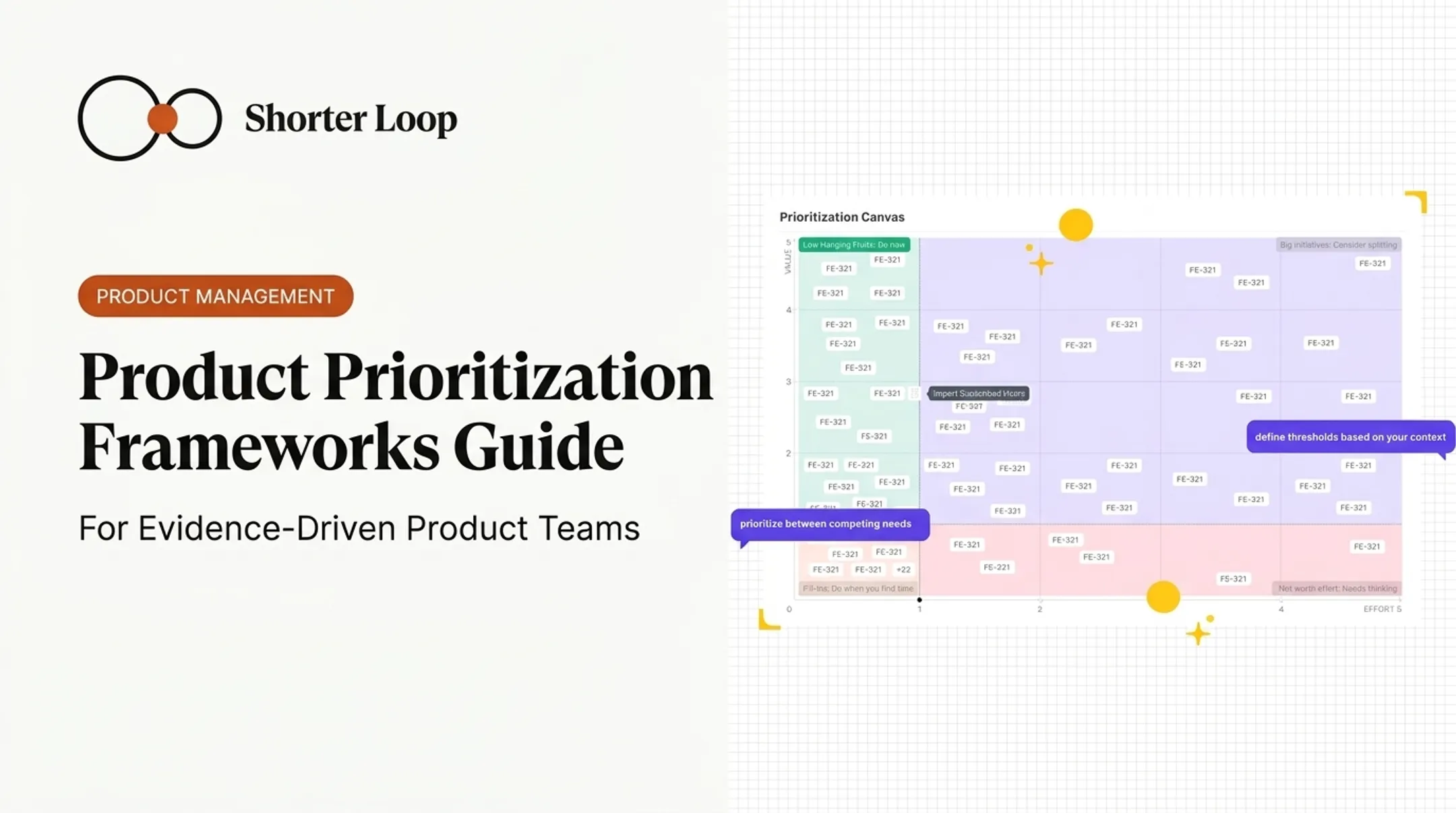
Shorter Loop follows the same logic. Backlog Prioritization is a value-versus-effort chart of epics and features: where you drop an item on the chart sets both its value and its effort, and you drag the cut lines to mark what gets done now and what waits. Solutions carry a RICE Score in Strategy Builder, shown on the same card as the evidence count for that solution, such as "3 backed · 1 unsettled".
Agree on criteria and weights before anyone scores a specific feature; it's much harder to argue for a pet project once the rubric is locked. Bring in engineering, design, customer-facing teams, and whoever owns the business relationship, and ask them to challenge assumptions, not negotiate from preference.
When two features land close in score, don't force a tiebreaker. Find the biggest uncertainty behind either one and run the smallest experiment that could resolve it.
Step 5: Document, Communicate, and Review
Write a short decision record. In Shorter Loop, start from the Decision Record template in Docs > New > From template (the "Product work" set). Cover:
- The feature, problem, and affected users
- Evidence, expected outcome, and rejected alternatives
- Assumptions, confidence level, and effort estimate
- Dependencies and ownership
Keep it short. Its job is to give the next argument about this feature something to start from besides memory.
Tell stakeholders what you're building, and just as important, why something else didn't make the cut. A rejected request handled with a clear reason creates far less friction than one that simply vanishes from the roadmap.
Review the decision after launch, a material delivery change or the arrival of relevant customer evidence.
Shorter Loop, a Product Integrity System, keeps that review point tied to the evidence. Evidence links to claims, claims to the opportunities and solutions that depend on them, and those to the epics that sync two-way with Jira or Azure DevOps. When new evidence that contradicts a claim is linked and accepted, the claim's state changes to evidence disagrees, and the opportunities, solutions and epics resting on it can be traced from that one record while changing course is still cheap. Delivery status itself stays in the delivery tool.

When Should You Prioritize One Feature and What Do You Need First?
Not every backlog item needs this much rigor. A single-feature decision is worth the full process when you have constrained engineering capacity, a defined release objective, several competing opportunities, and a genuine trade-off to make.
If there's only one reasonable option, you don't need a scoring exercise. Just ship it.
Pause instead when:
- The user problem is still vague or contested
- Different customer segments want conflicting things
- The evidence is thin, dated, or comes from a single source
- An untested assumption could invalidate the whole feature if it's wrong
Prioritizing under those conditions doesn't produce a better decision. It produces a confident-sounding one. Marty Cagan's four big risks framework argues that value and business-viability risks in particular deserve attention before a team commits engineering time, not after.
Evidence and Decision Readiness
Before assigning a final priority, confirm you have:
- A clearly stated problem
- An identified customer segment
- Some real evidence
- A desired outcome
- A named decision-maker
If any of these are missing, you're not ready. You're guessing with extra steps.
Delivery and Organizational Readiness
Check whether the organization can deliver and learn from the work:
- Engineering capacity
- Design and research availability
- Dependencies on other teams
- Operational or support readiness
- Legal or security review
- Ability to measure the result after launch
Make the reasons for a feature’s priority explicit so stakeholders can evaluate the decision.
Key Parameters That Affect Which Feature You Choose
Frameworks organize judgment; they don't remove uncertainty. Every score should trace back to either evidence or an assumption you're willing to name out loud.
These parameters are what that score should rest on.
Customer Value and Problem Severity
Value depends on a few concrete factors:
- How often the problem shows up
- How severe it is when it does
- How many people in the target segment are affected
- How bad their current workaround is
- How important the underlying job is to them
Watch the gap between what people say and what they do. In the FlowDesk demo data, eleven of fourteen customer interviews point to the same friction: dispatchers can't access the schedule because seats are tied to whoever signed the contract. The buyer's problem and the daily user's problem are two different problems.

Strategic and Business Value
Check alignment with product strategy and company objectives:
- Retention
- Revenue
- Cost reduction
- Differentiation
- Risk reduction
- Opening a new opportunity
Don't invent financial outcomes you can't support. "Likely to help retention" is honest; "will add $200K in ARR" usually isn't, unless you have the model to back it.
A feature can be valuable to customers and still lose priority if it doesn't support what the team is currently trying to achieve.
Reach, Confidence, and Evidence Quality
Reach estimates how many relevant users or accounts would benefit within a given period. Confidence reflects how strongly your evidence supports the expected impact, not how strongly you believe it.
Weak or indirect evidence should lower your confidence score, not get dressed up in a precise-looking number. A reach estimate of "350 accounts" sounds rigorous. If it's based on a guess, say so.
Effort, Complexity, Risk, and Dependencies
Effort covers more than engineering hours. Fold these into the estimate:
- Design complexity
- Ongoing maintenance
- Technical risk
- Migration work
- Security implications
- Dependencies on other initiatives
Sometimes the full feature isn't the right first move. A smaller version, or an enabling change underneath it, can be a better initial priority since it tests the idea and reduces risk before you commit to the complete build.
Urgency, Cost of Delay, and Learning Value
Some features carry a real cost of delay:
- Contractual deadlines
- Regulatory timing
- Competitive pressure
- Active user harm
- A narrow seasonal window
Others can wait a quarter with no consequence. Cost-of-delay estimates can differ widely between people looking at the same scenario, so write down the reasoning behind yours instead of relying on intuition alone.
Learning value matters too. A small feature or experiment that tests a critical assumption can deserve priority even with limited reach, because what you learn changes every decision that comes after it.
Alternative Methods When a Full Scoring Exercise Isn't Appropriate
Match the method to the size of the decision:
- Stack ranking or value-versus-effort for a small, familiar call
- RICE or weighted scoring for repeatable comparisons across a backlog
- Opportunity scoring or Kano when customer satisfaction data is central
Simple methods are faster but more subjective. Detailed models need reliable data, or they create false precision.
Common Mistakes and Troubleshooting
Skipping Problem Validation
If a feature is backed mainly by opinions or a couple of isolated requests, stop. Go back to the evidence and restate the problem before it goes anywhere near a ranking.
Confusing Stakeholder Influence With Product Value
When an executive, a sales team, or one big account pushes hard for something, document that request separately from actual evidence. Then test whether the need generalizes to your target segment.
Treating Framework Scores as Objective Truth
If small changes to your weights or estimates flip the winner, that's not a framework failure. It's a sign the input is uncertain. Run targeted discovery instead of defending the score.
Ignoring Effort, Dependencies, or Operational Impact
When a high-value feature keeps slipping, check the constraints behind the delay:
- Technical dependencies
- Team capacity
- Security requirements
- Support load
- Maintenance cost
Reducing scope or prioritizing an enabler first is often the faster path.
Choosing a Feature but Never Defining Success
If nobody can say what should change after launch, fix that before committing engineering time. Write the expected outcome down and set a measurement plan first.
Losing the Reasoning After Delivery
Keep the original evidence, assumptions, decision, and outcome connected. Without that trail, teams can't tell whether the prioritization logic actually worked. Every future bet then starts from zero again.

Conclusion
A practical rule for the next time two features compete for one slot: before the decision is final, write down the single piece of evidence that would make you reverse it. If nobody can name one, the choice rests on preference, and that's worth knowing before engineering starts.
When you lock the choice, three things are worth five minutes each:
- Name the evidence it rests on and the assumption it still carries, in one line each
- Send the people whose item lost the reason it lost, before they ask
- Put the review on the calendar for the week after launch, with the number that would change your mind written next to it
If you'd like to see claims, evidence, and prioritization linked in one place, start a 14-day trial of Shorter Loop (no credit card) or book a walkthrough.
Frequently Asked Questions
What is the best product prioritization framework?
There isn't one universal answer. It depends on your evidence quality, team maturity, and how repeatable the decision is. Simple value-versus-effort works for a quick call; RICE, weighted scoring, or Kano suit more complex or recurring comparisons.
What is feature prioritization?
Feature prioritization is the process of deciding which product work gets attention first, based on customer value, business alignment, effort, risk, urgency, and the evidence behind each option.
What are the 5 levels of priority?
Priority levels vary by organization, but a common five-level example is critical, high, medium, low, and deferred. What matters more than the labels is tying each one to explicit, agreed decision criteria.