
That movement gets harder as organisations grow. Customer evidence, assumptions, strategy, roadmaps and delivery work scatter across teams and tools. ProductPlan's 2024 survey found that product managers join user research 73% of the time, designers 45% and tech leads 23%. All three together? 14%.
This article defines effective collaboration, explains why it fails, lays out an operating model, ties it to each lifecycle stage, and shows how to keep decision context intact.
Key Takeaways
- Real collaboration needs a shared outcome, clear decision ownership and reliable context.
- Bring in the functions that can change a bet's shape before it becomes expensive.
- Record the reasoning behind important decisions, not only the decisions.
- Link discovery evidence to strategy, delivery and outcomes so teams learn from each release.
What Cross-Functional Collaboration Means in Product Development
Atlassian's guide describes cross-functional teams as people with different functional expertise working towards a common goal. The key word is shared. Each person holds responsibility for the product outcome, not just a departmental task.
Cooperation and collaboration differ in practice:
- Cooperation: work passes from team to team, each completing its piece.
- Collaboration: relevant perspectives join problem framing, decisions, execution and learning together.
Types of cross-functional collaboration
Four structures turn up most often:
- Project-based teams exist to deliver an output; members move on afterwards.
- Permanent product teams own an outcome over the long term.
- Task forces pull in functional representatives for a defined problem, then disband.
- Committees provide oversight or shared governance.
Pick the structure by the decision at hand, the level of uncertainty, the product stage, and whether you need temporary expertise or ongoing ownership. A pricing overhaul may suit a task force. A core product area usually needs a standing team.
What effective collaboration should produce
More communication is not the goal. Look for shared understanding of the customer problem, the constraints, the trade-offs, the chosen direction, who does what, and the expected outcome. If people leave a meeting with different answers to those questions, the meeting failed.
Why Cross-Functional Collaboration Breaks Down
Silos form when each function works from different evidence, priorities, vocabulary, incentives or definitions of success. Support sees one customer problem, sales hears another, and engineering builds from a third version relayed through a ticket.
Common failure patterns
- Design or engineering joins after the direction is set
- Work gets handed off repeatedly, losing context each time
- Nobody clearly owns the decision
- Teams duplicate research
- Priorities conflict and cause avoidable rework
- Nobody can explain, months later, why a decision was made
AWS guidance on decision records notes that teams debate the same decisions repeatedly when justification is missing, and forget them when records are absent.
The consequences are familiar: slower delivery, missed dependencies, stakeholder conflict, and products that solve an assumed problem instead of a validated one. Shorter Loop illustrates the cost with FlowDesk, a fictional company: two teams spent six weeks of engineering on different solutions to the same unsupported explanation for churn.
Diagnose before adding meetings
More meetings or another tool is rarely the fix. First ask what is actually broken:
- Unclear decision rights
- Missing context
- Poor documentation
- Misaligned goals
Each needs a different remedy. A new tool will not settle who decides.
How to Build a Cross-Functional Collaboration Model
Start with a shared product outcome
Before assigning work, agree on four things:
- The customer problem
- The desired user or business outcome
- Known constraints
- The evidence that would justify moving forward
Shorter Loop's "six decisions" framing is a useful checklist:
- Which problem
- Whose problem
- Is it worth solving
- Which solution
- Whether to continue
- Whether it worked
Bring the right functions in at the right time
Involve research, product, design, engineering, commercial, operational and customer-facing people before key assumptions harden into commitments. Legal, finance, security and privacy constraints also belong early, as SVPG's product guidance stresses.
But not everyone belongs in every discussion. Invite those who can change the shape of the bet.
Establish decision rights and working agreements
Two common frameworks set clear roles. In DACI, a Driver coordinates, one Approver decides, Contributors give expertise (a voice, not a vote), and others are informed. RAPID separates Recommend, Agree, Input, Decide and Perform.

Amazon's 2015 shareholder letter adds a useful filter: reversible "two-way door" decisions should move fast with small groups, while irreversible ones deserve wider consultation.
Write down working agreements covering:
- Preparation expectations
- Response times
- How disagreement is raised
- When and how to escalate
- Where decisions are recorded
Make evidence and assumptions visible
For each major bet, record:
- Customer evidence
- Assumptions
- Risks
- Alternatives considered
- Rationale
- Owner
- Expected outcome
Then every function works from the same context. Shorter Loop labels claims as Claimed, Corroborated, Unsupported or Contradicted, so weak support is visible rather than buried.
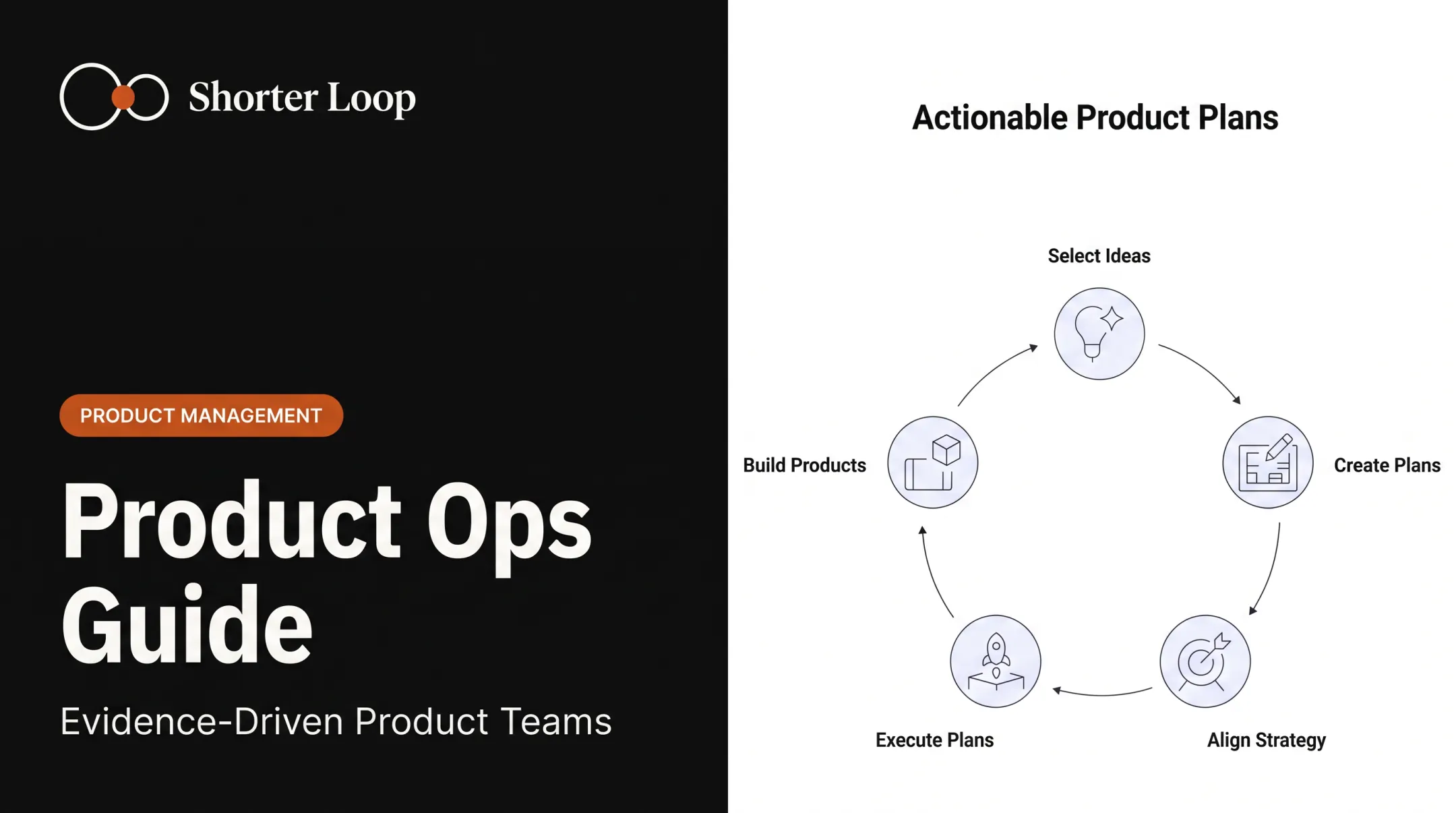
Create a feedback loop from delivery to learning
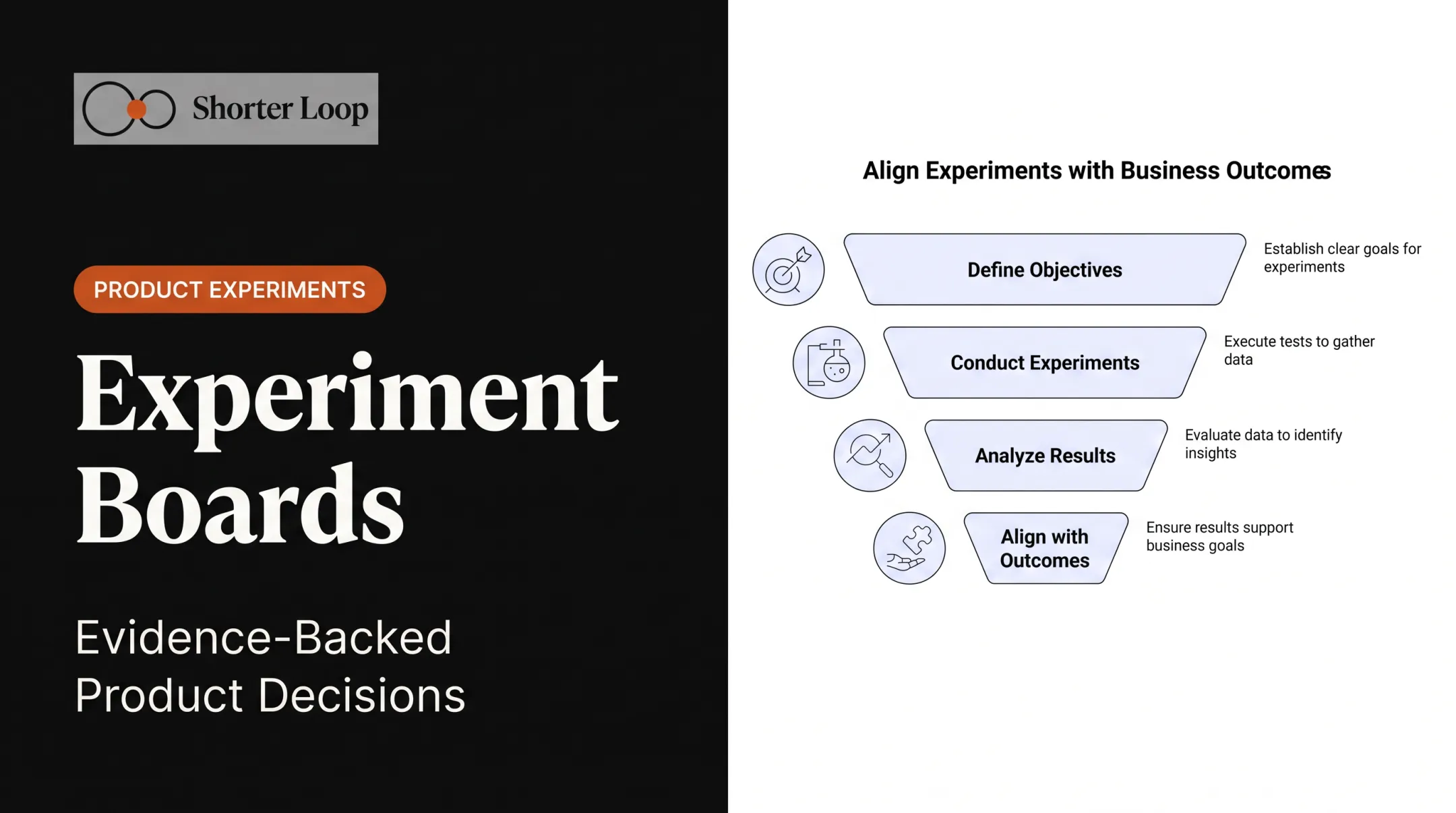
Delivery is not the end of collaboration. After release, compare observed outcomes with what the team expected, then update strategy and priorities.
One example: a Guided Integration Setup was expected to lift 30-day retention. Integration completion improved 18%, yet retention barely moved. That gap is the learning.
Collaborating Across the Product Development Lifecycle
Discovery and problem framing
Product, research, design, sales and support combine interviews, support themes, usage data and market input. The task is separating evidence from opinion and isolated requests. At FlowDesk, 41 pieces of feedback across three systems pointed to one problem, which only became visible once someone pulled them together.
Strategy and prioritisation
Product, design, engineering and commercial leads evaluate opportunities against strategy, customer value, feasibility, risk, commercial considerations and capacity. They document why one opportunity won over another. Without that note, the trade-off gets relitigated every quarter.
Design and technical exploration
Product, design and engineering explore user flows, prototypes, architecture, dependencies, security, accessibility and scalability together before anything is treated as final. Product Talk describes the product trio of PM, designer and engineer collaborating from beginning to end rather than through serial handoffs.

Regulation can matter here. In the Netherlands, the European Accessibility Act applies from 28 June 2025 to covered consumer e-commerce services, with the ACM as supervisor. It is not blanket B2B SaaS coverage, so check whether your product falls within scope.
Delivery and launch preparation
Product, design, engineering, quality, marketing, sales, support and operations need a shared view of:
- Scope and dependencies
- Launch readiness
- Known trade-offs and changes to the original decision
Within 48 hours of a deal closing (won or lost), run a short debrief with sales, product and ideally customer success.
Outcomes and continuous learning
Teams connect shipped work to adoption, customer behaviour, business results, qualitative feedback and unintended effects. Then document what changed in your beliefs.
Shorter Loop is a product integrity system built for this. It connects customer evidence, strategy, decisions, delivery work and outcomes, surfaces dependent decisions for review when new evidence changes a claim's state, and feeds outcomes back as evidence for the next decision.
Practices and Tools That Keep Teams Aligned
Use a shared source of context
Give teams one place to find shared context:
- Problem statement and supporting evidence
- Assumptions, strategic link and rationale
- Delivery status, owner and post-launch learning
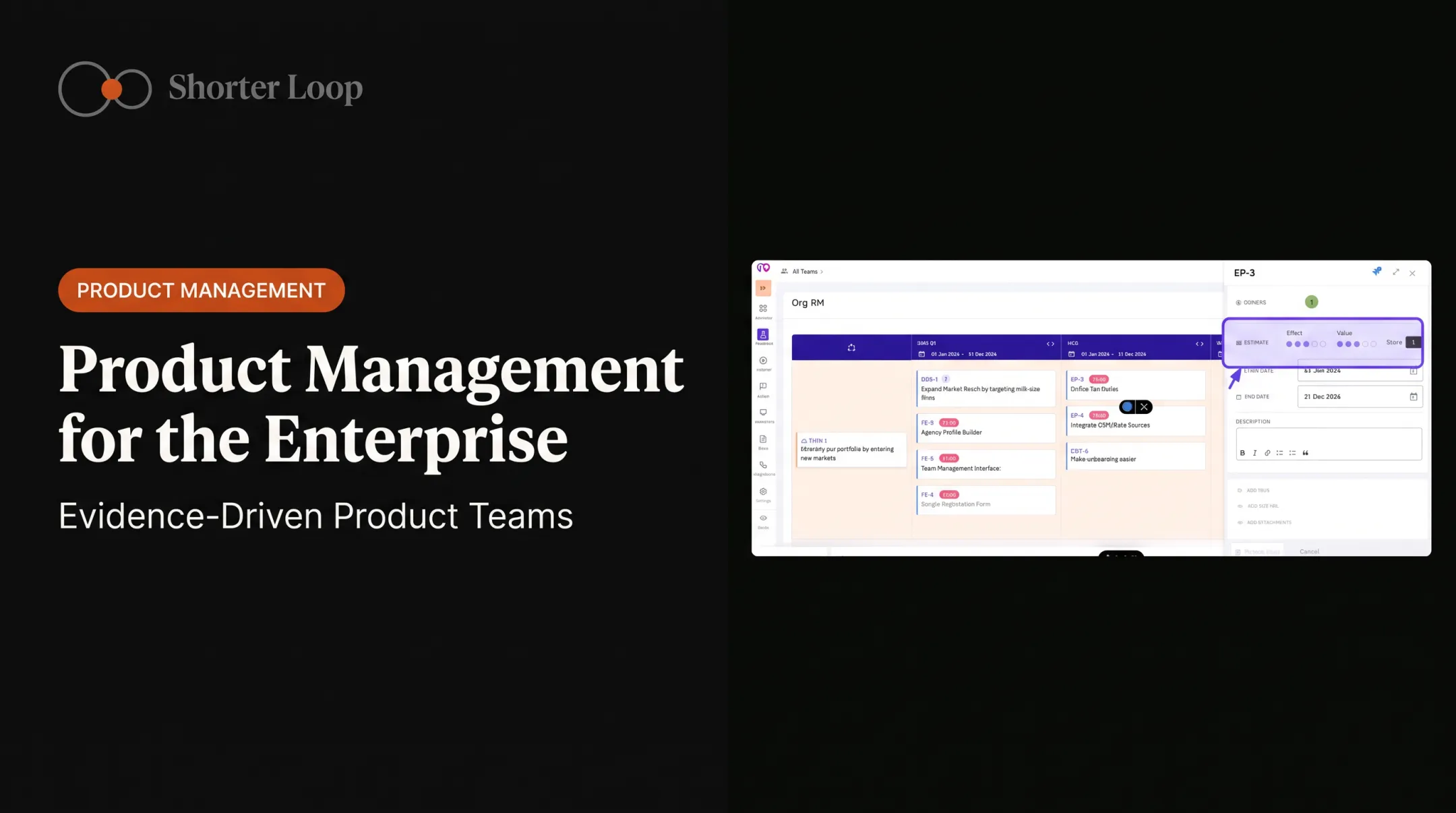
That cuts information loss between tools. Shorter Loop's collaboration workspace pairs a real-time whiteboard with decision documents linked to strategy, roadmap items and personas.
Combine synchronous and asynchronous collaboration
- Live: workshops, design critiques, planning and decision meetings
- Written: updates, decision records, research summaries, review comments
Live sessions suit ambiguity and conflict. Written records protect focus and leave a trail.
A Nature Human Behaviour study of 61,182 Microsoft employees found remote work left collaboration more siloed, with less synchronous communication. That is not proof asynchronous work is worse, but it warns that written channels need deliberate design.

Inspect collaboration through useful signals
Watch for:
- Unresolved dependencies
- Repeated rework
- Decision delays
- Participation gaps
- Outdated documentation
- Shipped work with no link to an intended outcome
Be careful with delivery metrics. DORA measures such as lead time and change fail rate describe delivery performance, not collaboration quality.
Shorter Loop's stale-commitment check flags solution-opportunity pairs past 90 days with no experiment or KPI. That is one signal tied to decision quality rather than throughput alone.
Frequently Asked Questions
What is product design and development?
It is the process of understanding a customer problem, shaping a viable solution, building, testing and launching it, then learning from outcomes. Product, design, engineering, research and commercial teams all contribute.
What are the four types of collaboration?
Commonly cited cross-functional structures are project-based teams, permanent teams, task forces and committees. Organisations choose based on the goal and duration of the work.
How do you build a cross-functional product development team?
Start with a shared outcome and complementary expertise. Add clear responsibilities, decision rights, working agreements and a reliable way to share evidence and decisions.
What are the biggest barriers to cross-functional collaboration?
Silos, conflicting incentives, unclear ownership, late involvement, fragmented information, communication gaps and low psychological safety. Google's team research highlights safety as a core factor.
How can product teams keep customer evidence connected to delivery?
Create traceable links from evidence to problem statements, strategic choices, decisions, delivery work and post-launch outcomes. Consistent documentation keeps those links alive.
Which tools support cross-functional collaboration in product development?
Research repositories, planning systems, design tools, issue trackers, documentation platforms, analytics and decision records all help. The operating model matters more than the number of tools.